
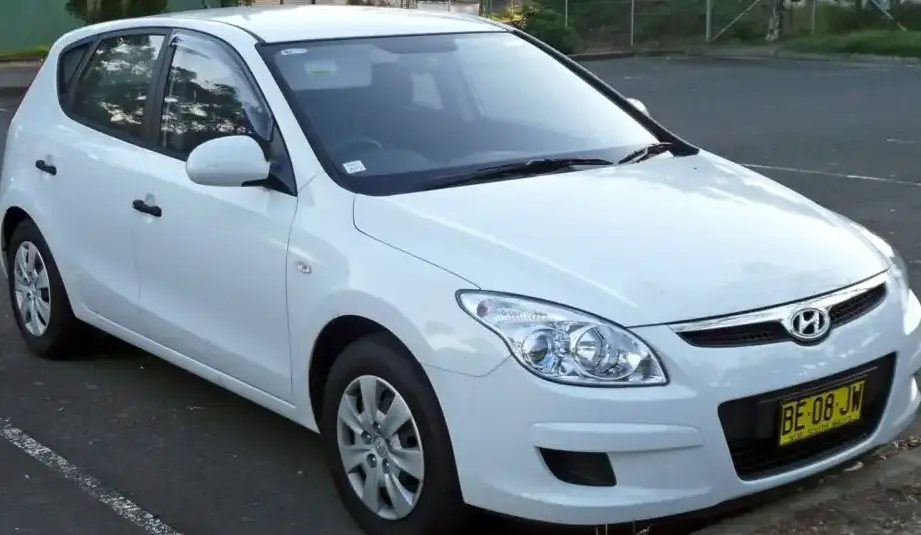
The Hyundai i30 (first generation, internally designated FD) was Hyundai’s entry into the competitive European compact hatchback segment. Introduced in 2007 and produced through 2010, the i30 represented a significant step forward for the Korean automaker in terms of design, build quality, and driving dynamics. The 1.4-liter (109 hp) variant, positioned as the entry-level model, aimed to provide affordable and efficient transportation for budget-conscious buyers. It was a key component of Hyundai’s strategy to establish a stronger foothold in the European market, offering a compelling alternative to established rivals like the Volkswagen Golf, Ford Focus, and Opel Astra. This specific engine and transmission combination was primarily sold in Europe, with limited availability in other markets.
Technical Specifications
| Brand | Hyundai |
| Model | i30 |
| Generation | i30 I |
| Type (Engine) | 1.4 (109 Hp) |
| Start of production | 2008 |
| End of production | 2010 |
| Powertrain Architecture | Internal Combustion engine |
| Body type | Hatchback |
| Seats | 5 |
| Doors | 5 |
| Fuel consumption (urban) | 7.6 l/100 km (30.9 US mpg) |
| Fuel consumption (extra urban) | 5.2 l/100 km (45.2 US mpg) |
| Fuel consumption (combined) | 6.1 l/100 km (38.6 US mpg) |
| Fuel Type | Petrol (Gasoline) |
| Acceleration 0 – 100 km/h | 12.6 sec |
| Acceleration 0 – 62 mph | 12.6 sec |
| Acceleration 0 – 60 mph | 12 sec |
| Maximum speed | 187 km/h (116.2 mph) |
| Emission standard | Euro 4 |
| Weight-to-power ratio | 11.6 kg/Hp |
| Weight-to-torque ratio | 9.3 kg/Nm |
| Power | 109 Hp @ 6200 rpm |
| Torque | 137 Nm @ 5000 rpm (101.05 lb.-ft. @ 5000 rpm) |
| Engine layout | Front, Transverse |
| Engine Model/Code | G4FA |
| Engine displacement | 1396 cm3 (85.19 cu. in.) |
| Number of cylinders | 4 |
| Engine configuration | Inline |
| Compression ratio | 10:1 |
| Number of valves per cylinder | 4 |
| Fuel injection system | Multi-port manifold injection |
| Engine aspiration | Naturally aspirated |
| Engine oil capacity | 3.3 l (3.49 US qt | 2.9 UK qt) |
| Kerb Weight | 1268 kg (2795.46 lbs.) |
| Max. weight | 1728 kg (3809.59 lbs.) |
| Max load | 460 kg (1014.13 lbs.) |
| Trunk (boot) space – minimum | 340 l (12.01 cu. ft.) |
| Trunk (boot) space – maximum | 1200 l (42.38 cu. ft.) |
| Fuel tank capacity | 53 l (14 US gal | 11.66 UK gal) |
| Length | 4245 mm (167.13 in.) |
| Width | 1775 mm (69.88 in.) |
| Height | 1480 mm (58.27 in.) |
| Wheelbase | 2650 mm (104.33 in.) |
| Drivetrain Architecture | Front wheel drive |
| Number of gears and type of gearbox | 5 gears, manual transmission |
| Front brakes | Ventilated discs |
| Rear brakes | Disc |
| Assisting systems | ABS (Anti-lock braking system) |
| Tires size | 185/65 R15 |
| Wheel rims size | 15 |
Powertrain & Engine Architecture
The Hyundai i30 1.4 utilized the G4FA engine, a 1.4-liter inline-four cylinder gasoline engine. This engine featured a multi-point fuel injection system and a single overhead camshaft (SOHC) valvetrain with four valves per cylinder. The G4FA was designed for efficiency and smooth operation rather than outright performance. It produced 109 horsepower at 6200 rpm and 137 Nm (101 lb-ft) of torque at 5000 rpm. The engine’s relatively low compression ratio of 10:1 contributed to its ability to run on readily available fuel grades. The engine was transversely mounted in the front of the vehicle, driving the front wheels. The standard transmission for this variant was a five-speed manual gearbox, offering a conventional shift pattern. While an automatic transmission was offered on other i30 models, it was not typically paired with the 1.4-liter engine due to the powertrain’s limited power output.
Driving Characteristics
The i30 1.4, with its 109 hp engine and five-speed manual transmission, provided adequate, but not exhilarating, performance. Acceleration from 0 to 60 mph took approximately 12 seconds, and the top speed was around 116 mph. The engine felt somewhat strained when pushed hard, particularly when fully loaded or climbing hills. The five-speed gearbox was well-matched to the engine’s characteristics, offering reasonable spacing between gears. However, the relatively long gearing emphasized fuel economy over spirited driving. Compared to the more powerful 1.6-liter or diesel variants, the 1.4 felt noticeably slower and required more frequent downshifts to maintain momentum. The steering was light and precise, making it easy to maneuver in urban environments, but lacked the feedback desired by more enthusiastic drivers.
Equipment & Trim Levels
The 1.4-liter i30 typically served as the base trim level, offering a practical and well-equipped package. Standard features generally included air conditioning, power steering, electric front windows, a CD player with MP3 compatibility, and ABS brakes. Safety features such as dual front airbags and side airbags were also standard. Interior upholstery was typically cloth, and the dashboard featured a straightforward design with easy-to-use controls. Optional extras included alloy wheels, a sunroof, rear electric windows, and upgraded audio systems. Higher trim levels, such as the Comfort or Style, added features like climate control, cruise control, and parking sensors.
Chassis & Braking
The i30’s chassis was a typical front-wheel-drive configuration, utilizing MacPherson strut suspension at the front and a torsion beam axle at the rear. This setup provided a comfortable ride quality, absorbing bumps and imperfections in the road surface effectively. The torsion beam rear suspension was a cost-effective solution, but it didn’t offer the same level of sophistication as independent rear suspension found in some competitors. Braking duties were handled by ventilated discs at the front and solid discs at the rear. ABS (Anti-lock Braking System) was standard, providing enhanced stopping power and stability in emergency braking situations. The i30’s weight of around 1268 kg (2795 lbs) contributed to its moderate handling characteristics.
Market Reception & Comparison
The Hyundai i30 1.4 was generally well-received by automotive critics as a solid and reliable entry-level hatchback. It was praised for its value for money, comfortable ride, and spacious interior. However, it was often criticized for its lack of performance and somewhat uninspiring driving dynamics. Compared to the 1.6-liter i30, the 1.4 offered significantly lower running costs but sacrificed performance. The diesel variants, while more expensive to purchase, provided superior fuel economy and torque. In terms of reliability, the G4FA engine proved to be generally robust, with few major issues reported. Fuel economy figures of around 38.6 US mpg combined were competitive for its class.
Legacy
The Hyundai i30 1.4, while not a performance standout, played a crucial role in establishing Hyundai as a credible competitor in the European compact hatchback market. The G4FA engine, despite its modest output, proved to be a reliable and durable unit. Today, used examples of the i30 1.4 are readily available and represent an affordable option for buyers seeking a practical and economical hatchback. Maintenance costs are generally low, and parts availability is good. While not a collector’s item, the i30 1.4 remains a sensible and dependable choice for everyday transportation, particularly for those prioritizing fuel efficiency and affordability over outright performance.
