
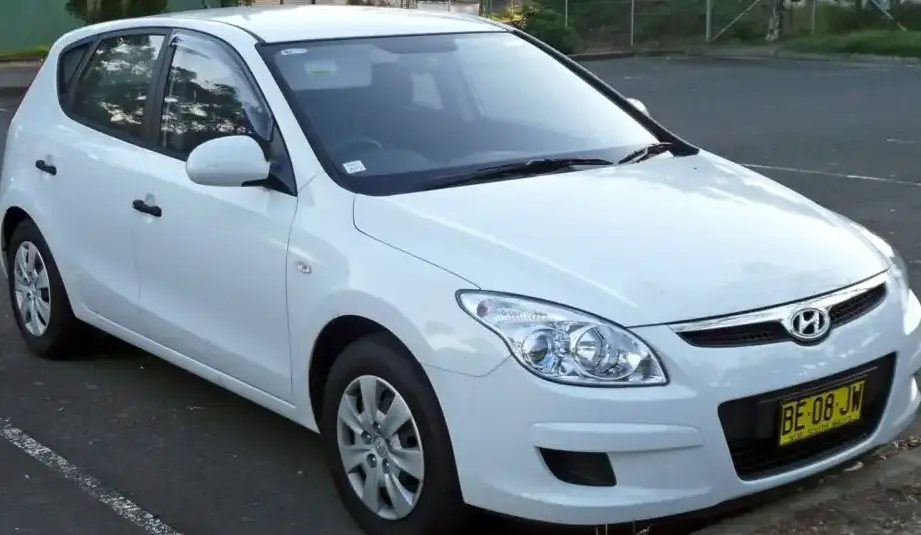
The Hyundai i30 I 1.6 CRDi Automatic, produced between 2007 and 2010, represented a significant step forward for Hyundai in the European compact hatchback market. Positioned as a mid-range offering within the first generation i30 (FD) lineup, this variant combined a fuel-efficient diesel engine with the convenience of an automatic transmission. It aimed to appeal to buyers seeking practicality, reasonable performance, and lower running costs. The i30, as a whole, was Hyundai’s first car to be conceived, designed, and tested entirely in Europe, and this model specifically targeted the Volkswagen Golf, Ford Focus, and Opel Astra segments.
Technical Specifications
| Brand | Hyundai |
| Model | i30 |
| Generation | i30 I |
| Type (Engine) | 1.6 CRDi (116 Hp) Automatic |
| Start of production | 2007 |
| End of production | 2010 |
| Powertrain Architecture | Internal Combustion engine |
| Body type | Hatchback |
| Seats | 5 |
| Doors | 5 |
| Fuel consumption (urban) | 7.6 l/100 km (30.9 US mpg) |
| Fuel consumption (extra urban) | 4.9 l/100 km (48 US mpg) |
| Fuel consumption (combined) | 5.9 l/100 km (39.9 US mpg) |
| Fuel Type | Diesel |
| Maximum speed | 184 km/h (114.33 mph) |
| Emission standard | Euro 4 |
| Power | 116 Hp @ 4000 rpm |
| Torque | 255 Nm @ 1900-2750 rpm (188.08 lb.-ft.) |
| Engine layout | Front, Transverse |
| Engine Model/Code | D4FB |
| Engine displacement | 1582 cm3 (96.54 cu. in.) |
| Number of cylinders | 4 |
| Engine configuration | Inline |
| Cylinder Bore | 77.2 mm (3.04 in.) |
| Piston Stroke | 84.5 mm (3.33 in.) |
| Compression ratio | 17.3:1 |
| Number of valves per cylinder | 4 |
| Fuel injection system | Diesel Commonrail |
| Engine aspiration | Turbocharger, Intercooler |
| Valvetrain | DOHC |
| Engine oil capacity | 5.3 l (5.6 US qt | 4.66 UK qt) |
| Coolant capacity | 6.8 l (7.19 US qt | 5.98 UK qt) |
| Trunk (boot) space (minimum) | 340 l (12.01 cu. ft.) |
| Trunk (boot) space (maximum) | 1200 l (42.38 cu. ft.) |
| Fuel tank capacity | 53 l (14 US gal | 11.66 UK gal) |
| Length | 4245 mm (167.13 in.) |
| Width | 1775 mm (69.88 in.) |
| Height | 1480 mm (58.27 in.) |
| Wheelbase | 2650 mm (104.33 in.) |
| Drivetrain | Front wheel drive |
| Number of gears | 4 |
| Gearbox type | Automatic transmission |
| Front brakes | Ventilated discs |
| Rear brakes | Disc |
| Tires size | 185/65 R15 |
| Wheel rims size | 15 |
Powertrain & Engine Architecture
The heart of the i30 1.6 CRDi Automatic is the D4FB engine, a 1.6-liter inline-four cylinder diesel. This engine utilizes a second-generation common rail direct injection system, delivering fuel at extremely high pressures for improved combustion efficiency and reduced emissions. The D4FB features a turbocharger with an intercooler, boosting power output and providing a broader torque curve. The engine employs a double overhead camshaft (DOHC) valvetrain with four valves per cylinder, optimizing gas flow for enhanced performance. The 17.3:1 compression ratio is typical for a diesel engine, contributing to its thermal efficiency. The four-speed automatic transmission, while providing convenience, was a relatively conventional unit for its time. It wasn’t known for particularly quick shifts or advanced features, but it offered smooth operation for everyday driving.
Driving Characteristics
The 116 horsepower and 188 lb-ft of torque offered by the 1.6 CRDi engine provided adequate, though not exhilarating, performance. Acceleration from 0 to 60 mph took around 11-12 seconds, making it competitive with other diesel hatchbacks in its class. The automatic transmission, with its four gears, meant that the engine often operated at higher RPMs during acceleration compared to a manual transmission, potentially impacting fuel economy in certain driving conditions. The torque delivery was strong from around 1900 rpm, making it suitable for overtaking and cruising on highways. Compared to the more powerful 1.6 GDI gasoline engine or the later 1.7 CRDi, the 1.6 CRDi Automatic prioritized fuel efficiency and relaxed driving over outright performance.
Equipment & Trim Levels
The i30 1.6 CRDi Automatic typically came equipped with air conditioning, power windows, central locking, and an audio system with CD player. Safety features included ABS (Anti-lock Braking System) and front airbags. Higher trim levels, such as the Comfort or Style variants, added features like alloy wheels, fog lights, a multi-function steering wheel, and upgraded interior trim. Interior upholstery was generally cloth, with options for different color schemes. Optional extras included a sunroof, parking sensors, and a more advanced audio system.
Chassis & Braking
The i30 I utilized a MacPherson strut front suspension and a coupled torsion beam rear suspension. This setup provided a good balance between ride comfort and handling. The front brakes were ventilated discs, offering good stopping power, while the rear brakes were solid discs. The steering was hydraulically assisted, providing a reasonably direct feel. The 15-inch wheels and 185/65 R15 tires were standard, contributing to a comfortable ride quality. Stabilizer bars were fitted to both the front and rear axles to reduce body roll during cornering.
Market Reception & Comparison
The Hyundai i30 1.6 CRDi Automatic was generally well-received by automotive critics. It was praised for its fuel efficiency, comfortable ride, and competitive price. However, the automatic transmission was sometimes criticized for being somewhat dated and lacking the responsiveness of more modern units. Compared to the manual version of the same engine, the automatic offered slightly lower fuel economy and slower acceleration. Against rivals like the Volkswagen Golf and Ford Focus, the i30 offered a compelling value proposition, often undercutting them in price while providing a similar level of equipment. The 1.6 CRDi engine was considered a good compromise between performance and economy, making it a popular choice for fleet buyers and private customers alike.
Legacy
The Hyundai i30 I 1.6 CRDi Automatic has proven to be a relatively reliable vehicle in the used car market. The D4FB engine is known for its durability, provided it has been properly maintained. Common issues include wear and tear on the turbocharger and potential problems with the diesel particulate filter (DPF) if the vehicle has primarily been used for short journeys. The automatic transmission, while generally reliable, may require servicing or rebuilding after high mileage. Today, these i30s represent an affordable and practical option for buyers seeking a fuel-efficient and comfortable hatchback. Their relatively simple mechanical design makes them easier and cheaper to maintain compared to more complex modern vehicles.
