
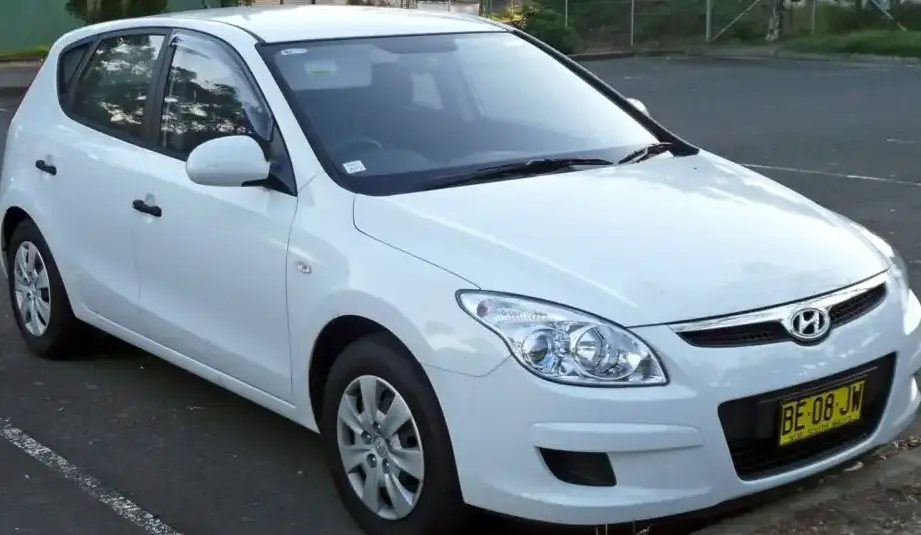
The Hyundai i30 I 1.6 CRDi (90 hp) was a front-wheel-drive, five-door hatchback produced between 2007 and 2010. It represented an entry-level diesel option within the first generation (FD) i30 lineup, positioned below the more powerful 1.6 CRDi 115 hp and 2.0 CRDi variants. Introduced as Hyundai aimed to establish a stronger foothold in the European compact car market, the i30 sought to offer a blend of practicality, affordability, and a relatively modern driving experience. This particular 90 hp diesel variant was geared towards buyers prioritizing fuel efficiency and lower running costs over outright performance.
Technical Specifications
| Brand | Hyundai |
| Model | i30 |
| Generation | i30 I |
| Type (Engine) | 1.6 CRDi (90 Hp) |
| Start of production | 2007 |
| End of production | 2010 |
| Powertrain Architecture | Internal Combustion engine |
| Body type | Hatchback |
| Seats | 5 |
| Doors | 5 |
| Fuel consumption (urban) | 5.4 l/100 km (43.6 US mpg, 52.3 UK mpg, 18.5 km/l) |
| Fuel consumption (extra urban) | 4.1 l/100 km (57.4 US mpg, 68.9 UK mpg, 24.4 km/l) |
| Fuel consumption (combined) | 4.5 l/100 km (52.3 US mpg, 62.8 UK mpg, 22.2 km/l) |
| Fuel Type | Diesel |
| Acceleration 0 – 100 km/h | 14.9 sec |
| Acceleration 0 – 62 mph | 14.9 sec |
| Acceleration 0 – 60 mph | 14.2 sec |
| Maximum speed | 172 km/h (106.88 mph) |
| Emission standard | Euro 4 |
| Weight-to-power ratio | 14.3 kg/Hp, 69.7 Hp/tonne |
| Weight-to-torque ratio | 5.5 kg/Nm, 182 Nm/tonne |
| Power | 90 Hp @ 4000 rpm |
| Power per litre | 56.9 Hp/l |
| Torque | 235 Nm @ 1750-2500 rpm (173.33 lb.-ft. @ 1750-2500 rpm) |
| Engine layout | Front, Transverse |
| Engine Model/Code | D4FB |
| Engine displacement | 1582 cm3 (96.54 cu. in.) |
| Number of cylinders | 4 |
| Engine configuration | Inline |
| Cylinder Bore | 77.2 mm (3.04 in.) |
| Piston Stroke | 84.5 mm (3.33 in.) |
| Compression ratio | 17.3:1 |
| Number of valves per cylinder | 4 |
| Fuel injection system | Diesel Commonrail |
| Engine aspiration | Turbocharger, Intercooler |
| Valvetrain | DOHC |
| Engine oil capacity | 5.3 l (5.6 US qt | 4.66 UK qt) |
| Coolant | 6.8 l (7.19 US qt | 5.98 UK qt) |
| Kerb Weight | 1291 kg (2846.17 lbs.) |
| Max. weight | 1820 kg (4012.41 lbs.) |
| Max load | 529 kg (1166.25 lbs.) |
| Trunk (boot) space – minimum | 340 l (12.01 cu. ft.) |
| Trunk (boot) space – maximum | 1250 l (44.14 cu. ft.) |
| Fuel tank capacity | 53 l (14 US gal | 11.66 UK gal) |
| Length | 4245 mm (167.13 in.) |
| Width | 1775 mm (69.88 in.) |
| Height | 1480 mm (58.27 in.) |
| Wheelbase | 2650 mm (104.33 in.) |
| Front track | 1546 mm (60.87 in.) |
| Rear (Back) track | 1544 mm (60.79 in.) |
| Drag coefficient (Cd) | 0.33 |
| Minimum turning circle | 10.2 m (33.46 ft.) |
| Drivetrain Architecture | The Internal combustion engine (ICE) drives the front wheels of the vehicle. |
| Drive wheel | Front wheel drive |
| Number of gears and type of gearbox | 5 gears, manual transmission |
| Front brakes | Ventilated discs |
| Rear brakes | Disc |
| Assisting systems | ABS (Anti-lock braking system) |
| Steering type | Steering rack and pinion |
| Tires size | 185/65 R15 H |
| Wheel rims size | 15 |
Powertrain & Engine Architecture
The i30 1.6 CRDi (90 hp) was powered by Hyundai’s D4FB engine, a 1.6-liter inline-four cylinder diesel. This engine utilized a second-generation common rail direct injection system, delivering fuel at extremely high pressures for improved combustion efficiency and reduced emissions. The D4FB featured a double overhead camshaft (DOHC) design operating four valves per cylinder. A turbocharger with an intercooler was employed to boost power output and improve torque across a wider rev range. The engine’s 17.3:1 compression ratio was typical for a diesel engine, contributing to its thermal efficiency. The engine was transversely mounted in the front of the vehicle. The 90 hp version was typically paired with a five-speed manual transmission, although a four-speed automatic transmission was also available, albeit less common. The automatic transmission was a conventional torque converter type, prioritizing smooth shifts over outright performance.
Driving Characteristics
The 1.6 CRDi 90 hp i30 offered modest performance. Acceleration from 0 to 60 mph took around 14.2 seconds, and top speed was approximately 107 mph. The engine produced a respectable 235 Nm (173 lb-ft) of torque, available from 1750-2500 rpm, which provided adequate pulling power for everyday driving. However, the engine felt strained when fully loaded or during overtaking maneuvers. The five-speed manual transmission was well-matched to the engine’s characteristics, allowing drivers to keep the engine in its optimal torque band. The automatic transmission, while providing convenience, resulted in noticeable performance degradation due to its less efficient power transfer and wider gear ratios. Handling was generally safe and predictable, but not particularly engaging. The suspension was tuned for comfort, prioritizing ride quality over sporty handling.
Equipment & Trim Levels
The i30 1.6 CRDi (90 hp) typically came equipped with air conditioning, power steering, electric front windows, and a basic audio system. Safety features included ABS brakes, front airbags, and seatbelt pretensioners. Higher trim levels, such as the Comfort or Style, added features like alloy wheels, rear electric windows, a multi-function steering wheel, and upgraded interior trim. Optional extras included a sunroof, parking sensors, and a more advanced audio system with Bluetooth connectivity.
Chassis & Braking
The i30 I utilized a MacPherson strut front suspension and a coupled torsion beam rear suspension. This setup provided a good balance between ride comfort and handling. The front brakes were ventilated discs, while the rear brakes were solid discs. The braking system was adequate for the vehicle’s weight and performance, but lacked the stopping power of higher-performance i30 variants. The steering was a rack-and-pinion system, providing reasonably precise steering feel.
Market Reception & Comparison
The Hyundai i30 1.6 CRDi (90 hp) was generally well-received by critics as an affordable and fuel-efficient option in the compact hatchback segment. However, its performance was often criticized as being underwhelming, particularly when compared to more powerful rivals. The 1.6 CRDi 115 hp offered a significant performance upgrade, while the 2.0 CRDi provided even more power and torque. In terms of fuel economy, the 90 hp version excelled, achieving combined fuel consumption figures of around 52.3 US mpg. Reliability was generally good, although some owners reported issues with the diesel particulate filter (DPF) and the common rail injection system.
Legacy
The Hyundai i30 I 1.6 CRDi (90 hp) remains a relatively common sight on used car markets. The D4FB engine, while not known for being particularly refined, proved to be reasonably durable when properly maintained. The availability of affordable spare parts and a relatively simple mechanical design contribute to its continued appeal. However, potential buyers should be aware of the potential for DPF issues and the importance of regular servicing to ensure long-term reliability. This variant represents a significant step forward for Hyundai in terms of build quality and design, helping to establish the i30 as a credible competitor in the European compact car market.
