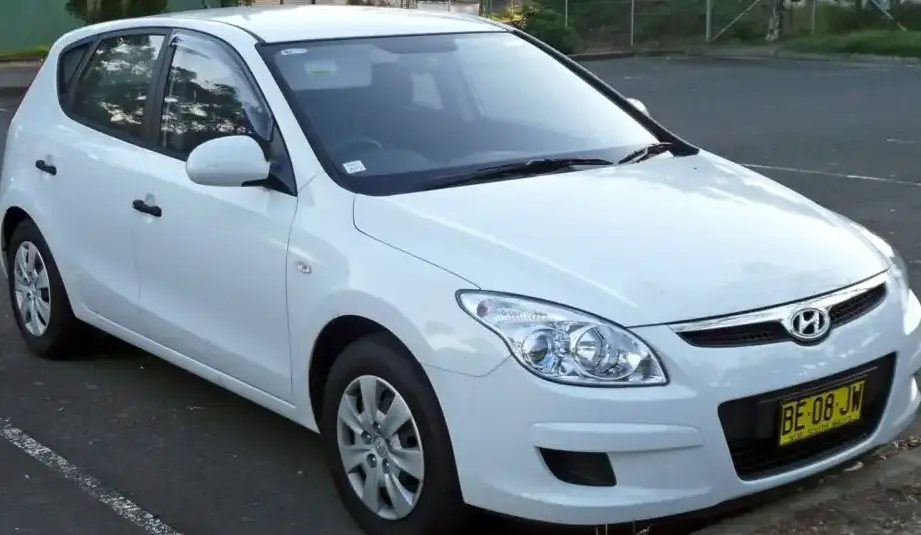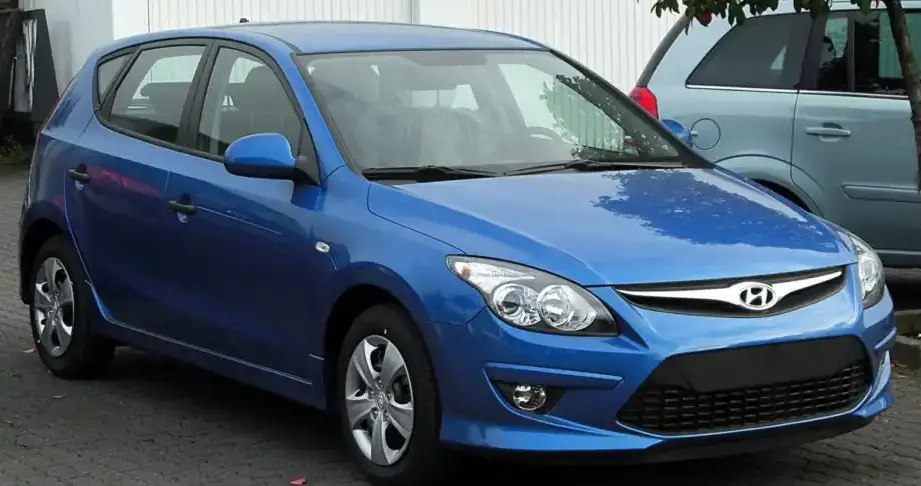
The Hyundai i30 (first generation, facelifted in 2010) 1.6 CRDi Automatic represents a significant step in Hyundai’s ambition to establish itself as a mainstream competitor in the European compact hatchback market. Produced from 2010 to 2012, this variant combined a fuel-efficient diesel engine with the convenience of an automatic transmission, targeting buyers seeking practicality and ease of driving. It sat within the i30 range as a mid-level offering, positioned between the base petrol models and the higher-specification trims with more powerful engines. The i30, as a whole, was Hyundai’s first car to be conceived primarily for the European market, designed and engineered at the company’s R&D center in Rüsselsheim, Germany.
Technical Specifications
| Brand | Hyundai |
| Model | i30 |
| Generation | i30 I (facelift 2010) |
| Type (Engine) | 1.6 CRDi (116 Hp) Automatic |
| Start of production | 2010 |
| End of production | 2012 |
| Powertrain Architecture | Internal Combustion engine |
| Body type | Hatchback |
| Seats | 5 |
| Doors | 5 |
| Fuel consumption (urban) | 7 l/100 km (33.6 US mpg, 40.4 UK mpg, 14.3 km/l) |
| Fuel consumption (extra urban) | 5 l/100 km (47 US mpg, 56.5 UK mpg, 20 km/l) |
| Fuel consumption (combined) | 5.7 l/100 km (41.3 US mpg, 49.6 UK mpg, 17.5 km/l) |
| CO2 emissions | 150 g/km |
| Fuel Type | Diesel |
| Acceleration 0 – 100 km/h | 12.8 sec |
| Acceleration 0 – 62 mph | 12.8 sec |
| Acceleration 0 – 60 mph | 12.2 sec |
| Maximum speed | 180 km/h (111.85 mph) |
| Emission standard | Euro 5 |
| Weight-to-power ratio | 11.2 kg/Hp, 89.4 Hp/tonne |
| Weight-to-torque ratio | 5.1 kg/Nm, 196.5 Nm/tonne |
| Power | 116 Hp @ 4000 rpm |
| Power per litre | 73.3 Hp/l |
| Torque | 255 Nm @ 1900-2750 rpm (188.08 lb.-ft. @ 1900-2750 rpm) |
| Engine layout | Front, Transverse |
| Engine Model/Code | D4FB |
| Engine displacement | 1582 cm3 (96.54 cu. in.) |
| Number of cylinders | 4 |
| Engine configuration | Inline |
| Cylinder Bore | 77.2 mm (3.04 in.) |
| Piston Stroke | 84.5 mm (3.33 in.) |
| Compression ratio | 17.3:1 |
| Number of valves per cylinder | 4 |
| Fuel injection system | Diesel Commonrail |
| Engine aspiration | Turbocharger, Intercooler |
| Valvetrain | DOHC |
| Engine oil capacity | 5.3 l (5.6 US qt | 4.66 UK qt) |
| Coolant | 6.8 l (7.19 US qt | 5.98 UK qt) |
| Kerb Weight | 1298 kg (2861.6 lbs.) |
| Max. weight | 1840 kg (4056.51 lbs.) |
| Max load | 542 kg (1194.91 lbs.) |
| Trunk (boot) space – minimum | 340 l (12.01 cu. ft.) |
| Trunk (boot) space – maximum | 1250 l (44.14 cu. ft.) |
| Fuel tank capacity | 53 l (14 US gal | 11.66 UK gal) |
| Permitted trailer load with brakes (12%) | 1300 kg (2866.01 lbs.) |
| Permitted trailer load without brakes | 550 kg (1212.54 lbs.) |
| Length | 4280 mm (168.5 in.) |
| Width | 1775 mm (69.88 in.) |
| Height | 1480 mm (58.27 in.) |
| Wheelbase | 2650 mm (104.33 in.) |
| Front track | 1546 mm (60.87 in.) |
| Rear (Back) track | 1544 mm (60.79 in.) |
| Drag coefficient (Cd) | 0.33 |
| Minimum turning circle | 10.2 m (33.46 ft.) |
| Drivetrain Architecture | The Internal combustion engine (ICE) drives the front wheels of the vehicle. |
| Drive wheel | Front wheel drive |
| Number of gears and type of gearbox | 4 gears, automatic transmission |
| Front brakes | Ventilated discs |
| Rear brakes | Disc |
| Assisting systems | ABS (Anti-lock braking system) |
| Steering type | Steering rack and pinion |
| Tires size | 185/65 R15 H |
| Wheel rims size | 15 |
INTRODUCTION
The 2010 facelift of the first-generation Hyundai i30 brought with it revised styling, improved equipment levels, and refinements to the engine range. The 1.6 CRDi Automatic variant, powered by the D4FB engine, was a key component of this update. This model aimed to provide a balance between fuel efficiency, reasonable performance, and the convenience of an automatic gearbox, appealing to a broad range of buyers in the competitive European C-segment. The i30 was a pivotal model for Hyundai, demonstrating a commitment to building cars that could genuinely compete with established European brands.
Powertrain & Engine Architecture
The heart of the i30 1.6 CRDi Automatic is the D4FB engine, a 1.6-liter inline-four cylinder diesel. This engine utilizes a second-generation common-rail direct injection system, delivering fuel at extremely high pressure for optimized combustion. A turbocharger with an intercooler further enhances performance by forcing more air into the cylinders. The engine produces 116 horsepower at 4,000 rpm and 255 Nm (188 lb-ft) of torque between 1,900 and 2,750 rpm. The D4FB engine is known for its relatively robust construction and decent fuel economy. The automatic transmission is a conventional four-speed unit. While not the most modern transmission available at the time, it provided smooth shifts and ease of use, particularly in urban driving conditions. The transmission’s gear ratios are tuned for fuel efficiency and comfortable cruising rather than outright performance.
Driving Characteristics
The i30 1.6 CRDi Automatic offers a comfortable and relaxed driving experience. Acceleration is adequate for everyday driving, with the 0-60 mph sprint taking around 12.2 seconds. However, it’s not a particularly quick car, and overtaking maneuvers require careful planning. The automatic transmission contributes to a smooth ride, but it can sometimes feel hesitant when downshifting. Compared to the manual version of the same engine, the automatic suffers a slight performance penalty due to the transmission’s inherent inefficiencies. The torque delivery is strong from low revs, making it easy to navigate city traffic. Higher-output versions of the i30, such as those with the 1.6 GDI petrol engine or the more powerful diesel variants, offer significantly more performance, but at the cost of fuel economy.
Equipment & Trim Levels
The 1.6 CRDi Automatic typically came equipped with a reasonable level of standard features. These included air conditioning, electric front windows, central locking, a CD stereo with MP3 compatibility, and ABS brakes. Higher trim levels added features such as alloy wheels, a multi-function steering wheel, cruise control, and a trip computer. Interior upholstery was typically cloth, with a dark color scheme. Optional extras included a sunroof, parking sensors, and upgraded audio systems. The overall interior design was functional and well-built, although it lacked the premium feel of some of its competitors.
Chassis & Braking
The i30 utilizes a MacPherson strut front suspension and a coupled torsion beam rear suspension. This setup provides a good balance between ride comfort and handling. The front brakes are ventilated discs, while the rear brakes are solid discs. ABS (Anti-lock Braking System) is standard. The suspension is tuned for comfort, resulting in a relatively soft ride. The steering is light and easy to use, making it well-suited for urban driving. Stabilizer bars are fitted to both the front and rear axles to reduce body roll during cornering.
Market Reception & Comparison
The Hyundai i30 1.6 CRDi Automatic was generally well-received by critics, who praised its fuel efficiency, comfortable ride, and competitive price. However, some reviewers criticized its lack of outright performance and the somewhat dated four-speed automatic transmission. Compared to rivals such as the Volkswagen Golf, Ford Focus, and Opel Astra, the i30 offered a compelling value proposition, often undercutting them on price while offering a similar level of equipment. The 1.6 CRDi engine provided good fuel economy, typically achieving around 49.6 mpg (UK) on the combined cycle. Reliability was generally good, although some owners reported minor issues with the electronic systems.
Legacy
The Hyundai i30 1.6 CRDi Automatic has proven to be a relatively reliable and durable car. The D4FB engine, while not without its quirks, is generally considered to be a robust unit. The four-speed automatic transmission is known to be reliable, but it can be prone to wear and tear if not properly maintained. In the used car market, these i30s represent a good value for money, offering a practical and economical mode of transport. They are particularly appealing to buyers looking for a fuel-efficient and comfortable hatchback at an affordable price. The i30’s success helped to establish Hyundai as a serious player in the European car market, paving the way for future models that would further challenge the established brands.