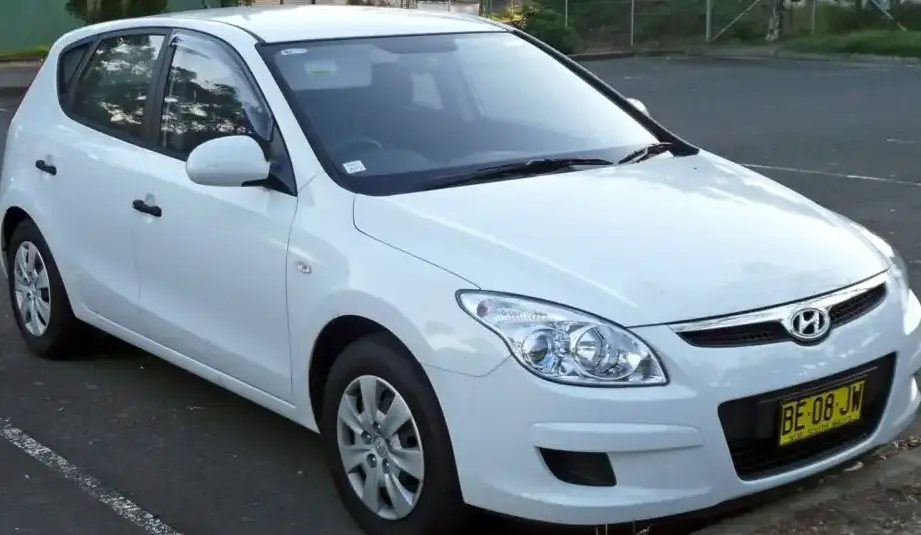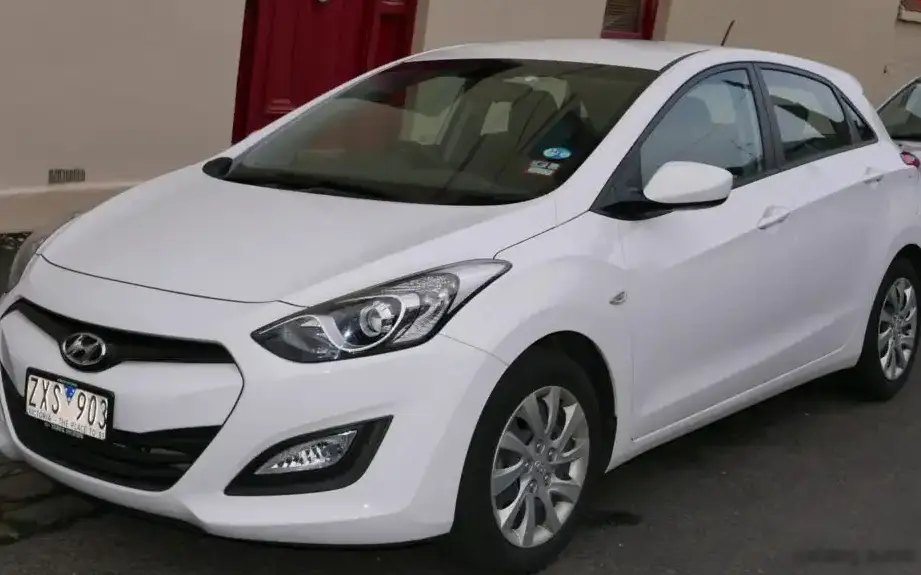
The Hyundai i30 II 1.8, produced between 2011 and 2015, represented a significant step forward for Hyundai in the competitive European C-segment hatchback market. Positioned as a mid-range offering within the second generation i30 (FD) lineup, this variant aimed to balance performance, fuel efficiency, and affordability. Built on the i30 platform (also shared with the Kia Cee’d), the 1.8-liter model provided a more powerful alternative to the base 1.6-liter engine, while remaining more accessible than the turbocharged options that would later become available. The i30 II aimed to appeal to buyers seeking a practical, well-equipped, and reliable family hatchback.
Technical Specifications
| Brand | Hyundai |
| Model | i30 |
| Generation | i30 II |
| Type (Engine) | 1.8 (150 Hp) |
| Start of production | 2011 |
| End of production | 2015 |
| Powertrain Architecture | Internal Combustion engine |
| Body type | Hatchback |
| Seats | 5 |
| Doors | 5 |
| Fuel consumption (urban) | 8.9 l/100 km (26.4 US mpg) |
| Fuel consumption (extra urban) | 5.1 l/100 km (46.1 US mpg) |
| Fuel consumption (combined) | 6.5 l/100 km (36.2 US mpg) |
| CO2 emissions | 156 g/km |
| Fuel Type | Petrol (Gasoline) |
| Weight-to-power ratio | 8.2 kg/Hp |
| Weight-to-torque ratio | 6.9 kg/Nm |
| Power | 150 Hp @ 6500 rpm |
| Power per litre | 83.5 Hp/l |
| Torque | 178 Nm @ 4700 rpm (131.29 lb.-ft. @ 4700 rpm) |
| Engine layout | Front, Transverse |
| Engine Model/Code | Nu / G4NB |
| Engine displacement | 1797 cm3 (109.66 cu. in.) |
| Number of cylinders | 4 |
| Engine configuration | Inline |
| Cylinder Bore | 81 mm (3.19 in.) |
| Piston Stroke | 87.2 mm (3.43 in.) |
| Compression ratio | 10.3:1 |
| Number of valves per cylinder | 4 |
| Fuel injection system | Multi-port manifold injection |
| Engine aspiration | Naturally aspirated engine |
| Valvetrain | DOHC D-CVVT |
| Engine oil capacity | 4 l (4.23 US qt | 3.52 UK qt) |
| Coolant capacity | 5.9 l (6.23 US qt | 5.19 UK qt) |
| Kerb Weight | 1225-1329 kg (2700.66 – 2929.94 lbs.) |
| Max. weight | 1840 kg (4056.51 lbs.) |
| Max load | 511-615 kg (1126.56 – 1355.84 lbs.) |
| Trunk (boot) space – minimum | 378 l (13.35 cu. ft.) |
| Trunk (boot) space – maximum | 1316 l (46.47 cu. ft.) |
| Fuel tank capacity | 53 l (14 US gal | 11.66 UK gal) |
| Length | 4300 mm (169.29 in.) |
| Width | 1780 mm (70.08 in.) |
| Height | 1470 mm (57.87 in.) |
| Wheelbase | 2650 mm (104.33 in.) |
| Front track | 1549-1555 mm (60.98 – 61.22 in.) |
| Rear (Back) track | 1562-1568 mm (61.5 – 61.73 in.) |
| Ride height (ground clearance) | 140 mm (5.51 in.) |
| Minimum turning circle (turning diameter) | 10.6 m (34.78 ft.) |
| Drivetrain Architecture | Front wheel drive |
| Number of gears and type of gearbox | 6 gears, manual transmission |
| Front suspension | Independent type McPherson |
| Rear suspension | Torsion |
| Front brakes | Ventilated discs, 280 mm |
| Rear brakes | Disc, 262 mm |
| Assisting systems | ABS (Anti-lock braking system) |
| Steering type | Steering rack and pinion |
| Tires size | 205/55 R16; 225/45 R17 |
| Wheel rims size | 6.5J x 16; 7.0J x 17 |
INTRODUCTION
The Hyundai i30 II 1.8 was a key component of Hyundai’s strategy to establish itself as a major player in the European hatchback market. Introduced in 2011 as part of the second-generation i30 (FD) series, it offered a compelling blend of practicality, comfort, and value. The 1.8-liter engine, designated the Nu engine family (G4NB code), was a naturally aspirated four-cylinder designed to provide a balance between performance and fuel economy. This variant typically sat in the middle of the i30 II range, offering more power than the base 1.6-liter models but remaining more affordable than the higher-spec turbocharged versions. It was primarily sold in Europe, where the C-segment hatchback market is particularly competitive.
Powertrain & Engine Architecture
The heart of the i30 II 1.8 is the Hyundai Nu engine, specifically the G4NB variant. This 1797cc (1.8L) inline-four cylinder engine utilizes a cast iron block with an aluminum cylinder head. It features multi-point fuel injection and a double overhead camshaft (DOHC) valvetrain with Hyundai’s Dual Continuously Variable Valve Timing (D-CVVT) technology. D-CVVT optimizes valve timing based on engine load and speed, improving both performance and fuel efficiency. The engine produces 150 horsepower at 6500 rpm and 178 Nm (131.29 lb-ft) of torque at 4700 rpm. The engine’s design prioritized smooth operation and reliability over outright performance. The i30 1.8 was typically paired with a six-speed manual transmission, although a six-speed automatic transmission was also available, albeit less common. The automatic transmission was a conventional torque converter type, offering smooth shifts but at the expense of some fuel economy compared to the manual.
Driving Characteristics
The i30 II 1.8 offered a comfortable and predictable driving experience. With 150 hp, acceleration was adequate for everyday driving, with a 0-60 mph time estimated around 9.5-10.5 seconds. The engine felt responsive enough for overtaking maneuvers, but it wasn’t particularly sporty. The six-speed manual transmission provided precise shifts, while the automatic offered convenience but felt slightly less engaging. The gear ratios were tuned for fuel efficiency, meaning the engine didn’t feel overly stressed at highway speeds. Compared to the 1.6-liter i30, the 1.8 offered noticeably more power, making it a better choice for drivers who frequently carry passengers or cargo. However, it lacked the punch of the turbocharged 1.6 GDI engine, which was available in higher trim levels. The suspension was tuned for comfort, providing a smooth ride over most road surfaces, but it wasn’t particularly sporty or engaging.
Equipment & Trim Levels
The i30 II 1.8 was available in various trim levels, typically including base, SE, and Premium. Standard equipment on the base model included air conditioning, power windows, central locking, and a basic audio system. The SE trim added features such as alloy wheels, fog lights, and a more advanced audio system. The Premium trim offered additional luxuries like leather upholstery, a sunroof, and automatic climate control. Optional extras included a navigation system, parking sensors, and a rearview camera. Interior upholstery was typically cloth on the lower trims, with leather available on the Premium model. The dashboard layout was functional and well-designed, with clear instrumentation and intuitive controls.
Chassis & Braking
The i30 II utilized a McPherson strut front suspension and a torsion beam rear suspension. This setup provided a good balance between ride comfort and handling. The front brakes were ventilated discs, while the rear brakes were solid discs. Anti-lock Braking System (ABS) was standard on all models. Steering was via a rack and pinion system, providing precise and responsive steering feel. Wheel sizes varied depending on the trim level, with 16-inch and 17-inch alloy wheels being common options. The chassis was designed to be lightweight yet rigid, contributing to the car’s overall handling and safety.
Market Reception & Comparison
The Hyundai i30 II 1.8 was generally well-received by automotive critics. It was praised for its comfortable ride, spacious interior, and competitive price. However, some critics noted that the engine lacked the refinement and performance of some of its rivals. Compared to the Volkswagen Golf or Ford Focus, the i30 II 1.8 offered a similar level of practicality and comfort at a lower price point. Fuel economy was competitive, averaging around 36.2 US mpg in combined driving. Reliability was also a strong point, with the Hyundai i30 II generally proving to be a dependable vehicle. The 1.8L engine was considered relatively robust and required minimal maintenance.
Legacy
The Hyundai i30 II 1.8 has proven to be a reliable and affordable used car. The Nu engine is known for its durability, and the i30 II’s overall build quality is generally good. While it may not offer the same level of performance or refinement as some of its rivals, it represents a solid value proposition for buyers seeking a practical and dependable family hatchback. Parts availability is good, and maintenance costs are relatively low. Today, the i30 II 1.8 remains a popular choice for budget-conscious buyers looking for a well-rounded and reliable vehicle.