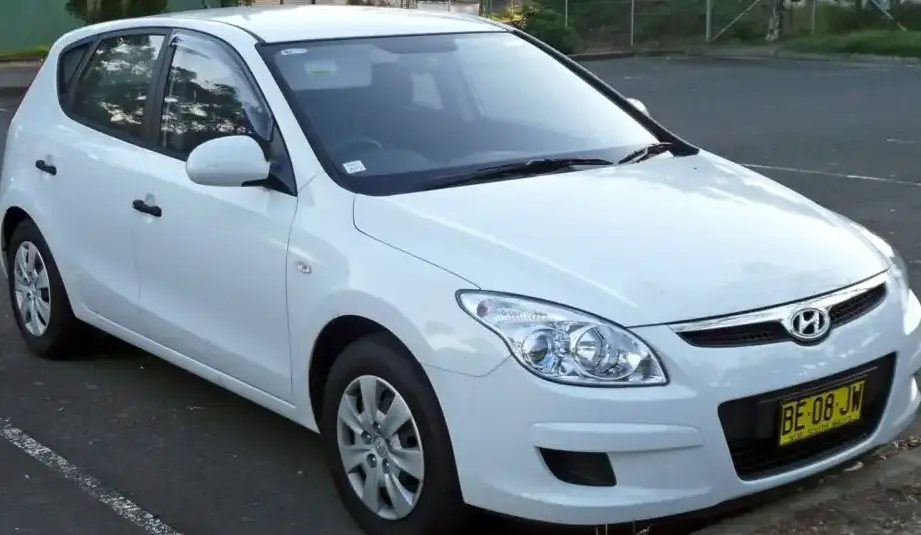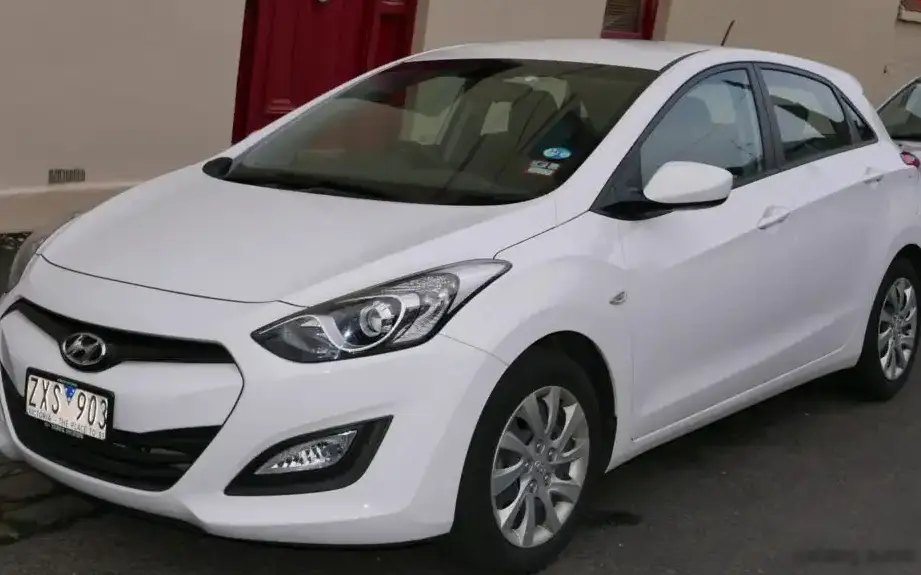
The Hyundai i30 II 1.8 Automatic, produced between 2011 and 2015, represented a mid-range offering within the second generation of Hyundai’s popular compact hatchback. Positioned as a comfortable and practical option, it aimed to bridge the gap between the more economical base models and the sportier, higher-horsepower variants. This particular configuration, pairing the 1.8-liter Nu engine with a six-speed automatic transmission, was primarily targeted at buyers prioritizing ease of driving and refinement over outright performance. It was a key model for Hyundai in the European market, where the i30 competed directly with established rivals like the Volkswagen Golf, Ford Focus, and Opel Astra, and also gained traction in other global markets.
Technical Specifications
| Brand | Hyundai |
| Model | i30 |
| Generation | i30 II |
| Type (Engine) | 1.8 (150 Hp) Automatic |
| Start of production | 2011 |
| End of production | 2015 |
| Powertrain Architecture | Internal Combustion engine |
| Body type | Hatchback |
| Seats | 5 |
| Doors | 5 |
| Fuel consumption (urban) | 9.7 l/100 km (24.2 US mpg) |
| Fuel consumption (extra urban) | 5.2 l/100 km (45.2 US mpg) |
| Fuel consumption (combined) | 6.9 l/100 km (34.1 US mpg) |
| CO2 emissions | 164 g/km |
| Fuel Type | Petrol (Gasoline) |
| Weight-to-power ratio | 8.3 kg/Hp |
| Weight-to-torque ratio | 7 kg/Nm |
| Power | 150 Hp @ 6500 rpm |
| Torque | 178 Nm @ 4700 rpm (131.29 lb.-ft. @ 4700 rpm) |
| Engine layout | Front, Transverse |
| Engine Model/Code | Nu / G4NB |
| Engine displacement | 1797 cm3 (109.66 cu. in.) |
| Number of cylinders | 4 |
| Engine configuration | Inline |
| Cylinder Bore | 81 mm (3.19 in.) |
| Piston Stroke | 87.2 mm (3.43 in.) |
| Compression ratio | 10.3:1 |
| Number of valves per cylinder | 4 |
| Fuel injection system | Multi-port manifold injection |
| Engine aspiration | Naturally aspirated engine |
| Valvetrain | DOHC D-CVVT |
| Engine oil capacity | 4 l (4.23 US qt | 3.52 UK qt) |
| Coolant capacity | 5.8 l (6.13 US qt | 5.1 UK qt) |
| Kerb Weight | 1240-1344 kg (2733.73 – 2963.01 lbs.) |
| Max. weight | 1840 kg (4056.51 lbs.) |
| Max load | 496-600 kg (1093.49 – 1322.77 lbs.) |
| Trunk (boot) space – minimum | 378 l (13.35 cu. ft.) |
| Trunk (boot) space – maximum | 1316 l (46.47 cu. ft.) |
| Fuel tank capacity | 53 l (14 US gal | 11.66 UK gal) |
| Length | 4300 mm (169.29 in.) |
| Width | 1780 mm (70.08 in.) |
| Height | 1470 mm (57.87 in.) |
| Wheelbase | 2650 mm (104.33 in.) |
| Front track | 1549-1555 mm (60.98 – 61.22 in.) |
| Rear track | 1562-1568 mm (61.5 – 61.73 in.) |
| Ride height (ground clearance) | 140 mm (5.51 in.) |
| Minimum turning circle | 10.6 m (34.78 ft.) |
| Drivetrain Architecture | Front wheel drive |
| Number of gears | 6 |
| Gearbox type | Automatic transmission |
| Front suspension | Independent type McPherson |
| Rear suspension | Torsion |
| Front brakes | Ventilated discs, 280 mm |
| Rear brakes | Disc, 262 mm |
| Assisting systems | ABS (Anti-lock braking system) |
| Steering type | Steering rack and pinion |
| Tires size | 205/55 R16; 225/45 R17 |
| Wheel rims size | 6.5J x 16; 7.0J x 17 |
Powertrain & Engine Architecture
The heart of the i30 1.8 Automatic is Hyundai’s Nu family of engines, specifically the G4NB code. This 1.8-liter inline-four cylinder engine utilizes a naturally aspirated configuration, meaning it doesn’t employ turbocharging or supercharging. It features a double overhead camshaft (DOHC) design with Hyundai’s Dual Continuously Variable Valve Timing (D-CVVT) system. This technology optimizes valve timing based on engine speed and load, improving both fuel efficiency and power output. Fuel delivery is handled by a multi-port fuel injection system. The engine produces 150 horsepower at 6,500 rpm and 178 Nm (131.29 lb-ft) of torque at 4,700 rpm. The six-speed automatic transmission, while providing smooth shifts, was a conventional torque converter type, differing from the more advanced dual-clutch transmissions (DCTs) becoming prevalent in the segment. It was chosen for its reliability and cost-effectiveness.
Driving Characteristics
The i30 1.8 Automatic offered a comfortable and predictable driving experience. While not particularly sporty, the engine provided adequate power for everyday driving situations. Acceleration was reasonable, but noticeably slower than the higher-output 1.6 GDI or diesel variants. The automatic transmission, while smooth, could sometimes feel hesitant during quick overtaking maneuvers. The gear ratios were tuned for fuel economy rather than performance, resulting in a more relaxed driving style. Compared to the manual transmission version of the 1.8, the automatic sacrificed some responsiveness and fuel efficiency, but gained in convenience. The weight of the vehicle, ranging from 1240 to 1344 kg depending on equipment, further impacted performance.
Equipment & Trim Levels
The i30 1.8 Automatic typically came equipped with a respectable level of standard features. These included air conditioning, power windows, central locking, a basic audio system with USB connectivity, and ABS brakes. Higher trim levels, such as Style or Premium, added features like alloy wheels, a more advanced audio system, cruise control, rear parking sensors, and automatic climate control. Interior upholstery was generally cloth, with leather options available on higher trims. The dashboard layout was functional and user-friendly, though not particularly luxurious. Optional extras included a panoramic sunroof, navigation system, and heated seats.
Chassis & Braking
The i30 II utilized a McPherson strut front suspension and a torsion beam rear suspension. This setup provided a good balance between ride comfort and handling. The front brakes were ventilated discs, offering good stopping power, while the rear brakes were solid discs. ABS (Anti-lock Braking System) was standard. Stabilizer bars were fitted to both the front and rear axles to reduce body roll during cornering. The steering was a rack and pinion system, providing precise and responsive control. Tire sizes varied depending on the trim level, with 205/55 R16 and 225/45 R17 being common options.
Market Reception & Comparison
The Hyundai i30 1.8 Automatic was generally well-received by automotive critics as a practical and well-rounded family car. It was praised for its comfortable ride, spacious interior, and good value for money. However, it was often criticized for its lack of dynamic flair and its relatively uninspiring engine. Compared to the 1.6 GDI, the 1.8 offered less power and slightly worse fuel economy. The diesel variants, such as the 1.6 CRDi, provided superior fuel efficiency but came with a higher purchase price. Against competitors like the Volkswagen Golf and Ford Focus, the i30 offered a competitive package, but often lacked the brand prestige and driving refinement of those established players.
Legacy
The Hyundai i30 II 1.8 Automatic has proven to be a relatively reliable vehicle in the used car market. The Nu engine is known for its durability, and the six-speed automatic transmission is generally dependable. Common issues are typically minor, such as wear and tear on suspension components and occasional sensor failures. The i30’s affordability and practicality have made it a popular choice for budget-conscious buyers. While it may not be the most exciting car to drive, it remains a sensible and dependable option for those seeking a comfortable and economical compact hatchback. Its continued presence on roads today is a testament to its overall build quality and reliability.