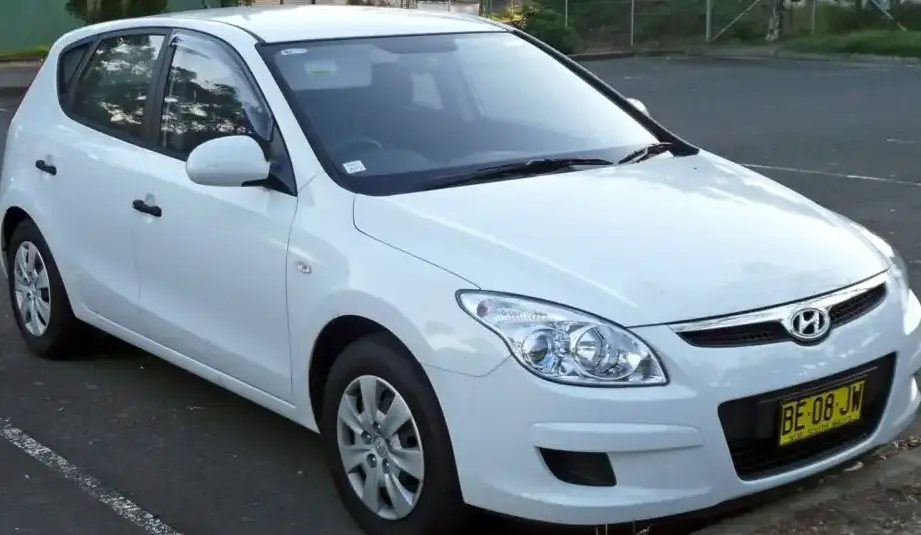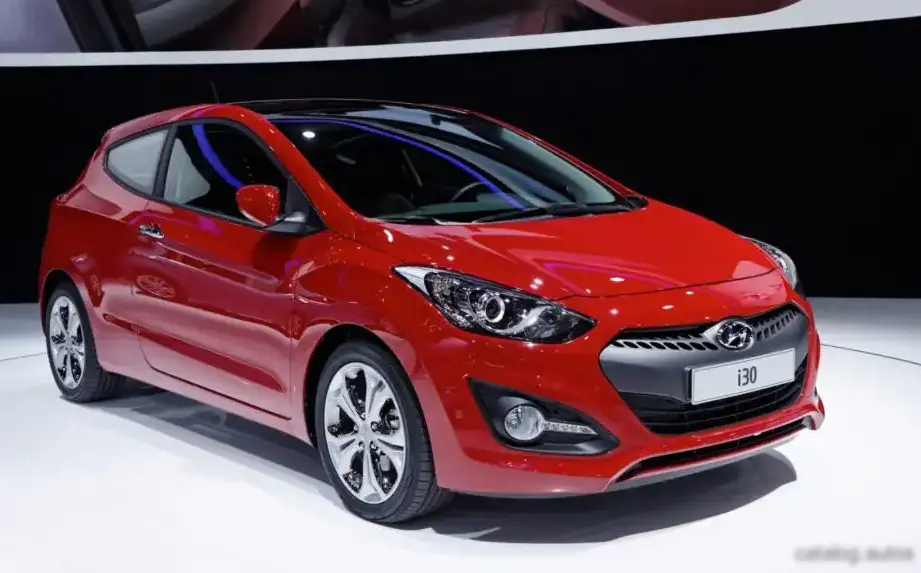
The Hyundai i30 II Coupe 1.4 CRDi (90 hp) was a front-wheel-drive, three-door coupe produced between 2013 and 2015. Positioned as an entry-level offering within the second-generation i30 (FD) range, it aimed to provide a fuel-efficient and affordable option for buyers seeking a stylish coupe. This variant was primarily marketed in Europe, where compact coupes were a popular segment. It represented Hyundai’s continued effort to establish itself as a mainstream competitor in the European automotive market, offering a blend of practicality, modern styling, and a diesel engine known for its economy.
Technical Specifications
| Brand | Hyundai |
| Model | i30 |
| Generation | i30 II Coupe |
| Type (Engine) | 1.4 CRDi (90 Hp) |
| Start of production | 2013 |
| End of production | 2015 |
| Powertrain Architecture | Internal Combustion engine |
| Body type | Coupe |
| Seats | 5 |
| Doors | 3 |
| Fuel consumption (urban) | 5.3 l/100 km (44.4 US mpg) |
| Fuel consumption (extra urban) | 3.5 l/100 km (67.2 US mpg) |
| Fuel consumption (combined) | 4.1 l/100 km (57.4 US mpg) |
| CO2 emissions | 109 g/km |
| Fuel Type | Diesel |
| Acceleration 0 – 100 km/h | 13.5 sec |
| Acceleration 0 – 62 mph | 13.5 sec |
| Acceleration 0 – 60 mph | 12.8 sec |
| Maximum speed | 170 km/h (105.63 mph) |
| Emission standard | Euro 5 |
| Weight-to-power ratio | 14.3 kg/Hp |
| Weight-to-torque ratio | 5.8 kg/Nm |
| Power | 90 Hp @ 4000 rpm |
| Torque | 220 Nm @ 1500-2750 rpm (162.26 lb.-ft.) |
| Engine layout | Front, Transverse |
| Engine Model/Code | D4FC |
| Engine displacement | 1396 cm3 (85.19 cu. in.) |
| Number of cylinders | 4 |
| Engine configuration | Inline |
| Cylinder Bore | 75 mm (2.95 in.) |
| Piston Stroke | 79 mm (3.11 in.) |
| Compression ratio | 17:1 |
| Number of valves per cylinder | 4 |
| Fuel injection system | Diesel Commonrail |
| Engine aspiration | Turbocharger, Intercooler |
| Valvetrain | DOHC |
| Engine oil capacity | 5.3 l (5.6 US qt | 4.66 UK qt) |
| Coolant capacity | 6.9 l (7.29 US qt | 6.07 UK qt) |
| Kerb Weight | 1285 kg (2832.94 lbs.) |
| Max. weight | 1910 kg (4210.83 lbs.) |
| Max load | 625 kg (1377.89 lbs.) |
| Trunk (boot) space – minimum | 378 l (13.35 cu. ft.) |
| Trunk (boot) space – maximum | 1316 l (46.47 cu. ft.) |
| Fuel tank capacity | 53 l (14 US gal | 11.66 UK gal) |
| Length | 4300 mm (169.29 in.) |
| Width | 1780 mm (70.08 in.) |
| Height | 1470 mm (57.87 in.) |
| Wheelbase | 2650 mm (104.33 in.) |
| Front track | 1563 mm (61.54 in.) |
| Rear track | 1571 mm (61.85 in.) |
| Ride height (ground clearance) | 140 mm (5.51 in.) |
| Minimum turning circle | 10.6 m (34.78 ft.) |
| Drivetrain | Front wheel drive |
| Number of gears | 6 |
| Gearbox type | Manual transmission |
| Front suspension | Independent type McPherson |
| Rear suspension | Independent multi-link spring suspension with stabilizer |
| Front brakes | Ventilated discs |
| Rear brakes | Disc |
| Assisting systems | ABS (Anti-lock braking system) |
| Steering type | Steering rack and pinion |
| Tires size | 195/65 R15 H |
| Wheel rims size | 15 |
INTRODUCTION
The Hyundai i30 II Coupe, launched in 2013, was a derivative of the second-generation i30 hatchback (internal code PD/FD). Hyundai aimed to broaden the i30’s appeal with the coupe variant, targeting a younger demographic seeking a more sporty and stylish alternative to the five-door model. The 1.4 CRDi 90 hp version represented the entry point into the Coupe range, prioritizing fuel efficiency and affordability over outright performance. It was built on the i30’s proven platform, offering a familiar driving experience with a focus on practicality and value.
Powertrain & Engine Architecture
The heart of the i30 II Coupe 1.4 CRDi was the D4FC engine, a 1.4-liter inline-four cylinder diesel. This engine utilized a second-generation common-rail direct injection system, delivering fuel at extremely high pressure for improved combustion efficiency and reduced emissions. A turbocharger with an intercooler was employed to boost power output, providing 90 horsepower at 4000 rpm and 220 Nm (162 lb-ft) of torque between 1500 and 2750 rpm. The engine featured a double overhead camshaft (DOHC) valvetrain with four valves per cylinder. The engine was transversely mounted in the front of the vehicle. The 1.4 CRDi was paired with a six-speed manual transmission, chosen for its fuel efficiency and relatively low cost. While an automatic transmission was available on other i30 models, it wasn’t offered with this specific engine and power output.
Driving Characteristics
The 1.4 CRDi 90 hp i30 Coupe offered a comfortable, if not particularly exhilarating, driving experience. Acceleration was modest, taking around 13.5 seconds to reach 62 mph (100 km/h). The engine’s strength lay in its low-end torque, making it reasonably responsive in everyday driving situations. The six-speed manual transmission was well-matched to the engine, allowing drivers to keep the engine in its optimal torque band. Compared to the more powerful 1.6-liter gasoline or diesel variants, the 1.4 CRDi felt noticeably slower, especially when fully loaded or tackling steep inclines. However, its fuel economy was significantly better, making it an attractive option for drivers prioritizing running costs. The gear ratios were tuned for efficiency, with a relatively long final drive contributing to the car’s highway fuel economy.
Equipment & Trim Levels
The 1.4 CRDi Coupe typically came with a reasonable level of standard equipment, though it was less lavishly equipped than higher-spec models. Standard features generally included air conditioning, electric front windows, a basic audio system with USB connectivity, and ABS brakes. Safety features such as front and side airbags were also standard. Optional extras included alloy wheels, a panoramic sunroof, rear parking sensors, and a more advanced infotainment system. Interior upholstery was typically cloth, with a relatively simple dashboard layout. Trim levels varied slightly depending on the market, but the 1.4 CRDi generally represented the base trim, with upgrades available at extra cost.
Chassis & Braking
The i30 II Coupe utilized a McPherson strut front suspension and a multi-link rear suspension, providing a good balance between ride comfort and handling. The suspension was tuned for everyday driving, prioritizing comfort over sporty handling. The front brakes were ventilated discs, while the rear brakes were solid discs. ABS (Anti-lock Braking System) was standard. The car’s weight of around 1285 kg (2833 lbs) contributed to its relatively modest performance. Stabilizer bars were fitted to both the front and rear axles to reduce body roll during cornering.
Market Reception & Comparison
The Hyundai i30 II Coupe 1.4 CRDi was generally well-received by automotive critics as a practical and fuel-efficient coupe. However, its performance was often criticized as being underwhelming. Compared to rivals like the Volkswagen Scirocco or the Peugeot RCZ, the i30 Coupe lacked the same level of sporting appeal. However, it offered a more affordable price point and a longer warranty, making it an attractive alternative for budget-conscious buyers. Fuel economy was a key strength, consistently achieving around 57.4 US mpg in combined driving. Reliability was also generally good, with Hyundai’s reputation for building durable vehicles.
Legacy
The Hyundai i30 II Coupe 1.4 CRDi has proven to be a relatively reliable and affordable used car. The D4FC engine is known for its durability, although regular maintenance is essential. Common issues include diesel particulate filter (DPF) clogging, particularly on cars that have primarily been used for short journeys. The car’s relatively simple mechanicals make it relatively easy and inexpensive to repair. Today, the i30 II Coupe 1.4 CRDi represents a good value proposition for buyers seeking a fuel-efficient and practical coupe, though its age and mileage should be carefully considered.