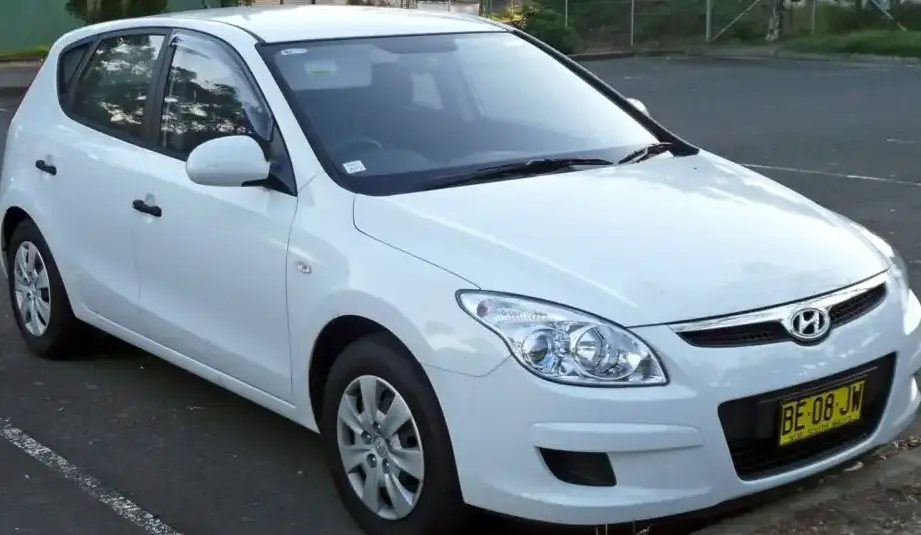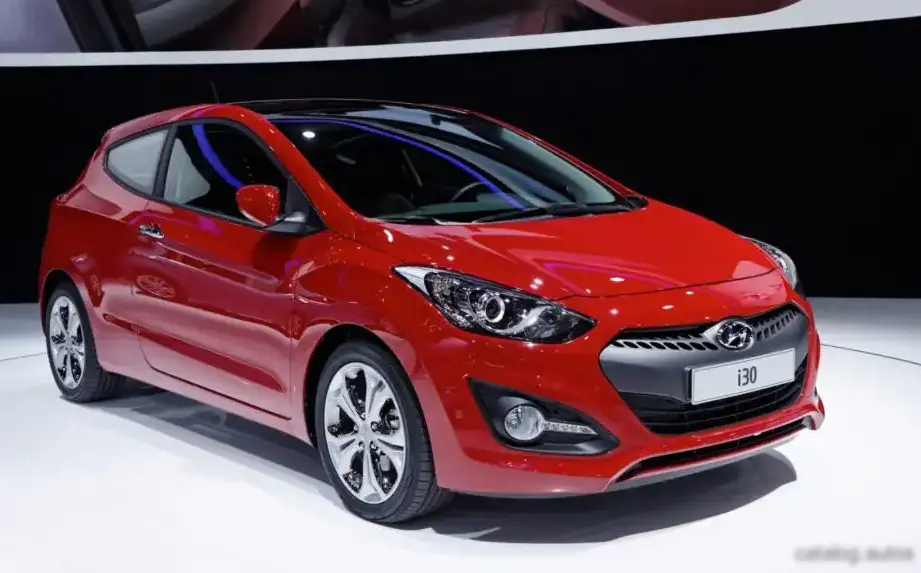
The Hyundai i30 II Coupe 1.6 CRDi (128 hp) was a front-wheel-drive, three-door coupe produced between 2013 and 2015. Positioned as a stylish and economical offering within the second-generation i30 range (based on the FD platform), it aimed to attract buyers seeking a more sporty alternative to the five-door hatchback. This variant represented a mid-range option in the Coupe lineup, slotting between the lower-powered 1.4-liter gasoline engine and the more potent 2.0-liter diesel. The i30 Coupe, in general, was Hyundai’s attempt to broaden the appeal of the i30 family and compete more directly with rivals like the Volkswagen Scirocco and Peugeot RCZ, though at a more accessible price point.
Technical Specifications
| Brand | Hyundai |
| Model | i30 |
| Generation | i30 II Coupe |
| Type (Engine) | 1.6 CRDi (128 Hp) |
| Start of production | 2013 |
| End of production | 2015 |
| Powertrain Architecture | Internal Combustion engine |
| Body type | Coupe |
| Seats | 5 |
| Doors | 3 |
| Fuel consumption (urban) | 4.8 l/100 km (49 US mpg, 58.9 UK mpg, 20.8 km/l) |
| Fuel consumption (extra urban) | 3.7 l/100 km (63.6 US mpg, 76.3 UK mpg, 27 km/l) |
| Fuel consumption (combined) | 4.1 l/100 km (57.4 US mpg, 68.9 UK mpg, 24.4 km/l) |
| Fuel Type | Diesel |
| Acceleration 0 – 100 km/h | 10.9 sec |
| Acceleration 0 – 62 mph | 10.9 sec |
| Acceleration 0 – 60 mph | 10.4 sec |
| Maximum speed | 196 km/h (121.79 mph) |
| Emission standard | Euro 5 |
| Weight-to-power ratio | 11.1 kg/Hp, 90.1 Hp/tonne |
| Weight-to-torque ratio | 5.5 kg/Nm, 183 Nm/tonne |
| Power | 128 Hp @ 4000 rpm |
| Power per litre | 80.9 Hp/l |
| Torque | 260 Nm @ 1900-2750 rpm (191.77 lb.-ft. @ 1900-2750 rpm) |
| Engine layout | Front, Transverse |
| Engine Model/Code | D4FB |
| Engine displacement | 1582 cm3 (96.54 cu. in.) |
| Number of cylinders | 4 |
| Engine configuration | Inline |
| Cylinder Bore | 77.2 mm (3.04 in.) |
| Piston Stroke | 84.5 mm (3.33 in.) |
| Compression ratio | 17.3:1 |
| Number of valves per cylinder | 4 |
| Fuel injection system | Diesel Commonrail |
| Engine aspiration | Turbocharger, Intercooler |
| Valvetrain | DOHC |
| Engine oil capacity | 5.3 l (5.6 US qt | 4.66 UK qt) |
| Coolant | 6.9 l (7.29 US qt | 6.07 UK qt) |
| Kerb Weight | 1421 kg (3132.77 lbs.) |
| Max. weight | 1920 kg (4232.88 lbs.) |
| Max load | 499 kg (1100.11 lbs.) |
| Trunk (boot) space – minimum | 378 l (13.35 cu. ft.) |
| Trunk (boot) space – maximum | 1316 l (46.47 cu. ft.) |
| Fuel tank capacity | 53 l (14 US gal | 11.66 UK gal) |
| Length | 4300 mm (169.29 in.) |
| Width | 1780 mm (70.08 in.) |
| Height | 1470 mm (57.87 in.) |
| Wheelbase | 2650 mm (104.33 in.) |
| Front track | 1549 mm (60.98 in.) |
| Rear (Back) track | 1557 mm (61.3 in.) |
| Minimum turning circle | 10.6 m (34.78 ft.) |
| Drivetrain Architecture | Front wheel drive |
| Number of gears | 6 |
| Gearbox type | Manual transmission |
| Front suspension | Independent type McPherson |
| Rear suspension | Independent multi-link spring suspension with stabilizer |
| Front brakes | Disc |
| Rear brakes | Disc |
| Assisting systems | ABS (Anti-lock braking system) |
| Steering type | Steering rack and pinion |
| Tires size | 225/45 R17 |
| Wheel rims size | 7.0J x 17 |
Powertrain & Engine Architecture
The heart of the i30 II Coupe 1.6 CRDi was the Hyundai D4FB engine, a 1.6-liter inline-four cylinder diesel. This engine was a common sight in various Hyundai and Kia models of the period. It featured a cast iron block and aluminum cylinder head, incorporating a turbocharger with an intercooler to boost power and efficiency. The D4FB utilized a second-generation common rail direct injection system, delivering fuel at extremely high pressures for optimized combustion. The engine boasted a relatively high compression ratio of 17.3:1, contributing to its fuel efficiency. The double overhead camshaft (DOHC) valvetrain, with four valves per cylinder, further enhanced breathing and performance. The 128 hp version of the D4FB was tuned for a balance between power and economy, rather than outright performance. The engine was paired with a six-speed manual transmission, delivering power to the front wheels.
Driving Characteristics
The 1.6 CRDi 128 hp engine in the i30 Coupe provided adequate, but not exhilarating, performance. Acceleration from 0-60 mph took around 10.4 seconds, and top speed was approximately 122 mph. The engine’s 260 Nm (192 lb-ft) of torque, available from 1900-2750 rpm, provided good low-end grunt, making it suitable for everyday driving and overtaking maneuvers. However, compared to the more powerful 2.0-liter diesel or even the gasoline engines, the 1.6 CRDi felt somewhat underpowered, particularly when fully loaded or tackling steep inclines. The six-speed manual transmission was well-matched to the engine, offering smooth shifts and allowing drivers to keep the engine in its optimal power band. The gear ratios were geared towards fuel efficiency, rather than outright acceleration. The ride quality was generally comfortable, though the sporty coupe styling did result in a slightly firmer suspension setup compared to the standard i30 hatchback.
Equipment & Trim Levels
The i30 II Coupe 1.6 CRDi typically came with a reasonable level of standard equipment. This included air conditioning, electric front windows, a USB audio connection, Bluetooth connectivity, and a multi-function steering wheel. Safety features such as ABS, Electronic Stability Control (ESC), and multiple airbags were also standard. Higher trim levels offered additional features like alloy wheels, a panoramic sunroof, leather upholstery, and a more advanced infotainment system. Interior upholstery was typically cloth, with options for partial leather. Dashboard design was consistent with the broader i30 II range, featuring a functional and modern layout.
Chassis & Braking
The i30 Coupe utilized a McPherson strut front suspension and a multi-link rear suspension, providing a good balance between ride comfort and handling. The suspension was tuned to be slightly firmer than the hatchback version, reflecting the Coupe’s more sporty aspirations. Braking was handled by disc brakes on all four wheels, providing adequate stopping power. ABS (Anti-lock Braking System) was standard, enhancing safety during emergency braking situations. The steering was a rack and pinion system, offering precise and responsive control.
Market Reception & Comparison
The Hyundai i30 II Coupe 1.6 CRDi was generally well-received by automotive critics as a practical and economical coupe. Its fuel economy was a major selling point, with combined figures around 57.4 US mpg. However, some reviewers noted that the 1.6 CRDi engine lacked the punch of its larger counterparts. Compared to the 2.0-liter diesel, the 1.6 CRDi offered lower performance but also lower running costs. Compared to the gasoline engines, the 1.6 CRDi provided significantly better fuel economy but a less engaging driving experience. The i30 Coupe, in general, was seen as a good value proposition, offering a stylish alternative to more expensive rivals.
Legacy
The Hyundai i30 II Coupe 1.6 CRDi has proven to be a relatively reliable vehicle in the used car market. The D4FB engine, while not without its potential issues (such as potential DPF clogging), is generally considered durable when properly maintained. Regular servicing, including oil changes and DPF regeneration, is crucial for long-term reliability. Today, these Coupes represent an affordable and economical option for buyers seeking a stylish and practical coupe. Parts availability is generally good, and maintenance costs are reasonable. The i30 Coupe helped Hyundai establish itself as a credible player in the European coupe market, paving the way for future models.