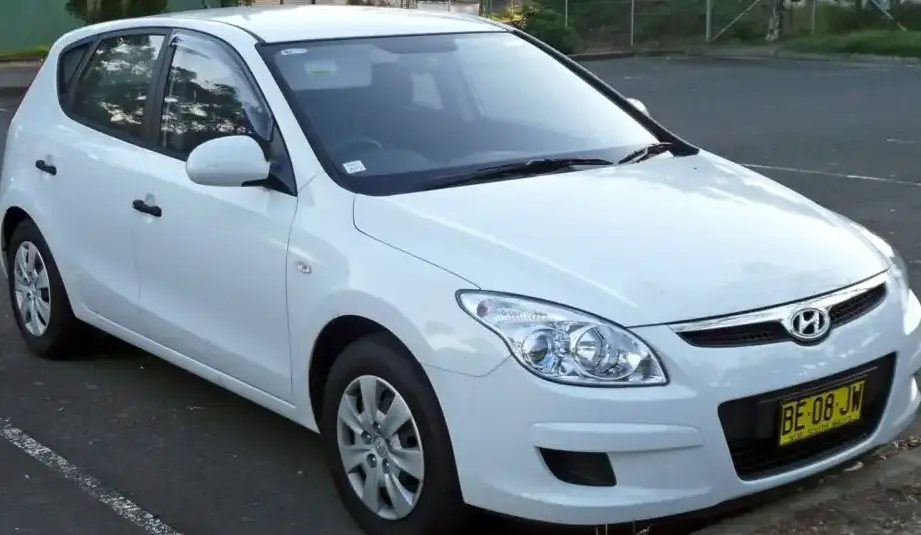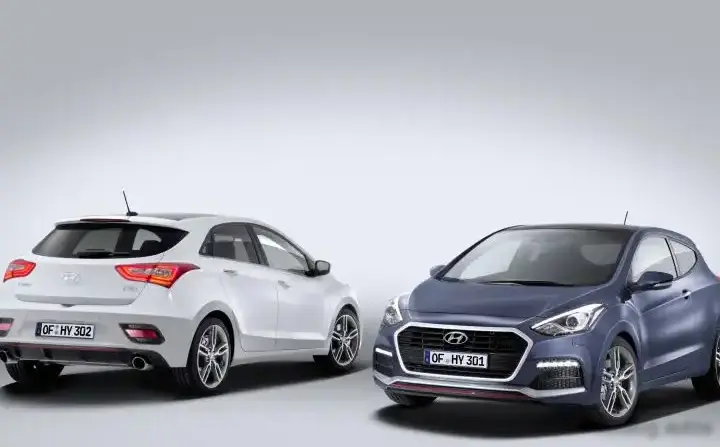
The Hyundai i30 II Coupe (facelift 2015) 1.6 CRDi, producing 110 horsepower, represents a significant offering within the second generation of Hyundai’s popular compact coupe. Introduced as part of the facelift in 2015 and continuing through 2017, this variant aimed to provide a fuel-efficient and practical option for buyers seeking a stylish, three-door vehicle. It was positioned as a mid-range trim, bridging the gap between the base models and the more performance-oriented variants. The i30 II Coupe itself was a derivative of the i30 hatchback, designed to appeal to a more individualistic customer base within the European market, where the three-door coupe body style remained popular.
Technical Specifications
| Brand | Hyundai |
| Model | i30 |
| Generation | i30 II Coupe (facelift 2015) |
| Type (Engine) | 1.6 CRDi (110 Hp) blue |
| Start of production | 2015 |
| End of production | 2017 |
| Powertrain Architecture | Internal Combustion engine |
| Body type | Coupe |
| Seats | 5 |
| Doors | 3 |
| Fuel consumption (urban) | 4.2-4.4 l/100 km (56 – 53.5 US mpg) |
| Fuel consumption (extra urban) | 3.4-3.6 l/100 km (69.2 – 65.3 US mpg) |
| Fuel consumption (combined) | 3.6-3.9 l/100 km (65.3 – 60.3 US mpg) |
| CO2 emissions | 94-102 g/km |
| Fuel Type | Diesel |
| Acceleration 0 – 100 km/h | 10.6 sec |
| Acceleration 0 – 62 mph | 10.6 sec |
| Acceleration 0 – 60 mph | 10.1 sec |
| Maximum speed | 189 km/h (117.44 mph) |
| Emission standard | Euro 6 |
| Weight-to-power ratio | 11.6 kg/Hp |
| Weight-to-torque ratio | 4.6 kg/Nm |
| Power | 110 Hp @ 4000 rpm |
| Torque | 280 Nm @ 1500-3000 rpm (206.52 lb.-ft. @ 1500-3000 rpm) |
| Engine layout | Front, Transverse |
| Engine Model/Code | D4FB |
| Engine displacement | 1582 cm3 (96.54 cu. in.) |
| Number of cylinders | 4 |
| Engine configuration | Inline |
| Cylinder Bore | 77.2 mm (3.04 in.) |
| Piston Stroke | 84.5 mm (3.33 in.) |
| Number of valves per cylinder | 4 |
| Fuel injection system | Diesel Commonrail |
| Engine aspiration | Turbocharger, Intercooler |
| Engine oil capacity | 5.3 l (5.6 US qt | 4.66 UK qt) |
| Coolant | 6.9 l (7.29 US qt | 6.07 UK qt) |
| Kerb Weight | 1281-1417 kg (2824.12 – 3123.95 lbs.) |
| Max. weight | 1920 kg (4232.88 lbs.) |
| Max load | 503-639 kg (1108.93 – 1408.75 lbs.) |
| Trunk (boot) space – minimum | 378 l (13.35 cu. ft.) |
| Trunk (boot) space – maximum | 1316 l (46.47 cu. ft.) |
| Fuel tank capacity | 53 l (14 US gal | 11.66 UK gal) |
| Max. roof load | 80 kg (176.37 lbs.) |
| Permitted trailer load with brakes (12%) | 1500 kg (3306.93 lbs.) |
| Permitted trailer load without brakes | 650 kg (1433 lbs.) |
| Permitted towbar download | 75 kg (165.35 lbs.) |
| Length | 4300 mm (169.29 in.) |
| Width | 1780 mm (70.08 in.) |
| Height | 1465-1470 mm (57.68 – 57.87 in.) |
| Wheelbase | 2650 mm (104.33 in.) |
| Front track | 1563-1569 mm (61.54 – 61.77 in.) |
| Rear (Back) track | 1571-1577 mm (61.85 – 62.09 in.) |
| Front overhang | 880 mm (34.65 in.) |
| Rear overhang | 770 mm (30.31 in.) |
| Ride height (ground clearance) | 135 mm (5.31 in.) |
| Minimum turning circle (turning diameter) | 10.6 m (34.78 ft.) |
| Drivetrain Architecture | Front wheel drive |
| Number of gears and type of gearbox | 6 gears, manual transmission |
| Front suspension | Independent, type McPherson with coil spring and anti-roll bar |
| Rear suspension | Independent multi-link suspension |
| Front brakes | Ventilated discs |
| Rear brakes | Disc |
| Assisting systems | ABS (Anti-lock braking system) |
| Steering type | Steering rack and pinion |
| Power steering | Electric Steering |
| Tires size | 195/65 R15; 205/55 R16; 225/45 R17 |
| Wheel rims size | 6.0J x 15; 6.5J x 16; 7.0J x 17 |
Powertrain & Engine Architecture
The heart of this i30 Coupe variant is the Hyundai D4FB 1.6-liter four-cylinder diesel engine. This engine is a common rail direct injection (CRDi) unit, utilizing a Bosch-supplied fuel system capable of delivering highly pressurized fuel directly into the cylinders. The D4FB engine features a single overhead camshaft (SOHC) design with four valves per cylinder, contributing to efficient combustion. A turbocharger with an intercooler is employed to boost power and torque, providing 110 horsepower at 4,000 rpm and a respectable 280 Nm (206.52 lb-ft) of torque between 1,500 and 3,000 rpm. This broad torque band is a key characteristic of modern diesel engines, offering strong pulling power at lower engine speeds. The engine is transversely mounted in the front of the vehicle, driving the front wheels. The 6-speed manual transmission was standard, offering precise gear changes and contributing to the car’s fuel efficiency.
Driving Characteristics
The 1.6 CRDi 110 hp i30 Coupe delivers a practical and economical driving experience. Acceleration from 0 to 60 mph takes around 10.1 seconds, and top speed is rated at 117.44 mph. While not a performance-oriented vehicle, the engine’s torque provides sufficient power for everyday driving and overtaking maneuvers. The manual transmission allows for driver control, and the gear ratios are well-matched to the engine’s power delivery. Compared to higher-output versions of the i30 Coupe, such as those with more powerful diesel engines or the gasoline variants, this 1.6 CRDi model prioritizes fuel economy and refinement over outright speed. The suspension setup provides a comfortable ride, absorbing bumps and imperfections in the road surface effectively.
Equipment & Trim Levels
The 1.6 CRDi 110 hp i30 Coupe typically came equipped with a reasonable level of standard features. These included air conditioning, electric front windows, a radio with USB connectivity, and central locking. Safety features such as ABS, ESP (Electronic Stability Program), and multiple airbags were also standard. Higher trim levels offered additional features such as alloy wheels, a touchscreen infotainment system, rear parking sensors, and climate control. Interior upholstery was typically cloth, with options for upgraded materials available. The dashboard layout was functional and user-friendly, with a focus on ergonomics.
Chassis & Braking
The i30 Coupe utilizes a McPherson strut front suspension and a multi-link rear suspension, providing a good balance between ride comfort and handling. The front brakes are ventilated discs, while the rear brakes are solid discs. The steering is electrically assisted, offering light and precise control. The chassis is designed to be relatively lightweight, contributing to the car’s fuel efficiency and agility. Stabilizer bars are fitted to both the front and rear axles to reduce body roll during cornering.
Market Reception & Comparison
The Hyundai i30 II Coupe 1.6 CRDi 110 hp was generally well-received by automotive critics for its fuel efficiency, practicality, and value for money. It was seen as a strong competitor to other compact coupes in the European market, such as the Volkswagen Scirocco and the Peugeot RCZ. Compared to the more powerful diesel variants of the i30, this model offered lower running costs but less performance. Its fuel economy figures of 3.6-3.9 l/100 km (65.3 – 60.3 US mpg) were particularly impressive, making it an attractive option for drivers who prioritize efficiency.
Legacy
The Hyundai i30 II Coupe 1.6 CRDi 110 hp has proven to be a reliable and durable vehicle. The D4FB engine is known for its longevity, and with regular maintenance, it can provide many years of trouble-free service. In the used car market, these models are often sought after for their fuel efficiency and affordability. While not a particularly rare or collectible vehicle, the i30 Coupe 1.6 CRDi remains a popular choice for buyers looking for a practical and economical coupe.