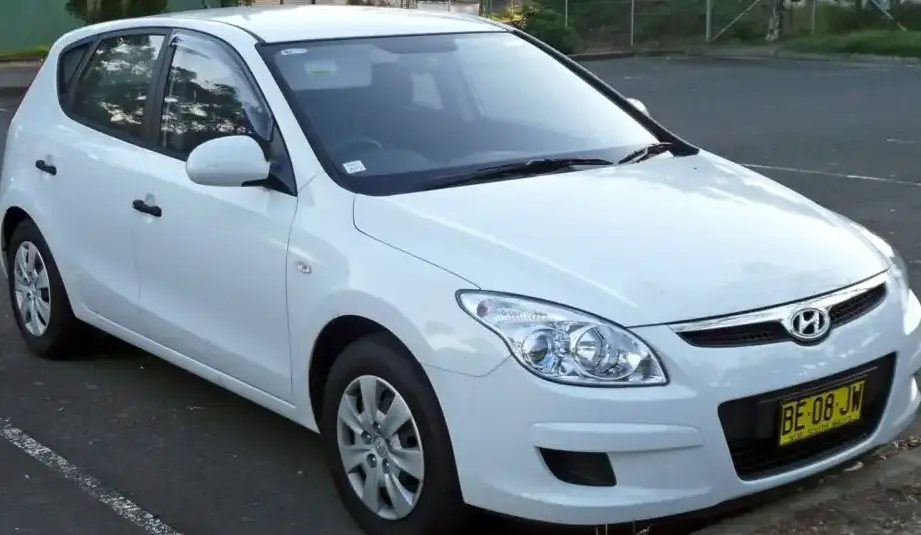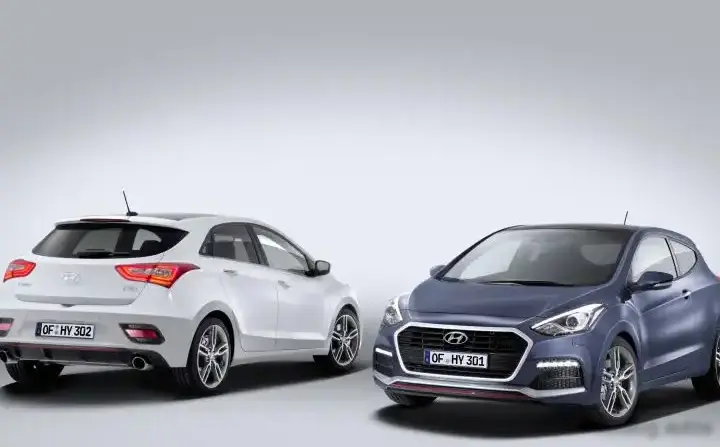
The Hyundai i30 II Coupe (facelift 2015) 1.6 T-GDi, producing 186 horsepower, represents a significant step forward in Hyundai’s offering within the European compact coupe market. Introduced as part of the i30 II generation’s mid-life refresh in 2015, this variant aimed to provide a more engaging driving experience compared to naturally aspirated models, while still maintaining the practicality expected of a Hyundai. Production continued through 2017, positioning it as a key competitor against established rivals like the Volkswagen Scirocco and Peugeot RCZ. This specific engine and trim level occupied the upper-mid range of the i30 Coupe lineup, offering a balance between performance and affordability.
Technical Specifications
| Brand | Hyundai |
| Model | i30 |
| Generation | i30 II Coupe (facelift 2015) |
| Type (Engine) | 1.6 T-GDi (186 Hp) |
| Start of production | 2015 |
| End of production | 2017 |
| Powertrain Architecture | Internal Combustion engine |
| Body type | Coupe |
| Seats | 5 |
| Doors | 3 |
| Fuel consumption (urban) | 9.6 l/100 km (24.5 US mpg) |
| Fuel consumption (extra urban) | 6 l/100 km (39.2 US mpg) |
| Fuel consumption (combined) | 7.3 l/100 km (32.2 US mpg) |
| CO2 emissions | 169 g/km |
| Fuel Type | Petrol (Gasoline) |
| Acceleration 0 – 100 km/h | 8 sec |
| Acceleration 0 – 62 mph | 8 sec |
| Acceleration 0 – 60 mph | 7.6 sec |
| Maximum speed | 219 km/h (136.08 mph) |
| Emission standard | Euro 6 |
| Weight-to-power ratio | 6.9 kg/Hp |
| Weight-to-torque ratio | 4.8 kg/Nm |
| Power | 186 Hp @ 5500 rpm |
| Torque | 265 Nm @ 1500-4500 rpm (195.45 lb.-ft.) |
| Engine layout | Front, Transverse |
| Engine Model/Code | Gamma II / G4FJ |
| Engine displacement | 1591 cm3 (97.09 cu. in.) |
| Number of cylinders | 4 |
| Engine configuration | Inline |
| Cylinder Bore | 77 mm (3.03 in.) |
| Piston Stroke | 85.44 mm (3.36 in.) |
| Compression ratio | 9.5:1 |
| Number of valves per cylinder | 4 |
| Fuel injection system | Direct injection |
| Engine aspiration | Turbocharger, Intercooler |
| Valvetrain | DOHC |
| Engine oil capacity | 4.5 l (4.76 US qt | 3.96 UK qt) |
| Coolant | 6.4 l (6.76 US qt | 5.63 UK qt) |
| Kerb Weight | 1282-1380 kg (2826.33 – 3042.38 lbs.) |
| Max. weight | 1870 kg (4122.64 lbs.) |
| Max load | 490-588 kg (1080.27 – 1296.32 lbs.) |
| Trunk (boot) space – minimum | 378 l (13.35 cu. ft.) |
| Trunk (boot) space – maximum | 1316 l (46.47 cu. ft.) |
| Fuel tank capacity | 53 l (14 US gal | 11.66 UK gal) |
| Max. roof load | 80 kg (176.37 lbs.) |
| Permitted trailer load with brakes (12%) | 1400 kg (3086.47 lbs.) |
| Permitted trailer load without brakes | 600 kg (1322.77 lbs.) |
| Permitted towbar download | 60 kg (132.28 lbs.) |
| Length | 4300 mm (169.29 in.) |
| Width | 1780 mm (70.08 in.) |
| Height | 1470 mm (57.87 in.) |
| Wheelbase | 2650 mm (104.33 in.) |
| Front track | 1553 mm (61.14 in.) |
| Rear (Back) track | 1545 mm (60.83 in.) |
| Ride height (ground clearance) | 140 mm (5.51 in.) |
| Minimum turning circle | 10.6 m (34.78 ft.) |
| Drivetrain Architecture | Front wheel drive |
| Drive wheel | Front wheel drive |
| Number of gears and type of gearbox | 6 gears, manual transmission |
| Front suspension | Independent, type McPherson with coil spring and anti-roll bar |
| Rear suspension | Independent multi-link suspension |
| Front brakes | Ventilated discs |
| Rear brakes | Disc |
| Assisting systems | ABS (Anti-lock braking system) |
| Steering type | Steering rack and pinion |
| Power steering | Electric Steering |
| Tires size | 225/40 R18 |
| Wheel rims size | 7.5J x 18 |
INTRODUCTION
The Hyundai i30 II Coupe, particularly the facelifted 2015-2017 models, represented Hyundai’s ambition to establish itself as a serious player in the European C-segment. Building upon the success of the first-generation i30, the Coupe variant offered a more stylish and sporty alternative to the five-door hatchback. The 1.6 T-GDi engine, introduced with the facelift, was a key component in this strategy, providing a significant power upgrade over the base engines. This engine was designed to appeal to drivers seeking a more dynamic driving experience without sacrificing fuel efficiency or everyday usability. The i30 II Coupe was built on the 1HX0/A3 platform, shared with the Kia Cee’d, allowing for economies of scale and a robust engineering base.
Powertrain & Engine Architecture
The heart of this i30 Coupe variant is the Hyundai Gamma II 1.6 T-GDi engine, designated with the code G4FJ. This is a four-cylinder, inline engine featuring direct fuel injection and a single scroll turbocharger with an intercooler. Direct injection allows for precise fuel delivery, improving both power and efficiency. The engine utilizes a dual continuously variable valve timing (D-CVVT) system on both intake and exhaust valves, optimizing engine breathing across the rev range. The 1.6 T-GDi produces 186 horsepower at 5500 rpm and 265 Nm (195 lb-ft) of torque between 1500 and 4500 rpm. The engine’s relatively flat torque curve contributes to strong mid-range acceleration. The engine is transversely mounted in the front of the vehicle. The 6-speed manual transmission was standard, offering precise shifts and a direct connection to the engine. While an automatic transmission was available in some i30 models, it wasn’t commonly paired with the 1.6 T-GDi in the Coupe.
Driving Characteristics
The 1.6 T-GDi-equipped i30 Coupe delivers a noticeably more spirited driving experience than its lower-powered siblings. The turbocharger provides a surge of power, making overtaking and merging onto highways effortless. The 0-60 mph time of around 7.6 seconds is respectable for a front-wheel-drive coupe in this class. The manual transmission’s gear ratios are well-matched to the engine’s powerband, allowing for quick acceleration in each gear. Compared to the naturally aspirated 1.6-liter engine, the T-GDi offers significantly more torque, resulting in stronger acceleration from lower speeds. While not as raw or focused as the Volkswagen Scirocco, the i30 Coupe provides a comfortable and engaging driving experience, suitable for both daily commutes and weekend drives. The steering is precise, though lacking some of the feedback found in more performance-oriented coupes.
Equipment & Trim Levels
The 1.6 T-GDi Coupe typically came equipped with a generous level of standard features. These included air conditioning, power windows and mirrors, a touchscreen infotainment system with Bluetooth connectivity, and alloy wheels. Higher trim levels added features such as a panoramic sunroof, leather upholstery, heated front seats, and a premium audio system. Safety features included ABS, Electronic Stability Control (ESC), and multiple airbags. The interior design was modern and functional, with a focus on ergonomics. The Coupe’s interior space is adequate for four adults, though rear seat headroom can be limited due to the sloping roofline.
Chassis & Braking
The i30 Coupe utilizes a McPherson strut front suspension and a multi-link rear suspension, providing a good balance between ride comfort and handling. The suspension is tuned to be slightly firmer than the standard i30 hatchback, enhancing body control during cornering. The front brakes are ventilated discs, while the rear brakes are solid discs, providing adequate stopping power for the vehicle’s weight and performance. The electric power steering offers light and precise steering feel. The i30 Coupe’s chassis is well-balanced, contributing to its predictable handling characteristics.
Market Reception & Comparison
The Hyundai i30 II Coupe 1.6 T-GDi was generally well-received by automotive critics. Reviewers praised its stylish design, strong engine performance, and generous equipment levels. However, some criticized its slightly bland interior and lack of overall refinement compared to more established rivals. In terms of fuel economy, the 1.6 T-GDi offered competitive figures, averaging around 32.2 US mpg in combined driving. Compared to the base 1.6-liter engine, the T-GDi offered a significant performance boost with a modest penalty in fuel economy. The 1.6 T-GDi was positioned as a more appealing alternative to the diesel-powered i30 models, offering similar fuel efficiency with a more responsive driving experience.
Legacy
The Hyundai i30 II Coupe 1.6 T-GDi has proven to be a relatively reliable vehicle in the used car market. The Gamma II engine is generally considered durable, although regular maintenance is crucial. Common issues include occasional turbocharger problems and potential oil leaks. The i30 Coupe’s relatively affordable price and good equipment levels make it an attractive option for buyers seeking a stylish and practical coupe. Today, these models represent a significant step in Hyundai’s evolution as a manufacturer, demonstrating their ability to produce vehicles that can compete with established European brands. The 1.6 T-GDi engine, in particular, helped to elevate Hyundai’s image and attract a wider range of customers.