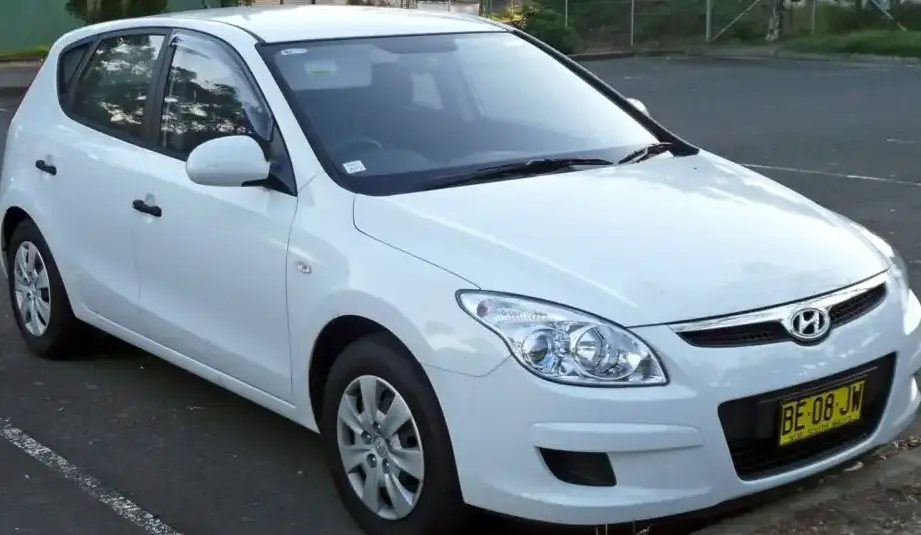
The Hyundai i30 II CW 1.6 CRDi Automatic, produced from 2012 to 2015, represents a practical and fuel-efficient offering within the second generation of Hyundai’s popular i30 compact family. The “CW” designation signifies the station wagon (estate) body style, offering increased cargo capacity compared to the hatchback version. This particular variant, powered by a 1.6-liter turbocharged diesel engine producing 128 horsepower and paired with a six-speed automatic transmission, was positioned as a mid-range option, appealing to buyers prioritizing economy and convenience over outright performance. It was a key model for Hyundai in the European market, where station wagons remain a popular choice, and aimed to compete with established rivals like the Volkswagen Golf Estate and Ford Focus Wagon.
Technical Specifications
| Brand | Hyundai |
| Model | i30 |
| Generation | i30 II CW |
| Type (Engine) | 1.6 CRDi (128 Hp) Automatic |
| Start of production | 2012 |
| End of production | 2015 |
| Powertrain Architecture | Internal Combustion engine |
| Body type | Station wagon (estate) |
| Seats | 5 |
| Doors | 5 |
| Fuel consumption (urban) | 4.9 l/100 km (48 US mpg, 57.6 UK mpg, 20.4 km/l) |
| Fuel consumption (extra urban) | 3.7 l/100 km (63.6 US mpg, 76.3 UK mpg, 27 km/l) |
| Fuel consumption (combined) | 4.1 l/100 km (57.4 US mpg, 68.9 UK mpg, 24.4 km/l) |
| Fuel Type | Diesel |
| Acceleration 0 – 100 km/h | 11.7 sec |
| Acceleration 0 – 62 mph | 11.7 sec |
| Acceleration 0 – 60 mph | 11.1 sec |
| Maximum speed | 190 km/h (118.06 mph) |
| Emission standard | Euro 5 |
| Weight-to-power ratio | 11.2 kg/Hp, 89.6 Hp/tonne |
| Weight-to-torque ratio | 5.5 kg/Nm, 182.1 Nm/tonne |
| Power | 128 Hp @ 4000 rpm |
| Power per litre | 80.9 Hp/l |
| Torque | 260 Nm @ 1900-2750 rpm (191.77 lb.-ft. @ 1900-2750 rpm) |
| Engine layout | Front, Transverse |
| Engine Model/Code | D4FB |
| Engine displacement | 1582 cm3 (96.54 cu. in.) |
| Number of cylinders | 4 |
| Engine configuration | Inline |
| Cylinder Bore | 77.2 mm (3.04 in.) |
| Piston Stroke | 84.5 mm (3.33 in.) |
| Compression ratio | 17.3:1 |
| Number of valves per cylinder | 4 |
| Fuel injection system | Diesel Commonrail |
| Engine aspiration | Turbocharger, Intercooler |
| Valvetrain | DOHC |
| Engine oil capacity | 5.3 l (5.6 US qt | 4.66 UK qt) |
| Coolant capacity | 6.7 l (7.08 US qt | 5.9 UK qt) |
| Kerb Weight | 1428 kg (3148.2 lbs.) |
| Max. weight | 1940 kg (4276.97 lbs.) |
| Max load | 512 kg (1128.77 lbs.) |
| Trunk (boot) space – minimum | 528 l (18.65 cu. ft.) |
| Trunk (boot) space – maximum | 1642 l (57.99 cu. ft.) |
| Fuel tank capacity | 53 l (14 US gal | 11.66 UK gal) |
| Length | 4485 mm (176.57 in.) |
| Width | 1780 mm (70.08 in.) |
| Height | 1500 mm (59.06 in.) |
| Wheelbase | 2650 mm (104.33 in.) |
| Front track | 1563 mm (61.54 in.) |
| Rear track | 1571 mm (61.85 in.) |
| Minimum turning circle | 10.6 m (34.78 ft.) |
| Drivetrain Architecture | Front wheel drive |
| Number of gears | 6 |
| Gearbox type | Automatic transmission |
| Front suspension | Independent type McPherson |
| Rear suspension | Independent coil spring |
| Front brakes | Ventilated discs |
| Rear brakes | Disc |
| Assisting systems | ABS (Anti-lock braking system) |
| Steering type | Steering rack and pinion |
| Power steering | Electric Steering |
| Tires size | 195/65 R15; 205/55 R16; 225/45 R17 |
| Wheel rims size | 6.0J x 15; 6.5J x 16; 7.0J x 17 |
Powertrain & Engine Architecture
The heart of the i30 CW 1.6 CRDi Automatic is the D4FB engine, a 1.6-liter inline-four cylinder diesel. This engine is a member of Hyundai-Kia’s Gamma family of engines, known for its relatively compact size and efficiency. The D4FB utilizes a second-generation common rail direct injection system, delivering fuel at extremely high pressure for optimized combustion. A turbocharger with an intercooler is employed to boost power output and improve torque across a wider rev range. The engine features a double overhead camshaft (DOHC) valvetrain with four valves per cylinder, contributing to its breathing efficiency. The six-speed automatic transmission is a conventional torque converter type, prioritizing smooth shifts and ease of use over the more aggressive performance of a dual-clutch transmission. While not the fastest shifting unit, it was well-suited to the engine’s torque characteristics and the intended relaxed driving experience.
Driving Characteristics
The 128 horsepower and 260 Nm (192 lb-ft) of torque produced by the 1.6 CRDi engine provide adequate, though not exhilarating, performance. Acceleration from 0-60 mph takes around 11.1 seconds, and top speed is rated at 118 mph. The automatic transmission’s gear ratios are tuned for fuel efficiency, meaning it prioritizes higher gears at lower speeds. This results in a comfortable cruising experience but can sometimes feel sluggish when needing to accelerate quickly, such as when overtaking. Compared to the more powerful 1.6 GDI gasoline engine or the 1.7 CRDi, the 1.6 CRDi Automatic offers less outright performance but significantly better fuel economy. The manual transmission version of this engine provides a more engaging driving experience and slightly quicker acceleration.
Equipment & Trim Levels
The i30 CW 1.6 CRDi Automatic typically came equipped with a reasonable level of standard features. These included air conditioning, electric front and rear windows, central locking, a radio/CD player with USB connectivity, and ABS brakes. Higher trim levels, such as Style or Premium, added features like alloy wheels, a touchscreen infotainment system, rear parking sensors, cruise control, and automatic climate control. Interior upholstery was typically cloth, with options for leather seats on higher-spec models. The dashboard layout was functional and straightforward, prioritizing usability over stylistic flair.
Chassis & Braking
The i30 CW utilizes a McPherson strut front suspension and an independent coil spring rear suspension. This setup provides a comfortable ride quality, absorbing bumps and imperfections in the road surface effectively. The front brakes are ventilated discs, providing good stopping power, while the rear brakes are solid discs. ABS (Anti-lock Braking System) is standard, enhancing safety during emergency braking situations. The steering is electrically assisted, providing a light and easy steering feel, although it lacks the feedback of a hydraulic system. Stabilizer bars are fitted to both the front and rear axles to reduce body roll during cornering.
Market Reception & Comparison
The Hyundai i30 CW 1.6 CRDi Automatic was generally well-received by automotive critics as a practical and economical family car. Its fuel economy was a major selling point, consistently achieving over 50 mpg in real-world driving. However, some reviewers criticized its lack of outright performance and the somewhat dated feel of the automatic transmission. Compared to rivals like the Volkswagen Golf Estate and Ford Focus Wagon, the i30 CW offered a competitive price point and a generous warranty, but lacked the brand prestige and driving refinement of its European competitors. The 1.6 CRDi engine proved to be reliable, but regular servicing and the use of quality diesel fuel were essential to maintain optimal performance and prevent issues with the fuel injection system.
Legacy
The Hyundai i30 II CW 1.6 CRDi Automatic has proven to be a relatively reliable and durable vehicle. The D4FB engine, while not without its potential issues (such as potential DPF clogging if not driven on longer journeys), is generally considered robust when properly maintained. On the used car market, these models represent good value for money, offering a practical and economical option for buyers seeking a spacious and fuel-efficient estate car. However, potential buyers should be aware of the importance of checking the service history and ensuring that the DPF (Diesel Particulate Filter) has been properly maintained.