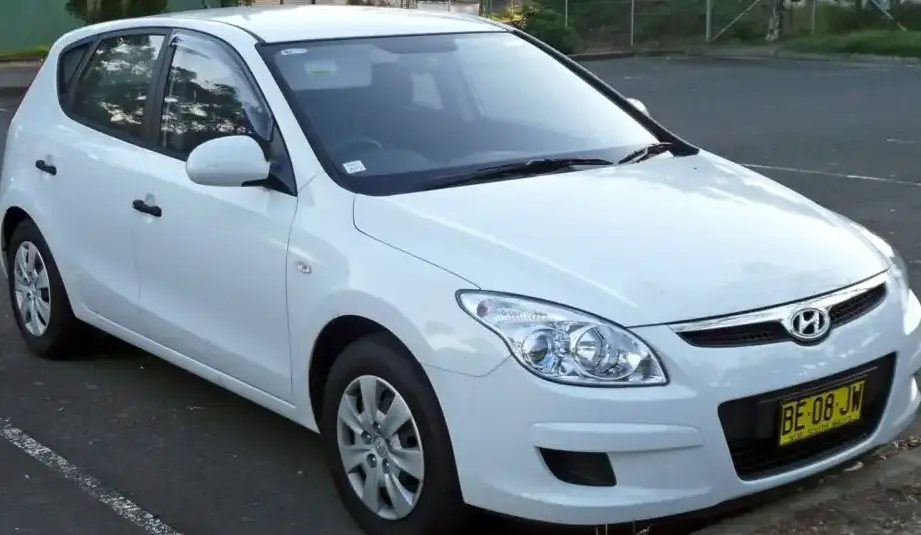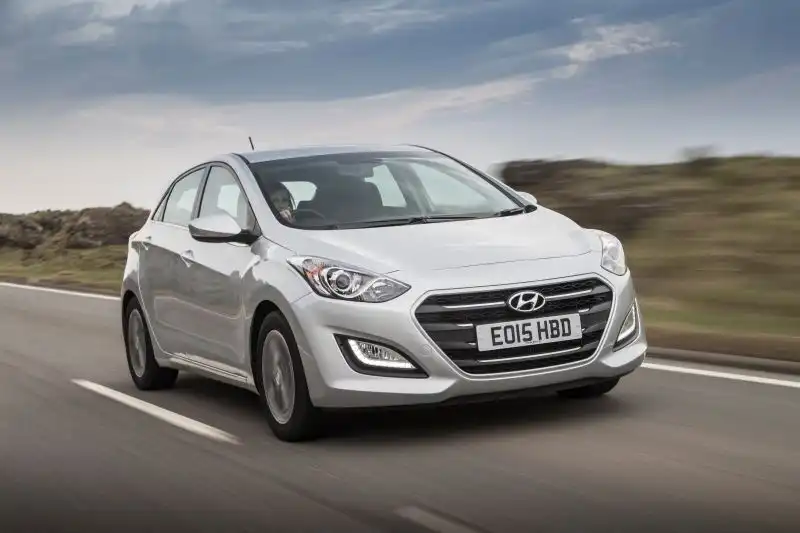
The Hyundai i30 II (facelift, produced from 2015 to 2017) 1.4 CRDi 90 hp represents an entry-level diesel option within the second generation of Hyundai’s popular C-segment hatchback. Positioned as a fuel-efficient and affordable choice, this variant aimed to attract buyers prioritizing economy over outright performance. It was a key model in Hyundai’s European lineup, designed to compete with established rivals like the Volkswagen Golf, Ford Focus, and Opel Astra. The facelift brought styling updates and revised equipment levels to the i30 range, enhancing its appeal in a competitive market.
Technical Specifications
| Brand | Hyundai |
| Model | i30 |
| Generation | i30 II (facelift 2015) |
| Type (Engine) | 1.4 CRDi (90 Hp) |
| Start of production | 2015 |
| End of production | 2017 |
| Powertrain Architecture | Internal Combustion engine |
| Body type | Hatchback |
| Seats | 5 |
| Doors | 5 |
| Fuel consumption (urban) | 5.1 l/100 km (46.1 US mpg, 55.4 UK mpg, 19.6 km/l) |
| Fuel consumption (extra urban) | 3.7 l/100 km (63.6 US mpg, 76.3 UK mpg, 27 km/l) |
| Fuel consumption (combined) | 4.2 l/100 km (56 US mpg, 67.3 UK mpg, 23.8 km/l) |
| CO2 emissions | 109 g/km |
| Fuel Type | Diesel |
| Acceleration 0 – 100 km/h | 13.5 sec |
| Acceleration 0 – 62 mph | 13.5 sec |
| Acceleration 0 – 60 mph | 12.8 sec |
| Maximum speed | 173 km/h (107.5 mph) |
| Emission standard | Euro 6 |
| Weight-to-power ratio | 14.2 kg/Hp, 70.2 Hp/tonne |
| Weight-to-torque ratio | 5.3 kg/Nm, 187.2 Nm/tonne |
| Power | 90 Hp @ 4000 rpm |
| Power per litre | 64.5 Hp/l |
| Torque | 240 Nm @ 1500-2500 rpm (177.01 lb.-ft. @ 1500-2500 rpm) |
| Engine layout | Front, Transverse |
| Engine Model/Code | D4FC |
| Engine displacement | 1396 cm3 (85.19 cu. in.) |
| Number of cylinders | 4 |
| Engine configuration | Inline |
| Cylinder Bore | 75 mm (2.95 in.) |
| Piston Stroke | 79 mm (3.11 in.) |
| Compression ratio | 16:1 |
| Number of valves per cylinder | 4 |
| Fuel injection system | Diesel Commonrail |
| Engine aspiration | Turbocharger, Intercooler |
| Valvetrain | DOHC |
| Engine oil capacity | 5.3 l (5.6 US qt | 4.66 UK qt) |
| Coolant | 6.9 l (7.29 US qt | 6.07 UK qt) |
| Kerb Weight | 1282 kg (2826.33 lbs.) |
| Max. weight | 1910 kg (4210.83 lbs.) |
| Max load | 628 kg (1384.5 lbs.) |
| Trunk (boot) space – minimum | 378 l (13.35 cu. ft.) |
| Trunk (boot) space – maximum | 1316 l (46.47 cu. ft.) |
| Fuel tank capacity | 53 l (14 US gal | 11.66 UK gal) |
| Length | 4300 mm (169.29 in.) |
| Width | 1780 mm (70.08 in.) |
| Height | 1470 mm (57.87 in.) |
| Wheelbase | 2650 mm (104.33 in.) |
| Front track | 1549-1569 mm (60.98 – 61.77 in.) |
| Rear (Back) track | 1557-1571 mm (61.3 – 61.85 in.) |
| Front overhang | 880 mm (34.65 in.) |
| Rear overhang | 770 mm (30.31 in.) |
| Ride height (ground clearance) | 140 mm (5.51 in.) |
| Minimum turning circle | 10.6 m (34.78 ft.) |
| Drivetrain Architecture | Front wheel drive |
| Number of gears and type of gearbox | 6 gears, manual transmission |
| Front suspension | Independent, type McPherson with coil spring and anti-roll bar |
| Rear suspension | Independent multi-link suspension |
| Front brakes | Ventilated discs |
| Rear brakes | Disc |
| Assisting systems | ABS (Anti-lock braking system) |
| Steering type | Steering rack and pinion |
| Power steering | Electric Steering |
| Tires size | 195/65 R15; 205/55 R16; 205/45 R17; 225/40 R18 |
| Wheel rims size | 6.0J x 15; 6.5J x 16; 7.0J x 17; 7.5J x 18 |
INTRODUCTION
The Hyundai i30 II facelift, launched in 2015, represented a significant update to Hyundai’s popular C-segment hatchback. The 1.4 CRDi 90 hp variant was a core offering, designed to appeal to buyers seeking a practical, economical, and reliable vehicle. Built on the i30’s (FD) platform, this version aimed to provide a balance between fuel efficiency and everyday usability. It served as a stepping stone into the i30 range, offering a more affordable alternative to the higher-powered engine options and trim levels.
Powertrain & Engine Architecture
The heart of this i30 variant is the Hyundai D4FC 1.4-liter four-cylinder diesel engine. This engine utilizes a second-generation common-rail direct injection system, delivering fuel at extremely high pressure for optimized combustion. The D4FC engine features a turbocharger with an intercooler, enhancing power output and torque. The engine’s valvetrain employs a double overhead camshaft (DOHC) configuration with four valves per cylinder, contributing to efficient gas exchange. The 90 hp output is achieved at 4000 rpm, while peak torque of 240 Nm (177 lb-ft) is available between 1500-2500 rpm. This broad torque curve provides good low-end responsiveness, making it suitable for everyday driving. The engine is paired with a six-speed manual transmission, chosen for its efficiency and driver engagement. While an automatic transmission was available on other i30 models, it wasn’t offered with this specific engine/power combination.
Driving Characteristics
The 1.4 CRDi 90 hp i30 offers a driving experience focused on fuel economy and relaxed cruising. Acceleration is modest, taking approximately 13.5 seconds to reach 62 mph (100 km/h). The engine’s strength lies in its mid-range torque, providing sufficient power for overtaking and maintaining speed on highways. The six-speed manual transmission is well-matched to the engine, allowing drivers to keep the engine in its optimal torque band. Compared to the more powerful 1.6 CRDi variants, this 1.4L engine feels noticeably less responsive, particularly at higher speeds. However, the lighter engine weight contributes to slightly improved handling and agility. The steering is light and precise, making it easy to maneuver in urban environments. The suspension provides a comfortable ride, absorbing bumps and imperfections in the road surface effectively.
Equipment & Trim Levels
The 1.4 CRDi 90 hp i30 typically came equipped as a base or mid-range trim level, depending on the specific market. Standard features generally included air conditioning, electric front windows, a basic audio system with USB connectivity, and ABS brakes. Safety features such as airbags and stability control were also standard. Higher trim levels offered additional features like alloy wheels, a touchscreen infotainment system, rear parking sensors, and cruise control. Interior upholstery was typically cloth, with a functional and durable design. Optional extras included a panoramic sunroof, leather upholstery, and a more advanced navigation system.
Chassis & Braking
The i30 II utilizes a McPherson strut front suspension and a multi-link rear suspension, providing a good balance between ride comfort and handling. The front suspension incorporates a coil spring and anti-roll bar to reduce body roll during cornering. The braking system consists of ventilated discs at the front and solid discs at the rear. ABS (Anti-lock Braking System) is standard, enhancing braking performance and stability. The i30’s chassis is designed to provide a stable and predictable driving experience, with a focus on safety and comfort.
Market Reception & Comparison
The Hyundai i30 1.4 CRDi 90 hp was generally well-received by critics as a practical and economical choice. It was praised for its fuel efficiency, comfortable ride, and competitive pricing. However, some reviewers noted its lack of outright performance compared to rivals with more powerful engines. Compared to the 1.6 CRDi variants, the 1.4L offered lower running costs but sacrificed some performance. Against competitors like the Volkswagen Golf 1.6 TDI, the i30 offered a similar level of fuel economy but often came with a lower price tag. Reliability was generally considered good, with Hyundai’s reputation for building durable and dependable vehicles.
Legacy
The Hyundai i30 II 1.4 CRDi 90 hp has proven to be a reliable and long-lasting vehicle. The D4FC engine, while not known for being particularly exciting, is generally robust and capable of high mileage with proper maintenance. On the used car market, these i30s represent a good value proposition for buyers seeking an affordable and economical hatchback. Common issues are relatively minor, often related to wear and tear on components like the clutch, suspension bushings, and exhaust system. The availability of spare parts is good, and maintenance costs are generally reasonable. The i30 II 1.4 CRDi 90 hp remains a popular choice for those seeking a practical and dependable everyday vehicle.