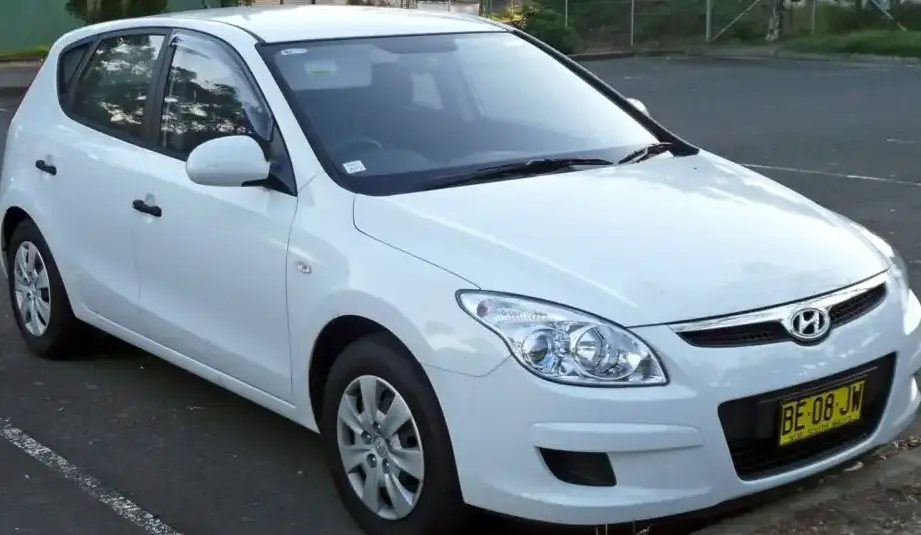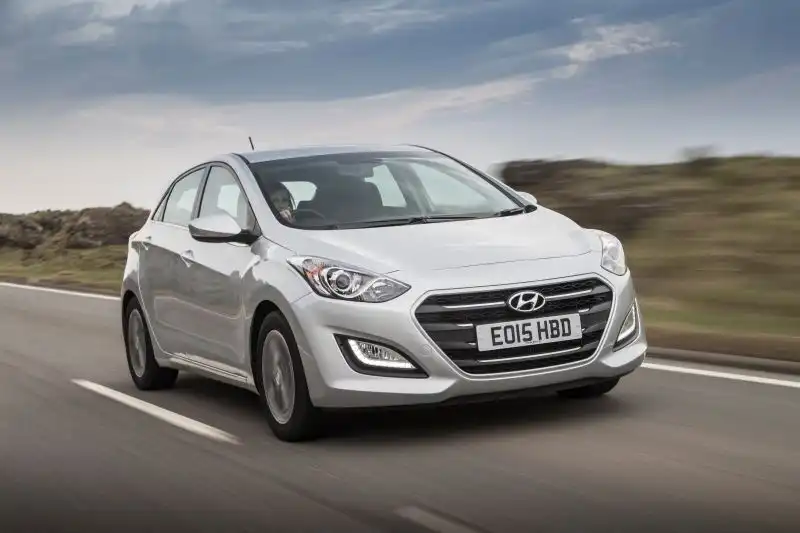
The Hyundai i30 II (facelift, produced 2015-2016) 1.6-liter (120 horsepower) automatic variant represented a key offering in Hyundai’s compact hatchback lineup, particularly within the European market. Positioned as a mid-range option, it aimed to balance affordability with convenience, offering an automatic transmission where many competitors still primarily offered manual gearboxes. This version of the i30 built upon the success of the initial i30 (launched in 2007) and the subsequent facelift in 2012, incorporating styling updates and refinements to both the exterior and interior. It was built on the Hyundai-Kia ‘PD’ platform, also known as the i30/Elantra platform.
Technical Specifications
| Brand | Hyundai |
| Model | i30 |
| Generation | i30 II (facelift 2015) |
| Type (Engine) | 1.6 (120 Hp) Automatic |
| Start of production | 2015 |
| End of production | 2016 |
| Powertrain Architecture | Internal Combustion engine |
| Body type | Hatchback |
| Seats | 5 |
| Doors | 5 |
| Fuel consumption (urban) | 9 l/100 km (26.1 US mpg, 31.4 UK mpg, 11.1 km/l) |
| Fuel consumption (extra urban) | 5.5 l/100 km (42.8 US mpg, 51.4 UK mpg, 18.2 km/l) |
| Fuel consumption (combined) | 6.8 l/100 km (34.6 US mpg, 41.5 UK mpg, 14.7 km/l) |
| CO2 emissions | 158 g/km |
| Fuel Type | Petrol (Gasoline) |
| Acceleration 0 – 100 km/h | 11.9 sec |
| Acceleration 0 – 62 mph | 11.9 sec |
| Acceleration 0 – 60 mph | 11.3 sec |
| Maximum speed | 192 km/h (119.3 mph) |
| Emission standard | Euro 6 |
| Weight-to-power ratio | 11.4 kg/Hp, 88.1 Hp/tonne |
| Weight-to-torque ratio | 8.7 kg/Nm, 114.5 Nm/tonne |
| Power | 120 Hp @ 6300 rpm |
| Power per litre | 75.4 Hp/l |
| Torque | 156 Nm @ 4850 rpm (115.06 lb.-ft. @ 4850 rpm) |
| Engine layout | Front, Transverse |
| Engine Model/Code | Gamma II / G4FG |
| Engine displacement | 1591 cm3 (97.09 cu. in.) |
| Number of cylinders | 4 |
| Engine configuration | Inline |
| Cylinder Bore | 77 mm (3.03 in.) |
| Piston Stroke | 85.44 mm (3.36 in.) |
| Compression ratio | 10.5:1 |
| Number of valves per cylinder | 4 |
| Fuel injection system | Multi-port manifold injection |
| Engine aspiration | Naturally aspirated engine |
| Valvetrain | DOHC |
| Engine oil capacity | 3.6 l (3.8 US qt | 3.17 UK qt) |
| Coolant | 6.5 l (6.87 US qt | 5.72 UK qt) |
| Kerb Weight | 1362 kg (3002.7 lbs.) |
| Max. weight | 1850 kg (4078.55 lbs.) |
| Max load | 488 kg (1075.86 lbs.) |
| Trunk (boot) space – minimum | 378 l (13.35 cu. ft.) |
| Trunk (boot) space – maximum | 1316 l (46.47 cu. ft.) |
| Fuel tank capacity | 53 l (14 US gal | 11.66 UK gal) |
| Max. roof load | 80 kg (176.37 lbs.) |
| Permitted trailer load with brakes (12%) | 1200 kg (2645.55 lbs.) |
| Permitted trailer load without brakes | 600 kg (1322.77 lbs.) |
| Permitted towbar download | 60 kg (132.28 lbs.) |
| Length | 4300 mm (169.29 in.) |
| Width | 1780 mm (70.08 in.) |
| Height | 1470 mm (57.87 in.) |
| Wheelbase | 2650 mm (104.33 in.) |
| Front track | 1555 mm (61.22 in.) |
| Rear (Back) track | 1563 mm (61.54 in.) |
| Minimum turning circle | 10.6 m (34.78 ft.) |
| Drivetrain Architecture | The Internal combustion engine (ICE) drives the front wheels of the vehicle. |
| Drive wheel | Front wheel drive |
| Number of gears and type of gearbox | 6 gears, automatic transmission |
| Front suspension | Independent, type McPherson with coil spring and anti-roll bar |
| Rear suspension | Independent multi-link suspension |
| Front brakes | Ventilated discs |
| Rear brakes | Disc |
| Assisting systems | ABS (Anti-lock braking system) |
| Steering type | Steering rack and pinion |
| Power steering | Electric Steering |
| Tires size | 205/55 R16 |
| Wheel rims size | 6.5J x 16 |
INTRODUCTION
The Hyundai i30 II facelift, produced from 2015 to 2016, represented a significant step forward for Hyundai in the European C-segment. The 1.6-liter engine paired with a six-speed automatic transmission was a popular choice for buyers seeking a comfortable and practical daily driver. This configuration aimed to provide a balance between fuel efficiency and acceptable performance, catering to customers who preferred the ease of an automatic gearbox over a manual. Within the i30 II range, this variant sat comfortably in the middle, offering more convenience than the base models but lacking the outright performance of the more powerful engine options.
Powertrain & Engine Architecture
The heart of this i30 variant is the Hyundai Gamma II engine, specifically the G4FG code. This 1.6-liter inline-four cylinder engine utilizes a naturally aspirated configuration and multi-point fuel injection. The Gamma II series was designed to offer improved efficiency and refinement over its predecessor. The engine features a double overhead camshaft (DOHC) valvetrain with four valves per cylinder, contributing to its breathing efficiency. The automatic transmission is a conventional six-speed torque converter unit, chosen for its smoothness and reliability. While not the sportiest transmission, it provided a comfortable driving experience, particularly in urban environments. The engine produces 120 horsepower at 6,300 rpm and 156 Nm (115 lb-ft) of torque at 4,850 rpm.
Driving Characteristics
The 1.6-liter automatic i30 offered a generally smooth and predictable driving experience. Acceleration from 0-60 mph took around 11.3 seconds, which was adequate for everyday driving but not particularly brisk. The automatic transmission, while smooth, wasn’t known for its quick shifts or responsiveness. Compared to the manual transmission version of the same engine, the automatic resulted in a slight performance decrease due to the transmission’s inherent efficiency losses. Higher-output versions of the i30, such as those equipped with the 1.6-liter turbocharged engine, offered significantly more performance, but at a higher price point. The gear ratios were tuned for fuel economy and comfort, prioritizing smooth cruising over sporty acceleration.
Equipment & Trim Levels
The 1.6-liter automatic i30 typically came equipped with a reasonable level of standard features. These included air conditioning, electric front and rear windows, a USB audio connection, and a basic audio system. Higher trim levels added features such as alloy wheels, a touchscreen infotainment system with navigation, rear parking sensors, and cruise control. Interior upholstery was typically cloth, with options for upgraded materials on higher trims. Safety features included ABS, ESC (Electronic Stability Control), and multiple airbags. Optional extras often included a panoramic sunroof, leather upholstery, and a more advanced audio system.
Chassis & Braking
The i30 II utilized an independent suspension setup, with a McPherson strut configuration at the front and a multi-link system at the rear. This provided a comfortable ride quality, absorbing bumps and imperfections in the road effectively. The front brakes were ventilated discs, while the rear brakes were solid discs. ABS (Anti-lock Braking System) was standard, providing enhanced braking performance and stability. The steering was electrically assisted, offering a light and easy driving experience. Stabilizer bars were fitted to both the front and rear axles to reduce body roll during cornering.
Market Reception & Comparison
The Hyundai i30 II 1.6 automatic received generally positive reviews, particularly for its value for money and comfortable ride. Critics noted that the engine, while not particularly powerful, was adequate for most driving situations. The automatic transmission was praised for its smoothness, but some reviewers found it to be somewhat sluggish. Compared to rivals like the Volkswagen Golf, Ford Focus, and Opel Astra, the i30 offered a competitive package with a longer warranty and often a lower price. Fuel economy was respectable, averaging around 34.6 US mpg in combined driving, making it an economical choice for daily commuting. Reliability was also a strong point, with the i30 generally proving to be a dependable vehicle.
Legacy
The Hyundai i30 II 1.6 automatic has proven to be a relatively reliable vehicle in the used car market. The Gamma II engine is generally considered to be durable, and the automatic transmission, while not without its quirks, has a good track record for longevity. Common issues are typically minor, such as sensor failures or wear and tear on suspension components. Today, these i30s represent an affordable and practical option for buyers seeking a dependable compact hatchback. Their relatively low running costs and comfortable driving experience continue to make them a popular choice in the used car market.