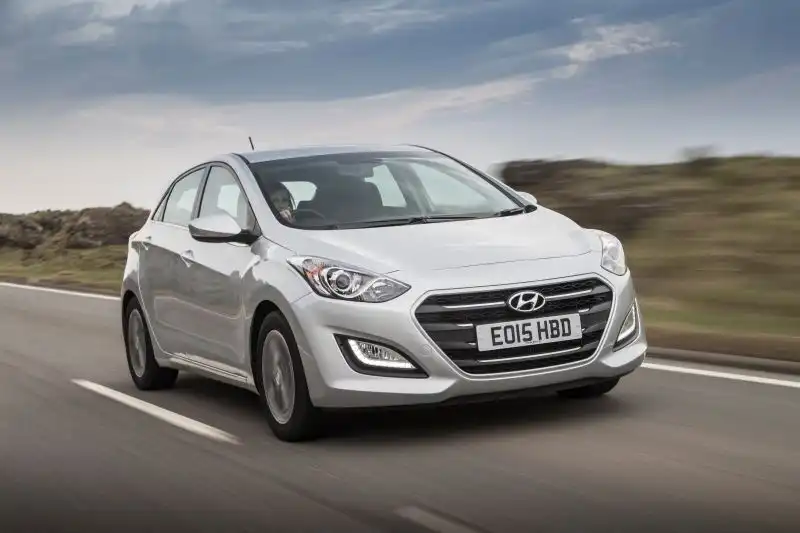
The Hyundai i30 II (facelift, produced from 2015 to 2017) 1.6 GDI 135 horsepower variant with a dual-clutch transmission (DCT) represented a significant step forward for Hyundai in the competitive European compact hatchback segment. Positioned as a mid-range offering within the i30 lineup, it aimed to balance fuel efficiency, performance, and modern technology. This version of the i30 was primarily marketed in Europe, where the demand for efficient and practical hatchbacks was high. It served as a key model in Hyundai’s strategy to establish a stronger foothold in the region, offering a compelling alternative to established European brands.
Technical Specifications
| Brand | Hyundai |
| Model | i30 |
| Generation | i30 II (facelift 2015) |
| Type (Engine) | 1.6 GDI (135 Hp) DCT |
| Start of production | 2015 |
| End of production | 2017 |
| Powertrain Architecture | Internal Combustion engine |
| Body type | Hatchback |
| Seats | 5 |
| Doors | 5 |
| Fuel consumption (urban) | 7.2 l/100 km (32.7 US mpg) |
| Fuel consumption (extra urban) | 4.9 l/100 km (48 US mpg) |
| Fuel consumption (combined) | 5.7 l/100 km (41.3 US mpg) |
| CO2 emissions | 132 g/km |
| Fuel Type | Petrol (Gasoline) |
| Acceleration 0 – 100 km/h | 10.7 sec |
| Acceleration 0 – 62 mph | 10.7 sec |
| Acceleration 0 – 60 mph | 10.2 sec |
| Maximum speed | 195 km/h (121.17 mph) |
| Emission standard | Euro 6 |
| Weight-to-power ratio | 9.1 kg/Hp |
| Weight-to-torque ratio | 7.5 kg/Nm |
| Power | 135 Hp @ 6300 rpm |
| Torque | 164 Nm @ 4850 rpm (120.96 lb.-ft. @ 4850 rpm) |
| Engine layout | Front, Transverse |
| Engine Model/Code | G4FD |
| Engine displacement | 1591 cm3 (97.09 cu. in.) |
| Number of cylinders | 4 |
| Engine configuration | Inline |
| Cylinder Bore | 77 mm (3.03 in.) |
| Piston Stroke | 85.44 mm (3.36 in.) |
| Compression ratio | 10.5:1 |
| Number of valves per cylinder | 4 |
| Fuel injection system | Direct injection |
| Engine aspiration | Naturally aspirated engine |
| Valvetrain | DOHC |
| Engine oil capacity | 3.6 l (3.8 US qt | 3.17 UK qt) |
| Coolant | 6.4 l (6.76 US qt | 5.63 UK qt) |
| Kerb Weight | 1230-1376 kg (2711.69 – 3033.56 lbs.) |
| Max. weight | 1850 kg (4078.55 lbs.) |
| Max load | 474-620 kg (1044.99 – 1366.87 lbs.) |
| Trunk (boot) space – minimum | 378 l (13.35 cu. ft.) |
| Trunk (boot) space – maximum | 1316 l (46.47 cu. ft.) |
| Fuel tank capacity | 53 l (14 US gal | 11.66 UK gal) |
| Max. roof load | 80 kg (176.37 lbs.) |
| Permitted trailer load with brakes (12%) | 1400 kg (3086.47 lbs.) |
| Permitted trailer load without brakes | 600 kg (1322.77 lbs.) |
| Permitted towbar download | 60 kg (132.28 lbs.) |
| Length | 4300 mm (169.29 in.) |
| Width | 1780 mm (70.08 in.) |
| Height | 1470 mm (57.87 in.) |
| Wheelbase | 2650 mm (104.33 in.) |
| Front track | 1549 mm (60.98 in.) |
| Rear (Back) track | 1557 mm (61.3 in.) |
| Front overhang | 880 mm (34.65 in.) |
| Rear overhang | 770 mm (30.31 in.) |
| Ride height (ground clearance) | 140 mm (5.51 in.) |
| Minimum turning circle (turning diameter) | 10.6 m (34.78 ft.) |
| Drivetrain Architecture | Front wheel drive |
| Drive wheel | Front wheel drive |
| Number of gears and type of gearbox | 7 gears, automatic transmission DCT |
| Front suspension | Independent, type McPherson with coil spring and anti-roll bar |
| Rear suspension | Independent multi-link suspension |
| Front brakes | Ventilated discs |
| Rear brakes | Disc |
| Assisting systems | ABS (Anti-lock braking system) |
| Steering type | Steering rack and pinion |
| Power steering | Electric Steering |
| Tires size | 205/55 R16; 225/45 R17 |
| Wheel rims size | 6.5 J x 16; 7.0J x 17 |
Powertrain & Engine Architecture
The heart of this i30 variant is the Hyundai G4FD 1.6-liter inline-four cylinder gasoline engine. This engine utilizes direct fuel injection (GDI) technology, which improves combustion efficiency and power output compared to traditional port fuel injection systems. The G4FD engine produces 135 horsepower at 6,300 rpm and 164 Nm (120.96 lb-ft) of torque at 4,850 rpm. The engine features a double overhead camshaft (DOHC) valvetrain with four valves per cylinder, optimizing airflow for enhanced performance. Paired with this engine is a seven-speed dual-clutch transmission (DCT). This DCT provides quicker and smoother gear changes than a traditional automatic transmission, contributing to improved acceleration and fuel economy. The DCT operates with two separate clutches, one for odd-numbered gears and one for even-numbered gears, allowing for pre-selection of the next gear and seamless shifts.
Driving Characteristics
The 1.6 GDI with the DCT offers a balanced driving experience. While not as sporty as higher-powered i30 variants, it provides adequate acceleration for everyday driving situations. The 0-60 mph time of around 10.2 seconds is respectable for a compact hatchback in this class. The DCT contributes to a responsive feel, with quick shifts and minimal torque interruption. Compared to the six-speed manual transmission available on other i30 models, the DCT prioritizes convenience and ease of use over outright driver engagement. The gear ratios are tuned for a blend of fuel efficiency and usable power, with the lower gears providing brisk acceleration and the higher gears optimizing fuel economy during highway cruising. The engine delivers a linear power delivery, making it predictable and easy to control.
Equipment & Trim Levels
The 1.6 GDI DCT trim typically included a good level of standard equipment. Features commonly found in this variant include air conditioning, power windows, power door locks, a touchscreen infotainment system with Bluetooth connectivity, and alloy wheels. Higher trim levels offered additional features such as a rearview camera, parking sensors, automatic climate control, and a premium audio system. Interior upholstery was typically cloth, with options for leather upgrades. Safety features included ABS, electronic stability control, and multiple airbags. The specific equipment levels could vary slightly depending on the market and optional packages selected.
Chassis & Braking
The i30 II utilizes a McPherson strut front suspension and a multi-link rear suspension, providing a comfortable and controlled ride. The suspension is tuned to balance handling and ride comfort, making it suitable for both city driving and longer journeys. The front brakes are ventilated discs, while the rear brakes are solid discs, providing adequate stopping power for the vehicle’s weight and performance. The electric power steering offers a light and precise feel, making it easy to maneuver in tight spaces. Stabilizer bars are fitted to both the front and rear axles to reduce body roll during cornering.
Market Reception & Comparison
The Hyundai i30 1.6 GDI DCT was generally well-received by automotive critics. It was praised for its fuel efficiency, comfortable ride, and well-equipped interior. However, some reviewers noted that the engine lacked the outright punch of some of its competitors. Compared to the 1.4L MPI engine, the 1.6 GDI offered a noticeable performance improvement. Against diesel variants like the 1.6 CRDi, the GDI offered a smoother and quieter driving experience, but with slightly higher fuel consumption. The DCT transmission was also a point of praise, offering a more refined driving experience than traditional automatics.
Legacy
The Hyundai i30 II 1.6 GDI DCT has proven to be a relatively reliable vehicle in the used car market. The G4FD engine is known for its durability, and the DCT transmission, while more complex than a traditional automatic, has generally held up well over time. Regular maintenance, including oil changes and transmission fluid services, is crucial for ensuring long-term reliability. Today, these i30s represent a good value proposition for buyers seeking a practical, fuel-efficient, and well-equipped compact hatchback. Their relatively low running costs and proven reliability make them an attractive option in the used car market.