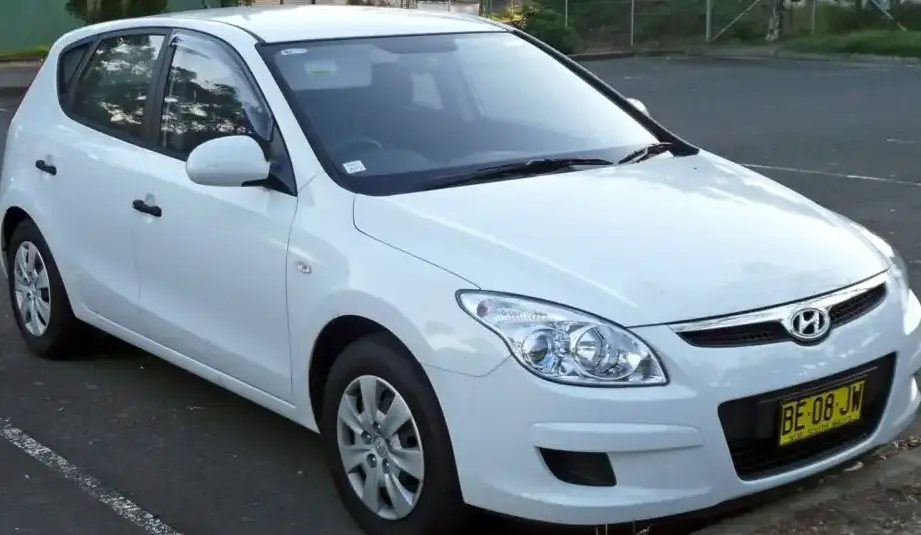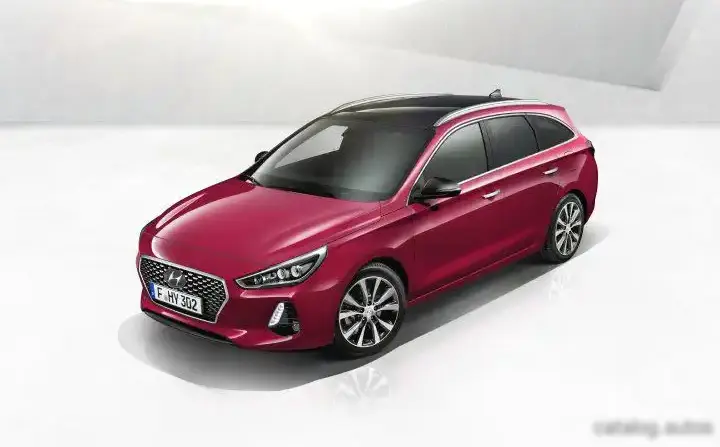
The Hyundai i30 III CW 1.4 (100 hp) is a compact station wagon (estate) that was produced between 2017 and 2019. Part of the third generation of the i30 (codenamed PD), the CW variant – denoting “Combined Wagon” – offered increased practicality and cargo space compared to the five-door hatchback. This particular engine and transmission combination represented an entry-level offering within the i30 CW lineup, aimed at buyers prioritizing fuel efficiency and affordability over outright performance. It was primarily sold in European markets, where the station wagon body style remains popular.
Technical Specifications
| Brand | Hyundai |
| Model | i30 |
| Generation | i30 III CW |
| Type (Engine) | 1.4 (100 Hp) |
| Start of production | 2017 |
| End of production | 2019 |
| Powertrain Architecture | Internal Combustion engine |
| Body type | Station wagon (estate) |
| Seats | 5 |
| Doors | 5 |
| Fuel consumption (urban) | 6.9-7.0 l/100 km (34.1 – 33.6 US mpg, 40.9 – 40.4 UK mpg, 14.5 – 14.3 km/l) |
| Fuel consumption (extra urban) | 4.9-5.1 l/100 km (48 – 46.1 US mpg, 57.6 – 55.4 UK mpg, 20.4 – 19.6 km/l) |
| Fuel consumption (combined) | 5.6-5.8 l/100 km (42 – 40.6 US mpg, 50.4 – 48.7 UK mpg, 17.9 – 17.2 km/l) |
| CO2 emissions | 131-136 g/km |
| Fuel Type | Petrol (Gasoline) |
| Acceleration 0 – 100 km/h | 12.9 sec |
| Acceleration 0 – 62 mph | 12.9 sec |
| Acceleration 0 – 60 mph | 12.3 sec |
| Maximum speed | 181 km/h (112.47 mph) |
| Emission standard | Euro 6c |
| Weight-to-power ratio | 12.1 kg/Hp, 82.6 Hp/tonne |
| Weight-to-torque ratio | 9 kg/Nm, 110.7 Nm/tonne |
| Power | 100 Hp @ 6000 rpm |
| Power per litre | 73.1 Hp/l |
| Torque | 134 Nm @ 4000 rpm (98.83 lb.-ft. @ 4000 rpm) |
| Engine layout | Front, Transverse |
| Engine Model/Code | Kappa / G4LC |
| Engine displacement | 1368 cm3 (83.48 cu. in.) |
| Number of cylinders | 4 |
| Engine configuration | Inline |
| Cylinder Bore | 72 mm (2.83 in.) |
| Piston Stroke | 84 mm (3.31 in.) |
| Compression ratio | 10.5:1 |
| Number of valves per cylinder | 4 |
| Fuel injection system | Multi-port manifold injection |
| Engine aspiration | Naturally aspirated engine |
| Engine oil capacity | 3.6 l (3.8 US qt | 3.17 UK qt) |
| Coolant | 5.8 l (6.13 US qt | 5.1 UK qt) |
| Kerb Weight | 1210-1447 kg (2667.59 – 3190.09 lbs.) |
| Max. weight | 1800 kg (3968.32 lbs.) |
| Max load | 353-590 kg (778.23 – 1300.73 lbs.) |
| Trunk (boot) space – minimum | 602 l (21.26 cu. ft.) |
| Trunk (boot) space – maximum | 1650 l (58.27 cu. ft.) |
| Fuel tank capacity | 50 l (13.21 US gal | 11 UK gal) |
| Max. roof load | 80 kg (176.37 lbs.) |
| Permitted trailer load with brakes (12%) | 1200 kg (2645.55 lbs.) |
| Permitted towbar download | 80 kg (176.37 lbs.) |
| Length | 4585 mm (180.51 in.) |
| Width | 1795 mm (70.67 in.) |
| Height | 1465-1475 mm (57.68 – 58.07 in.) |
| Wheelbase | 2650 mm (104.33 in.) |
| Front track | 1573-1559 mm (61.93 – 61.38 in.) |
| Rear (Back) track | 1581-1567 mm (62.24 – 61.69 in.) |
| Front overhang | 905 mm (35.63 in.) |
| Rear overhang | 1030 mm (40.55 in.) |
| Ride height (ground clearance) | 140 mm (5.51 in.) |
| Drivetrain Architecture | The Internal combustion engine (ICE) drives the front wheels of the vehicle. |
| Drive wheel | Front wheel drive |
| Number of gears and type of gearbox | 6 gears, manual transmission |
| Front suspension | Independent type McPherson |
| Rear suspension | Independent multi-link suspension |
| Front brakes | Ventilated discs |
| Rear brakes | Disc |
| Assisting systems | ABS (Anti-lock braking system) |
| Steering type | Steering rack and pinion |
| Power steering | Electric Steering |
| Tires size | 195/65 R15; 205/55 R16; 225/45 R17 |
| Wheel rims size | 6.0J x 15; 6.5J x 16; 7.0J x 17 |
Powertrain & Engine Architecture
The i30 CW 1.4 utilizes Hyundai’s Kappa generation 1.4-liter inline-four cylinder engine, internally designated as the G4LC. This engine is a naturally aspirated unit, meaning it does not employ turbocharging or supercharging. It features multi-point fuel injection and a dual overhead camshaft (DOHC) valvetrain with four valves per cylinder. The engine produces 100 horsepower at 6,000 rpm and 134 Nm (98.83 lb-ft) of torque at 4,000 rpm. The engine’s design prioritizes fuel efficiency and smooth operation over high performance. The engine is transversely mounted at the front of the vehicle, driving the front wheels. The standard transmission for this variant was a six-speed manual gearbox, although a six-speed automatic transmission was also available as an option. The automatic transmission was a conventional torque converter type, chosen for its smoothness and affordability.
Driving Characteristics
The 1.4-liter engine, paired with the manual transmission, provided adequate, but not exhilarating, performance. Acceleration from 0 to 60 mph took approximately 12.3 seconds, and the top speed was around 112 mph. The engine felt relatively strained during hard acceleration or when carrying a full load. The six-speed manual transmission helped to keep the engine in its optimal power band, but the overall driving experience was geared towards comfort and economy rather than sporty handling. Compared to the more powerful 1.6-liter gasoline or 1.6-liter diesel options available in the i30 CW range, the 1.4-liter felt noticeably slower. However, it offered a lighter steering feel and a more forgiving ride, making it well-suited for urban driving and long highway journeys.
Equipment & Trim Levels
The i30 CW 1.4 typically came equipped with a reasonable level of standard features. These included air conditioning, power windows, central locking, a basic audio system with USB connectivity, and stability control. Higher trim levels, such as SE Nav or Premium, added features like alloy wheels, a touchscreen infotainment system with navigation, rear parking sensors, and cruise control. Interior upholstery was typically cloth, with options for upgraded materials on higher trims. The dashboard layout was functional and straightforward, with a focus on ease of use.
Chassis & Braking
The i30 CW featured independent suspension all around, with a McPherson strut setup at the front and a multi-link system at the rear. This provided a comfortable ride and decent handling characteristics. The front brakes were ventilated discs, while the rear brakes were solid discs. ABS (Anti-lock Braking System) was standard. The suspension was tuned for comfort, prioritizing ride quality over sharp handling. Stabilizer bars were fitted to both the front and rear axles to reduce body roll during cornering.
Market Reception & Comparison
The i30 CW 1.4 was generally well-received by automotive critics as a practical and affordable family car. It was praised for its spacious interior, comfortable ride, and good fuel economy. However, some reviewers criticized its lack of power and somewhat uninspiring driving dynamics. Compared to rivals like the Volkswagen Golf Estate or Ford Focus Estate, the i30 CW offered a competitive price point and a longer warranty, but lacked the brand prestige and driving refinement of its European competitors. Fuel economy was a strong point, with combined figures ranging from 40 to 48 mpg, making it an attractive option for budget-conscious buyers.
Legacy
The Hyundai i30 CW 1.4 has proven to be a relatively reliable vehicle in the used car market. The Kappa 1.4-liter engine is known for its durability, and the six-speed manual transmission is generally trouble-free. Common issues are typically limited to wear-and-tear items such as brakes, suspension components, and exhaust systems. The i30 CW 1.4 remains a popular choice for buyers seeking an affordable and practical station wagon, offering a good balance of space, economy, and reliability.