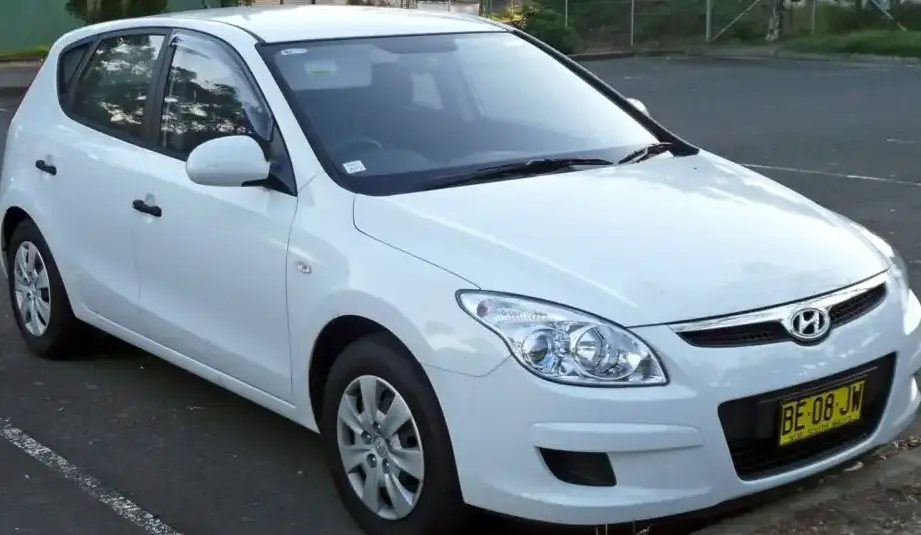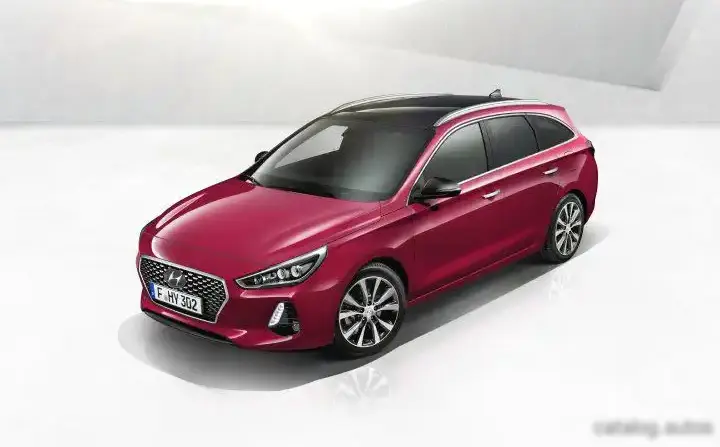
The Hyundai i30 III CW 1.6 CRDi (136 Hp) is a compact station wagon (estate) produced by the South Korean manufacturer Hyundai from 2017 to 2019. Part of the third generation (PD) i30 family, the CW designation specifically denotes the wagon body style. This variant occupied a middle ground within the i30 lineup, offering a balance between fuel efficiency, practicality, and reasonable performance. It was primarily aimed at European markets where the station wagon body style remains popular, providing a versatile option for families and individuals needing increased cargo capacity. The i30 PD series represented a significant step forward for Hyundai in terms of design, build quality, and technology, aiming to compete directly with established European rivals like the Volkswagen Golf and Ford Focus.
Technical Specifications
| Brand | Hyundai |
| Model | i30 |
| Generation | i30 III CW |
| Type (Engine) | 1.6 CRDi (136 Hp) |
| Start of production | 2017 |
| End of production | 2019 |
| Powertrain Architecture | Internal Combustion engine |
| Body type | Station wagon (estate) |
| Seats | 5 |
| Doors | 5 |
| Fuel consumption (urban) | 4.2-4.3 l/100 km (56 – 54.7 US mpg) |
| Fuel consumption (extra urban) | 3.6-3.7 l/100 km (65.3 – 63.6 US mpg) |
| Fuel consumption (combined) | 3.8-3.9 l/100 km (61.9 – 60.3 US mpg) |
| CO2 emissions | 99-102 g/km |
| Fuel Type | Diesel |
| Acceleration 0 – 100 km/h | 10.5 sec |
| Acceleration 0 – 62 mph | 10.5 sec |
| Acceleration 0 – 60 mph | 10 sec |
| Maximum speed | 198 km/h (123.03 mph) |
| Emission standard | Euro 6a |
| Weight-to-power ratio | 9.6 kg/Hp, 103.8 Hp/tonne |
| Weight-to-torque ratio | 4.7 kg/Nm, 213.7 Nm/tonne |
| Power | 136 Hp @ 4000 rpm |
| Power per litre | 86 Hp/l |
| Torque | 280 Nm @ 1500-3000 rpm (206.52 lb.-ft. @ 1500-3000 rpm) |
| Engine layout | Front, Transverse |
| Engine Model/Code | D4FB |
| Engine displacement | 1582 cm3 (96.54 cu. in.) |
| Number of cylinders | 4 |
| Engine configuration | Inline |
| Cylinder Bore | 77.2 mm (3.04 in.) |
| Piston Stroke | 84.5 mm (3.33 in.) |
| Compression ratio | 16:1 |
| Number of valves per cylinder | 4 |
| Fuel injection system | Diesel Commonrail |
| Engine aspiration | Turbocharger, Intercooler |
| Engine oil capacity | 5.3 l (5.6 US qt | 4.66 UK qt) |
| Coolant | 6.7 l (7.08 US qt | 5.9 UK qt) |
| Kerb Weight | 1310-1548 kg (2888.06 – 3412.76 lbs.) |
| Max. weight | 1900 kg (4188.78 lbs.) |
| Max load | 352-590 kg (776.03 – 1300.73 lbs.) |
| Trunk (boot) space – minimum | 602 l (21.26 cu. ft.) |
| Trunk (boot) space – maximum | 1650 l (58.27 cu. ft.) |
| Fuel tank capacity | 50 l (13.21 US gal | 11 UK gal) |
| Max. roof load | 80 kg (176.37 lbs.) |
| Permitted trailer load with brakes (12%) | 1500 kg (3306.93 lbs.) |
| Permitted towbar download | 80 kg (176.37 lbs.) |
| Length | 4585 mm (180.51 in.) |
| Width | 1795 mm (70.67 in.) |
| Height | 1465-1475 mm (57.68 – 58.07 in.) |
| Wheelbase | 2650 mm (104.33 in.) |
| Front track | 1573-1559 mm (61.93 – 61.38 in.) |
| Rear (Back) track | 1581-1567 mm (62.24 – 61.69 in.) |
| Front overhang | 905 mm (35.63 in.) |
| Rear overhang | 1030 mm (40.55 in.) |
| Ride height (ground clearance) | 140 mm (5.51 in.) |
| Drivetrain Architecture | The Internal combustion engine (ICE) drives the front wheels of the vehicle. |
| Drive wheel | Front wheel drive |
| Number of gears and type of gearbox | 6 gears, manual transmission |
| Front suspension | Independent type McPherson |
| Rear suspension | Independent multi-link suspension |
| Front brakes | Ventilated discs |
| Rear brakes | Disc |
| Assisting systems | ABS (Anti-lock braking system) |
| Steering type | Steering rack and pinion |
| Power steering | Electric Steering |
| Tires size | 195/65 R15; 205/55 R16; 225/45 R17 |
| Wheel rims size | 6J x 15; 6.5J x 16; 7J x 17 |
INTRODUCTION
The Hyundai i30 III CW 1.6 CRDi (136 Hp) represents a practical and efficient option within the third-generation i30 range. Introduced in 2017 and continuing through 2019, this station wagon variant was designed to appeal to buyers seeking a versatile vehicle with good fuel economy. It builds upon the foundation of the i30 III (PD) platform, which brought improvements in ride quality, interior refinement, and safety features compared to its predecessors. The 1.6 CRDi engine, paired with a manual transmission, was a popular choice in Europe, offering a balance between performance and running costs. This specific configuration positioned itself as a mid-range offering, slotting between the lower-powered diesel variants and the more potent gasoline engines.
Powertrain & Engine Architecture
The heart of the i30 III CW 1.6 CRDi is the D4FB engine, a 1.6-liter inline-four cylinder diesel engine. This engine utilizes a second-generation common-rail direct injection system, delivering fuel at extremely high pressure for improved combustion efficiency and reduced emissions. The D4FB engine features a turbocharger with an intercooler, which enhances power output by forcing more air into the cylinders. The engine produces 136 horsepower at 4,000 rpm and 280 Nm (206.52 lb-ft) of torque between 1,500 and 3,000 rpm. The six-speed manual transmission provides smooth gear changes and contributes to the vehicle’s overall fuel efficiency. The engine’s architecture is designed for durability and reliability, incorporating features like a cast iron block and aluminum cylinder head. The engine also includes a diesel particulate filter (DPF) to reduce harmful emissions, meeting Euro 6a standards.
Driving Characteristics
The 1.6 CRDi engine, while not exceptionally powerful, provides adequate performance for everyday driving. Acceleration from 0 to 100 km/h (0-62 mph) takes approximately 10.5 seconds. The engine’s strong low-end torque makes it well-suited for overtaking maneuvers and navigating hilly terrain. Compared to the higher-output gasoline engines in the i30 range, the 1.6 CRDi prioritizes fuel economy over outright speed. The six-speed manual transmission allows drivers to maintain optimal engine speed for efficiency or performance. The gear ratios are well-matched to the engine’s torque curve, providing responsive acceleration in most driving situations. The wagon body style does add some weight compared to the hatchback version, slightly impacting acceleration and handling, but the independent suspension system helps to maintain a comfortable and controlled ride.
Equipment & Trim Levels
The i30 III CW 1.6 CRDi typically came equipped with a range of standard features, including air conditioning, power windows, power mirrors, a touchscreen infotainment system with Bluetooth connectivity, and a suite of safety features such as ABS, ESC (Electronic Stability Control), and multiple airbags. Higher trim levels offered additional features like alloy wheels, a rearview camera, parking sensors, a larger touchscreen display, and advanced driver-assistance systems (ADAS) such as lane departure warning and automatic emergency braking. Interior upholstery was typically cloth, with options for leather upgrades on higher trims. Dashboard configuration was modern and functional, with a focus on ergonomics and ease of use. Optional extras included a panoramic sunroof, heated seats, and a premium sound system.
Chassis & Braking
The i30 III CW features a McPherson strut front suspension and a multi-link rear suspension, providing a comfortable and stable ride. The suspension is tuned to balance handling and comfort, making it suitable for both city driving and long-distance journeys. The braking system consists of ventilated discs on the front wheels and solid discs on the rear wheels. ABS (Anti-lock Braking System) is standard, enhancing braking performance and stability in emergency situations. The steering is electrically assisted, providing light and precise steering feel. The chassis is designed to minimize noise, vibration, and harshness (NVH), contributing to a refined driving experience.
Market Reception & Comparison
The Hyundai i30 III CW 1.6 CRDi was generally well-received by automotive critics, who praised its fuel efficiency, practicality, and comfortable ride. It was often compared to rivals such as the Volkswagen Golf Estate, Ford Focus Estate, and Skoda Octavia Combi. The i30 offered a competitive price point and a generous warranty, making it an attractive option for budget-conscious buyers. Compared to the gasoline-powered i30 variants, the 1.6 CRDi offered significantly better fuel economy, making it a popular choice for drivers covering long distances. However, some critics noted that the diesel engine was slightly noisier than the gasoline engines and that the performance was not as exhilarating. Reliability reports generally indicate that the D4FB engine is a durable and dependable unit, although regular maintenance is essential to ensure optimal performance and longevity.
Legacy
The Hyundai i30 III CW 1.6 CRDi has established itself as a reliable and practical used car option. The D4FB engine, while requiring regular servicing (including DPF maintenance), is known for its longevity. The availability of spare parts is good, and maintenance costs are generally reasonable. The i30 CW’s spacious interior and large cargo area continue to appeal to families and individuals needing a versatile vehicle. As a representative of Hyundai’s increasing focus on quality and refinement, the i30 III CW 1.6 CRDi represents a significant step forward for the brand and remains a popular choice in the used car market today.