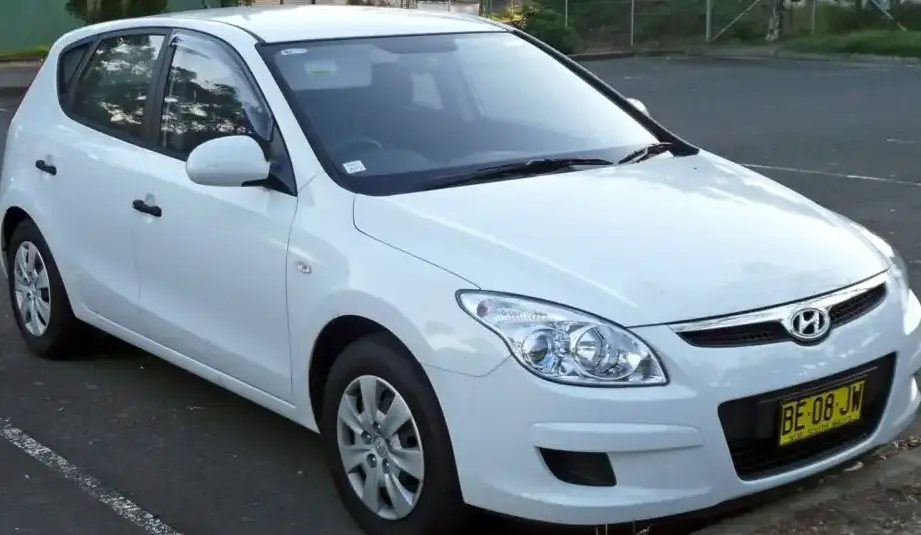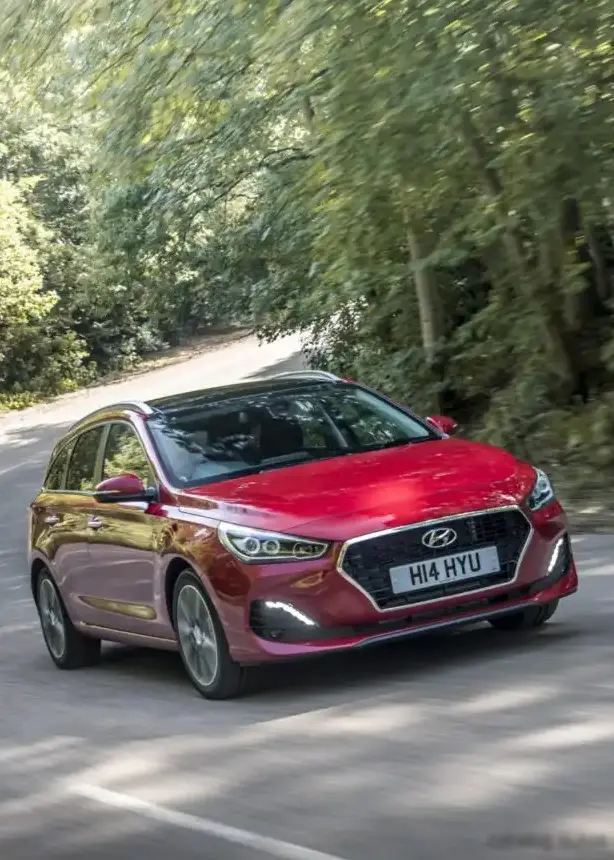
The Hyundai i30 III CW (facelift 2019) 1.6 CRDi 115 hp represents a specific configuration within the third generation of Hyundai’s popular i30 compact family vehicle. Introduced as part of the facelift in 2019 and continuing through 2020, this variant combined a diesel engine with an automatic transmission, offering a blend of fuel efficiency and convenience aimed at the European market. The “CW” designation signifies the station wagon (estate) body style, providing increased cargo capacity compared to the hatchback version. This model occupied a mid-range position in the i30 lineup, appealing to buyers prioritizing practicality and running costs over outright performance.
Technical Specifications
| Brand | Hyundai |
| Model | i30 |
| Generation | i30 III CW (facelift 2019) |
| Type (Engine) | 1.6 CRDi (115 Hp) |
| Start of production | 2019 |
| End of production | 2020 |
| Powertrain Architecture | Internal Combustion engine |
| Body type | Station wagon (estate) |
| Seats | 5 |
| Doors | 5 |
| Fuel consumption (urban) | 4.7 l/100 km (50 US mpg, 60.1 UK mpg, 21.3 km/l) |
| Fuel consumption (extra urban) | 4 l/100 km (58.8 US mpg, 70.6 UK mpg, 25 km/l) |
| Fuel consumption (combined) | 4.3 l/100 km (54.7 US mpg, 65.7 UK mpg, 23.3 km/l) |
| CO2 emissions | 112 g/km |
| Fuel Type | Diesel |
| Acceleration 0 – 100 km/h | 11.1 sec |
| Acceleration 0 – 62 mph | 11.1 sec |
| Acceleration 0 – 60 mph | 10.5 sec |
| Maximum speed | 192 km/h (119.3 mph) |
| Emission standard | Euro 6d – TEMP |
| Weight-to-power ratio | 11.7 kg/Hp, 85.8 Hp/tonne |
| Weight-to-torque ratio | 4.8 kg/Nm, 209 Nm/tonne |
| Power | 115 Hp @ 4000 rpm |
| Power per litre | 72 Hp/l |
| Torque | 280 Nm @ 1500-2750 rpm (206.52 lb.-ft. @ 1500-2750 rpm) |
| Engine layout | Front, Transverse |
| Engine Model/Code | D4FE |
| Engine displacement | 1598 cm3 (97.52 cu. in.) |
| Number of cylinders | 4 |
| Engine configuration | Inline |
| Cylinder Bore | 77 mm (3.03 in.) |
| Piston Stroke | 85.8 mm (3.38 in.) |
| Number of valves per cylinder | 4 |
| Fuel injection system | Diesel Commonrail |
| Engine aspiration | Turbocharger, Intercooler |
| Engine oil capacity | 4.4 l (4.65 US qt | 3.87 UK qt) |
| Coolant | 7.3 l (7.71 US qt | 6.42 UK qt) |
| Kerb Weight | 1340-1495 kg (2954.19 – 3295.91 lbs.) |
| Max. weight | 1920 kg (4232.88 lbs.) |
| Max load | 425-580 kg (936.96 – 1278.68 lbs.) |
| Trunk (boot) space – minimum | 602 l (21.26 cu. ft.) |
| Trunk (boot) space – maximum | 1650 l (58.27 cu. ft.) |
| Fuel tank capacity | 50 l (13.21 US gal | 11 UK gal) |
| Max. roof load | 80 kg (176.37 lbs.) |
| Permitted trailer load with brakes (12%) | 1500 kg (3306.93 lbs.) |
| Permitted trailer load without brakes | 650 kg (1433 lbs.) |
| Permitted towbar download | 80 kg (176.37 lbs.) |
| Length | 4585 mm (180.51 in.) |
| Width | 1795 mm (70.67 in.) |
| Height | 1475 mm (58.07 in.) |
| Wheelbase | 2650 mm (104.33 in.) |
| Front track | 1559-1573 mm (61.38 – 61.93 in.) |
| Rear (Back) track | 1567-1581 mm (61.69 – 62.24 in.) |
| Front overhang | 905 mm (35.63 in.) |
| Rear overhang | 1030 mm (40.55 in.) |
| Ride height (ground clearance) | 140 mm (5.51 in.) |
| Drivetrain Architecture | The Internal combustion engine (ICE) drives the front wheels of the vehicle. |
| Drive wheel | Front wheel drive |
| Number of gears and type of gearbox | 6 gears, manual transmission |
| Front brakes | Ventilated discs |
| Rear brakes | Disc |
| Assisting systems | ABS (Anti-lock braking system) |
| Steering type | Steering rack and pinion |
| Power steering | Electric Steering |
INTRODUCTION
The Hyundai i30 III CW (facelift 2019) 1.6 CRDi 115 hp is a front-wheel-drive, five-door station wagon that formed part of Hyundai’s strategy to offer a comprehensive range of compact vehicles in the European market. The third-generation i30, built on the PQ35 (or 1HX0/A3) platform, received a significant facelift in 2019, bringing updated styling, improved technology, and refined engine options. This particular variant, powered by the 1.6-liter CRDi diesel engine producing 115 horsepower, was designed to appeal to buyers seeking fuel efficiency and practicality in a family vehicle. It sat below the more powerful diesel options and the gasoline-powered variants in the i30 lineup.
Powertrain & Engine Architecture
The heart of this i30 variant is the D4FE 1.6-liter inline-four cylinder diesel engine. This engine utilizes a second-generation common rail direct injection system, delivering fuel directly into the combustion chamber at extremely high pressure for improved efficiency and reduced emissions. The engine is turbocharged with a variable geometry turbocharger (VGT) and intercooled, enhancing torque output across a broad RPM range. The 115 hp output is achieved at 4000 rpm, while the peak torque of 280 Nm (206.52 lb.-ft.) is available between 1500 and 2750 rpm. This broad torque curve contributes to good drivability in everyday conditions. The engine also incorporates a diesel particulate filter (DPF) to meet stringent Euro 6d-TEMP emission standards. The engine is paired with a six-speed automatic transmission, offering smooth gear changes and convenience for the driver. This transmission is a conventional torque converter automatic, prioritizing comfort over outright performance.
Driving Characteristics
The 1.6 CRDi 115 hp automatic i30 CW delivers a comfortable and relaxed driving experience. Acceleration from 0 to 100 km/h (0-62 mph) takes around 11.1 seconds, which is adequate for everyday driving but doesn’t offer particularly sporty performance. The automatic transmission is tuned for fuel efficiency, meaning it will upshift quickly to maintain lower engine speeds. This can sometimes result in the engine feeling slightly strained when accelerating or climbing hills. Compared to the manual transmission version of the same engine, the automatic offers less driver engagement but greater ease of use, especially in urban traffic. Compared to the higher-output diesel variants (like the 136 hp version), this 115 hp model provides less outright power but offers improved fuel economy. The suspension is tuned for comfort, absorbing bumps and imperfections in the road well, although it doesn’t provide the same level of handling precision as some of its rivals.
Equipment & Trim Levels
The i30 III CW 1.6 CRDi 115 hp typically came equipped with a reasonable level of standard features. These generally included air conditioning, electric front and rear windows, a touchscreen infotainment system with Bluetooth connectivity, and a suite of safety features such as ABS, ESC (Electronic Stability Control), and multiple airbags. Higher trim levels offered additional features such as alloy wheels, a rear parking sensor, a reversing camera, a larger touchscreen display with navigation, and climate control. Interior upholstery was typically cloth, with options for leather upgrades on higher trims. The dashboard layout was functional and user-friendly, with a focus on ergonomics.
Chassis & Braking
The i30 CW utilizes a MacPherson strut front suspension and a multi-link rear suspension, providing a good balance between ride comfort and handling. The front brakes are ventilated discs, while the rear brakes are solid discs. ABS (Anti-lock Braking System) is standard, along with ESC (Electronic Stability Control) to help maintain control in challenging driving conditions. The steering is electrically assisted, providing light and precise steering feel. Stabilizer bars are fitted to both the front and rear axles to reduce body roll during cornering.
Market Reception & Comparison
The Hyundai i30 III CW 1.6 CRDi 115 hp was generally well-received by automotive critics as a practical and fuel-efficient family vehicle. It was praised for its spacious interior, comfortable ride, and competitive pricing. However, some critics noted that the engine could feel underpowered at times, particularly when fully loaded. Compared to rivals such as the Volkswagen Golf Estate, Ford Focus Estate, and Skoda Octavia Estate, the i30 offered a strong value proposition, with a generous level of standard equipment and a long warranty. Fuel economy was a key strength, with combined fuel consumption figures of around 4.3 l/100 km (54.7 US mpg) making it an attractive option for high-mileage drivers.
Legacy
The 1.6 CRDi engine, in various iterations, proved to be a reliable and durable powertrain. While diesel engines, in general, have faced increased scrutiny in recent years due to emissions concerns, the D4FE engine has a relatively good reputation for longevity. In the used car market, the i30 CW 1.6 CRDi 115 hp represents a sensible and affordable option for buyers seeking a practical and fuel-efficient estate car. Regular maintenance, including timely servicing and DPF regeneration, is crucial to ensure the continued reliability of this powertrain. The i30 CW, in general, helped Hyundai solidify its position as a major player in the European compact car market, offering a compelling alternative to established brands.