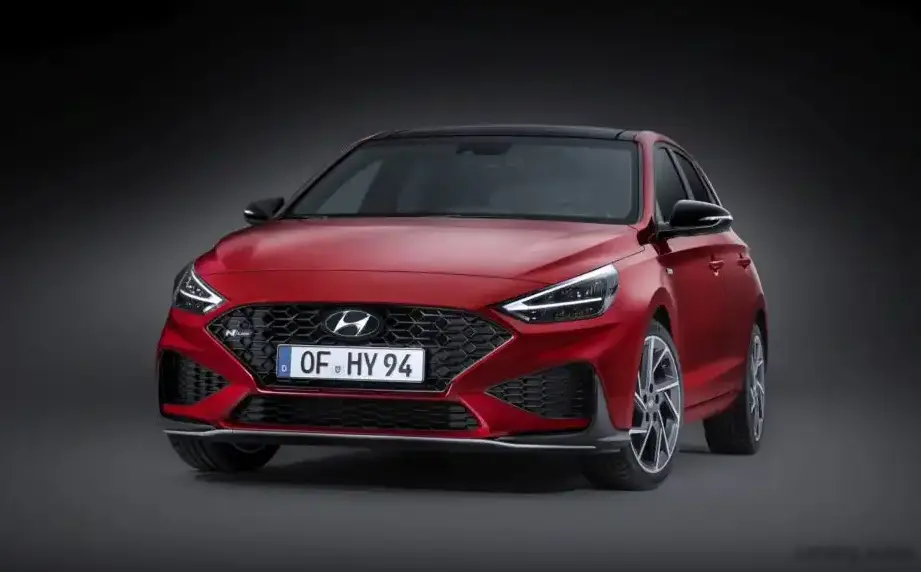
The Hyundai i30 III (facelift, introduced in May 2020) 1.0 T-GDi 120 hp Mild Hybrid represents a key offering within Hyundai’s compact hatchback range. Positioned as an entry-level to mid-range trim, this variant aimed to balance fuel efficiency with reasonable performance, appealing to buyers seeking a practical and economical daily driver. Production continued through June 2024. This model falls within the third generation of the i30 (codenamed PD), benefitting from the 2020 facelift which brought styling updates and revised technology. The i30 competes directly with vehicles like the Volkswagen Golf, Ford Focus, and Opel Astra in the European market, where it’s primarily sold.
Technical Specifications
| Brand | Hyundai |
| Model | i30 |
| Generation | i30 III (facelift 2020) |
| Type (Engine) | 1.0 T-GDi (120 Hp) Mild Hybrid |
| Start of production | May, 2020 |
| End of production | June, 2024 |
| Powertrain Architecture | MHEV (Mild Hybrid Electric Vehicle) |
| Body type | Hatchback |
| Seats | 5 |
| Doors | 5 |
| Fuel Type | Petrol (Gasoline) |
| Acceleration 0 – 100 km/h | 11.2 sec |
| Acceleration 0 – 62 mph | 11.2 sec |
| Acceleration 0 – 60 mph | 10.6 sec |
| Maximum speed | 196 km/h (121.79 mph) |
| Emission standard | EURO 6d |
| Weight-to-power ratio | 10.1 kg/Hp |
| Weight-to-torque ratio | 7.1 kg/Nm |
| Power | 120 Hp @ 6000 rpm |
| Torque | 172 Nm @ 1500-4000 rpm (126.86 lb.-ft. @ 1500-4000 rpm) |
| Engine layout | Front, Transverse |
| Engine Model/Code | Kappa II / G3LC |
| Engine displacement | 998 cm3 (60.9 cu. in.) |
| Number of cylinders | 3 |
| Engine configuration | Inline |
| Number of valves per cylinder | 4 |
| Fuel injection system | Direct injection |
| Engine aspiration | Turbocharger, Intercooler |
| Engine oil capacity | 3.6 l (3.8 US qt | 3.17 UK qt) |
| Coolant capacity | 6 l (6.34 US qt | 5.28 UK qt) |
| Kerb Weight | 1216 kg (2680.82 lbs.) |
| Max. weight | 1800 kg (3968.32 lbs.) |
| Max load | 584 kg (1287.5 lbs.) |
| Trunk (boot) space – minimum | 395 l (13.95 cu. ft.) |
| Trunk (boot) space – maximum | 1301 l (45.94 cu. ft.) |
| Max. roof load | 80 kg (176.37 lbs.) |
| Permitted trailer load with brakes (12%) | 1200 kg (2645.55 lbs.) |
| Permitted trailer load without brakes | 600 kg (1322.77 lbs.) |
| Length | 4340 mm (170.87 in.) |
| Width | 1795 mm (70.67 in.) |
| Height | 1455 mm (57.28 in.) |
| Wheelbase | 2650 mm (104.33 in.) |
| Number of gears | 6 |
| Gearbox type | Manual transmission |
Powertrain & Engine Architecture
The heart of the i30 1.0 T-GDi Mild Hybrid is Hyundai’s Kappa II three-cylinder, 1.0-liter turbocharged engine, designated G3LC. This engine utilizes direct fuel injection and a single scroll turbocharger with an intercooler to deliver a balance of power and efficiency. The mild hybrid system incorporates a 48V lithium-ion battery and a belt-driven starter generator (BSG). The BSG allows for features like extended start-stop operation, regenerative braking (capturing energy during deceleration), and a slight power assist during acceleration. This system doesn’t allow for fully electric driving, but it does contribute to improved fuel economy. The engine produces 120 horsepower at 6000 rpm and 172 Nm (126.86 lb-ft) of torque between 1500 and 4000 rpm. The engine is paired with a six-speed manual transmission, delivering power to the front wheels.
Driving Characteristics
The 1.0 T-GDi engine, while offering adequate performance for everyday driving, isn’t designed for outright speed. Acceleration from 0-60 mph takes around 10.6 seconds, and top speed is rated at 196 km/h (121.79 mph). The turbocharger provides a noticeable boost in power, but the three-cylinder engine can feel somewhat strained at higher RPMs. The six-speed manual transmission is well-matched to the engine’s characteristics, offering precise shifts and allowing drivers to keep the engine in its optimal power band. Compared to the more powerful 1.6 T-GDi variants, this engine prioritizes fuel economy over performance. The mild hybrid system contributes to smoother starts and stops, and the regenerative braking helps to reduce fuel consumption in urban environments. The gear ratios are tuned for efficiency, meaning highway cruising is comfortable, but quick overtaking maneuvers require downshifting.
Equipment & Trim Levels
The 1.0 T-GDi Mild Hybrid trim typically included standard features such as air conditioning, a touchscreen infotainment system with Apple CarPlay and Android Auto compatibility, Bluetooth connectivity, and a suite of safety features including lane keeping assist, forward collision avoidance assist, and automatic emergency braking. Higher trim levels added features like a larger touchscreen display, navigation system, heated seats, a rearview camera, and parking sensors. Interior upholstery was typically cloth, with options for leather upgrades on higher trims. Dashboard materials were generally durable plastics, reflecting the car’s price point. Optional extras included a panoramic sunroof, premium audio system, and various styling packages.
Chassis & Braking
The i30 III utilizes a McPherson strut front suspension and an independent multi-link rear suspension. This setup provides a good balance of ride comfort and handling. The suspension is tuned to be relatively compliant, absorbing bumps and imperfections in the road surface effectively. Stabilizer bars are fitted to both the front and rear axles to reduce body roll during cornering. Braking duties are handled by disc brakes on all four wheels, with ABS (Anti-lock Braking System) and Electronic Stability Control (ESC) as standard features. The brake system is adequate for the car’s weight and performance, providing confident stopping power in most driving conditions. The steering is a rack and pinion system, offering precise and responsive steering feel.
Market Reception & Comparison
The Hyundai i30 1.0 T-GDi Mild Hybrid was generally well-received by automotive critics for its fuel efficiency and value for money. Reviewers praised the engine’s responsiveness and the mild hybrid system’s contribution to reduced emissions. However, some critics noted that the engine could feel underpowered, particularly when fully loaded or driving uphill. Compared to the more powerful i30 variants, the 1.0 T-GDi offered significantly better fuel economy, making it an attractive option for drivers prioritizing efficiency. Reliability reports suggest that the Kappa II engine is generally reliable, although regular maintenance is essential. The mild hybrid system has also proven to be relatively trouble-free.
Legacy
The Hyundai i30 1.0 T-GDi Mild Hybrid has established itself as a popular choice in the used car market, particularly for buyers seeking an affordable and economical compact hatchback. The powertrain’s relatively simple design and proven reliability contribute to its appeal. While not a performance-oriented model, it offers a practical and efficient solution for everyday transportation. As Hyundai continues to develop and refine its hybrid and electric vehicle technology, the i30 1.0 T-GDi Mild Hybrid represents an important step in the company’s transition towards a more sustainable future.