Technical Specifications
| Brand | Hyundai |
| Model | i30 |
| Generation | i30 III (facelift 2019) |
| Type (Engine) | 1.6 CRDi (115 Hp) DCT |
| Start of production | 2019 |
| End of production | 2020 |
| Powertrain Architecture | Internal Combustion engine |
| Body type | Hatchback |
| Seats | 5 |
| Doors | 5 |
| Fuel consumption (urban) | 4.4 l/100 km (53.5 US mpg, 64.2 UK mpg, 22.7 km/l) |
| Fuel consumption (extra urban) | 3.9 l/100 km (60.3 US mpg, 72.4 UK mpg, 25.6 km/l) |
| Fuel consumption (combined) | 4.1 l/100 km (57.4 US mpg, 68.9 UK mpg, 24.4 km/l) |
| CO2 emissions | 107 g/km |
| Fuel Type | Diesel |
| Acceleration 0 – 100 km/h | 10.9 sec |
| Acceleration 0 – 62 mph | 10.9 sec |
| Acceleration 0 – 60 mph | 10.4 sec |
| Maximum speed | 192 km/h (119.3 mph) |
| Emission standard | Euro 6d – TEMP |
| Weight-to-power ratio | 11.7 kg/Hp, 85.6 Hp/tonne |
| Weight-to-torque ratio | 4.8 kg/Nm, 208.5 Nm/tonne |
| Power | 115 Hp @ 4000 rpm |
| Power per litre | 72 Hp/l |
| Torque | 280 Nm @ 1500-2750 rpm (206.52 lb.-ft. @ 1500-2750 rpm) |
| Engine layout | Front, Transverse |
| Engine Model/Code | D4FE |
| Engine displacement | 1598 cm3 (97.52 cu. in.) |
| Number of cylinders | 4 |
| Engine configuration | Inline |
| Cylinder Bore | 77 mm (3.03 in.) |
| Piston Stroke | 85.8 mm (3.38 in.) |
| Number of valves per cylinder | 4 |
| Fuel injection system | Diesel Commonrail |
| Engine aspiration | Turbocharger, Intercooler |
| Engine oil capacity | 4.4 l (4.65 US qt | 3.87 UK qt) |
| Coolant capacity | 7.3 l (7.71 US qt | 6.42 UK qt) |
| Kerb Weight | 1343-1491 kg (2960.81 – 3287.09 lbs.) |
| Max. weight | 1910 kg (4210.83 lbs.) |
| Max load | 419-567 kg (923.74 – 1250.02 lbs.) |
| Trunk (boot) space – minimum | 395 l (13.95 cu. ft.) |
| Trunk (boot) space – maximum | 1301 l (45.94 cu. ft.) |
| Fuel tank capacity | 50 l (13.21 US gal | 11 UK gal) |
| Max. roof load | 80 kg (176.37 lbs.) |
| Permitted trailer load with brakes (12%) | 1500 kg (3306.93 lbs.) |
| Permitted trailer load without brakes | 650 kg (1433 lbs.) |
| Permitted towbar download | 80 kg (176.37 lbs.) |
| Length | 4340 mm (170.87 in.) |
| Width | 1795 mm (70.67 in.) |
| Height | 1455 mm (57.28 in.) |
| Wheelbase | 2650 mm (104.33 in.) |
| Front track | 1559-1573 mm (61.38 – 61.93 in.) |
| Rear track | 1567-1581 mm (61.69 – 62.24 in.) |
| Front overhang | 905 mm (35.63 in.) |
| Rear overhang | 785 mm (30.91 in.) |
| Ride height (ground clearance) | 140 mm (5.51 in.) |
| Drivetrain | Front wheel drive |
| Number of gears and type of gearbox | 7 gears, automatic transmission DCT |
| Front brakes | Ventilated discs |
| Rear brakes | Disc |
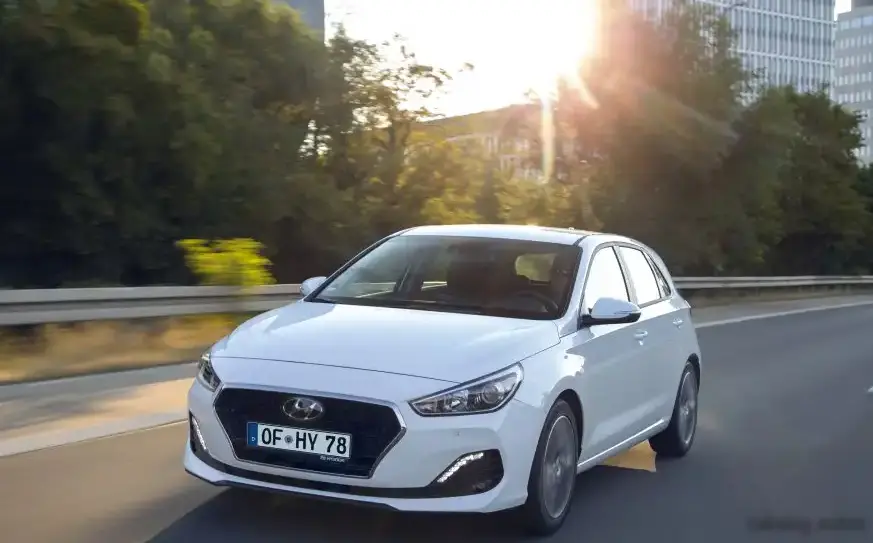
The Hyundai i30 III (facelift, introduced in 2019) 1.6 CRDi 115 horsepower variant with a dual-clutch transmission (DCT) was a significant offering in Hyundai’s European compact hatchback lineup. Positioned as a fuel-efficient and practical option, this model aimed to balance affordability with modern technology. Production of this specific configuration ran from 2019 to 2020, falling within the broader lifespan of the PD generation i30 (introduced in 2017 and facelifted in 2019). The facelift brought styling updates and enhanced equipment levels, solidifying the i30’s position as a competitive player in the crowded C-segment.
Powertrain & Engine Architecture
The heart of this i30 variant is the Hyundai D4FE 1.6-liter four-cylinder diesel engine. This engine utilizes a common-rail direct injection system, delivering fuel at extremely high pressure for optimized combustion. A turbocharger with an intercooler is employed to boost power and torque, providing a relatively responsive driving experience for a small-displacement diesel. The engine produces 115 horsepower at 4,000 rpm and a respectable 280 Nm (206.52 lb-ft) of torque between 1500 and 2750 rpm. This broad torque band is a hallmark of diesel engines, offering strong pulling power at lower engine speeds. The engine also incorporates a diesel particulate filter (DPF) to meet stringent Euro 6d-TEMP emissions standards.
Paired with the D4FE engine is a 7-speed dual-clutch transmission (DCT). DCTs offer faster and smoother gear changes compared to traditional automatic transmissions, contributing to improved fuel efficiency and a more engaging driving experience. The DCT in the i30 is designed for both efficiency and comfort, with programming geared towards smooth upshifts and downshifts in typical driving conditions.
Driving Characteristics
The 1.6 CRDi 115 hp DCT i30 delivers a balanced driving experience. Acceleration from 0 to 100 km/h (0-62 mph) takes approximately 10.9 seconds, which is adequate for everyday driving but doesn’t offer particularly sporty performance. The DCT transmission helps to maximize the available power, providing quick shifts and minimizing power loss during gear changes. Compared to the more powerful 1.6 T-GDI gasoline engine options, the diesel feels less eager to rev, but the abundant low-end torque makes it well-suited for overtaking maneuvers and driving in urban environments. The DCT, while generally smooth, can occasionally exhibit some hesitation at low speeds or during parking maneuvers.
Equipment & Trim Levels
The 1.6 CRDi 115 hp DCT trim typically included a good level of standard equipment. Features commonly found in this variant include air conditioning, a touchscreen infotainment system with Apple CarPlay and Android Auto compatibility, Bluetooth connectivity, and a suite of safety features such as ABS, ESC (Electronic Stability Control), and multiple airbags. Higher trim levels offered additional features like automatic climate control, a larger touchscreen display, a reversing camera, and parking sensors. Interior upholstery was typically cloth, with options for leather upgrades on higher-spec models. Dashboard materials were generally of good quality for the price point, with a focus on practicality and durability.
Chassis & Braking
The i30 III utilizes a MacPherson strut front suspension and a multi-link rear suspension, providing a comfortable and controlled ride. The suspension is tuned to prioritize comfort over outright sportiness, but it still offers decent handling characteristics. Braking duties are handled by ventilated discs at the front and solid discs at the rear. ABS (Anti-lock Braking System) is standard, providing enhanced braking performance and stability in emergency situations. The steering is electrically assisted, offering a light and precise feel.
Market Reception & Comparison
The Hyundai i30 1.6 CRDi 115 hp DCT was generally well-received by automotive critics as a practical and fuel-efficient option. Its strong fuel economy (around 57.4 US mpg combined) was a major selling point, particularly in Europe where diesel fuel was often cheaper than gasoline. Compared to other trims in the i30 lineup, the 1.6 CRDi offered a more economical alternative to the more powerful gasoline engines, but with a slight compromise in performance. Reliability was generally good, although some owners reported issues with the DPF system, a common concern with modern diesel engines.
Legacy
The Hyundai i30 III 1.6 CRDi 115 hp DCT has proven to be a relatively reliable and durable vehicle. On the used car market, these models represent a good value proposition for buyers seeking a fuel-efficient and practical hatchback. The D4FE engine, while not known for being particularly exciting, is generally considered to be robust and long-lasting if properly maintained. Regular servicing, including oil changes and DPF maintenance, is crucial to ensure the longevity of this powertrain. As with any used car, a thorough inspection by a qualified mechanic is recommended before purchase.