Technical Specifications
| Brand | Hyundai |
| Model | i30 |
| Generation | i30 III (facelift 2019) |
| Type (Engine) | 1.6 CRDi (95 Hp) |
| Start of production | 2019 |
| End of production | 2020 |
| Powertrain Architecture | Internal Combustion engine |
| Body type | Hatchback |
| Seats | 5 |
| Doors | 5 |
| Fuel consumption (urban) | 4.4 l/100 km (53.5 US mpg, 64.2 UK mpg, 22.7 km/l) |
| Fuel consumption (extra urban) | 3.7 l/100 km (63.6 US mpg, 76.3 UK mpg, 27 km/l) |
| Fuel consumption (combined) | 3.9 l/100 km (60.3 US mpg, 72.4 UK mpg, 25.6 km/l) |
| CO2 emissions | 104 g/km |
| Fuel Type | Diesel |
| Acceleration 0 – 100 km/h | 11.6 sec |
| Acceleration 0 – 62 mph | 11.6 sec |
| Acceleration 0 – 60 mph | 11 sec |
| Maximum speed | 178 km/h (110.6 mph) |
| Emission standard | Euro 6d – TEMP |
| Weight-to-power ratio | 13.8 kg/Hp, 72.4 Hp/tonne |
| Weight-to-torque ratio | 4.7 kg/Nm, 213.3 Nm/tonne |
| Power | 95 Hp @ 4000 rpm |
| Torque | 280 Nm @ 1500-2250 rpm (206.52 lb.-ft. @ 1500-2250 rpm) |
| Engine layout | Front, Transverse |
| Engine Model/Code | D4FE |
| Engine displacement | 1598 cm3 (97.52 cu. in.) |
| Number of cylinders | 4 |
| Engine configuration | Inline |
| Cylinder Bore | 77 mm (3.03 in.) |
| Piston Stroke | 85.8 mm (3.38 in.) |
| Number of valves per cylinder | 4 |
| Fuel injection system | Diesel Commonrail |
| Engine aspiration | Turbocharger, Intercooler |
| Engine oil capacity | 4.4 l (4.65 US qt | 3.87 UK qt) |
| Coolant capacity | 7.3 l (7.71 US qt | 6.42 UK qt) |
| Kerb Weight | 1313-1461 kg (2894.67 – 3220.95 lbs.) |
| Max. weight | 1880 kg (4144.69 lbs.) |
| Max load | 419-567 kg (923.74 – 1250.02 lbs.) |
| Trunk (boot) space – minimum | 395 l (13.95 cu. ft.) |
| Trunk (boot) space – maximum | 1301 l (45.94 cu. ft.) |
| Fuel tank capacity | 50 l (13.21 US gal | 11 UK gal) |
| Max. roof load | 80 kg (176.37 lbs.) |
| Permitted trailer load with brakes (12%) | 1500 kg (3306.93 lbs.) |
| Permitted trailer load without brakes | 650 kg (1433 lbs.) |
| Permitted towbar download | 80 kg (176.37 lbs.) |
| Length | 4340 mm (170.87 in.) |
| Width | 1795 mm (70.67 in.) |
| Height | 1455 mm (57.28 in.) |
| Wheelbase | 2650 mm (104.33 in.) |
| Front track | 1559-1573 mm (61.38 – 61.93 in.) |
| Rear (Back) track | 1567-1581 mm (61.69 – 62.24 in.) |
| Front overhang | 905 mm (35.63 in.) |
| Rear overhang | 785 mm (30.91 in.) |
| Ride height (ground clearance) | 140 mm (5.51 in.) |
| Drivetrain Architecture | The Internal combustion engine (ICE) drives the front wheels of the vehicle. |
| Drive wheel | Front wheel drive |
| Number of gears and type of gearbox | 6 gears, manual transmission |
| Front brakes | Ventilated discs |
| Rear brakes | Disc |
| Assisting systems | ABS (Anti-lock braking system) |
| Steering type | Steering rack and pinion |
| Power steering | Electric Steering |
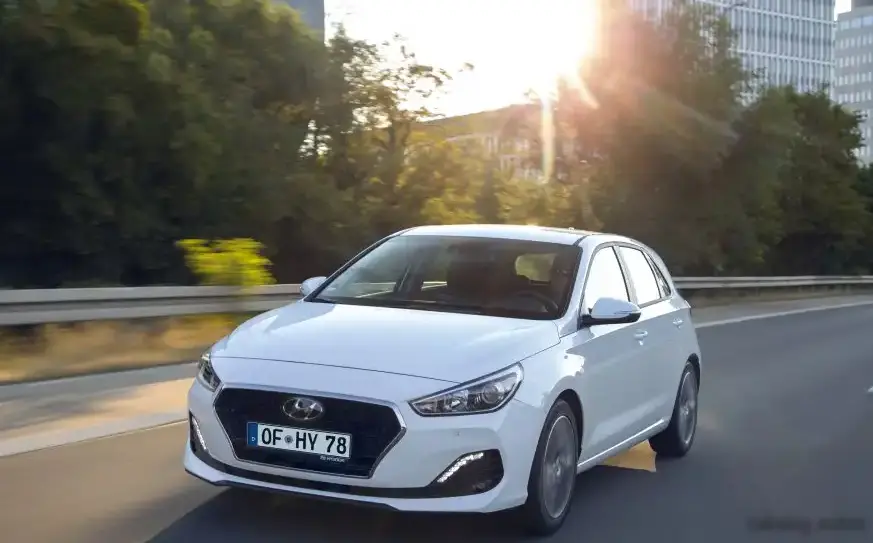
The Hyundai i30 III (facelift, introduced in 2019) 1.6 CRDi 95 hp variant represented an entry-level diesel option within the broader i30 range. Positioned as a fuel-efficient and practical hatchback, it catered to buyers prioritizing economy over outright performance. Production of this specific configuration ran from 2019 to 2020, falling within the lifecycle of the PD (i30 III) generation, which itself was a significant update to the popular i30 model. This facelift brought styling revisions, updated technology, and refinements to the powertrain lineup, including the 1.6 CRDi engine.
Powertrain & Engine Architecture
The heart of this i30 variant is the Hyundai D4FE 1.6-liter inline-four cylinder diesel engine. This engine, a mainstay in several Hyundai and Kia models, utilizes a common-rail direct injection system for optimized fuel delivery and combustion efficiency. The D4FE is a turbocharged engine, employing a variable geometry turbocharger (VGT) to enhance low-end torque and overall responsiveness. The engine’s 95 horsepower peak is reached at 4,000 rpm, while its 280 Nm (206.52 lb-ft) of torque is available from a low 1500-2250 rpm, making it well-suited for everyday driving. The engine also incorporates an intercooler to further improve efficiency by cooling the intake air. The transmission is a six-speed manual, chosen for its fuel efficiency and simplicity. While an automatic transmission was available on other i30 models, it wasn’t offered with this specific 1.6 CRDi 95 hp configuration.
Driving Characteristics
The 1.6 CRDi 95 hp i30 prioritizes fuel economy and usability over sporty performance. Acceleration from 0-100 km/h (0-62 mph) takes around 11.6 seconds, and top speed is rated at 178 km/h (110.6 mph). The engine’s strong low-end torque makes it feel more responsive in city driving and during overtaking maneuvers than its horsepower figure might suggest. However, it does require downshifting for quicker acceleration, especially when fully loaded. Compared to the more powerful 1.6 CRDi variants or the gasoline engines, this version feels noticeably less energetic. The six-speed manual transmission is well-matched to the engine, offering smooth shifts and helping to keep the engine in its optimal torque band. The gear ratios are geared towards maximizing fuel efficiency rather than outright speed.
Equipment & Trim Levels
The 1.6 CRDi 95 hp i30 typically came with a reasonable level of standard equipment, though it was generally positioned as the entry-level diesel option. Standard features often included air conditioning, power windows, central locking, a basic audio system with USB connectivity, and stability control. Interior upholstery was typically cloth, and the dashboard featured a functional but relatively simple design. Optional extras could include alloy wheels, a touchscreen infotainment system with navigation, rear parking sensors, and cruise control. Trim levels varied slightly depending on the market, but this variant generally represented the base level of diesel i30 ownership.
Chassis & Braking
The i30 III utilized a MacPherson strut front suspension and a coupled torsion beam rear suspension. This setup provided a good balance between ride comfort and handling. The front brakes were ventilated discs, while the rear brakes were solid discs. ABS (Anti-lock Braking System) was standard. The suspension tuning was geared towards comfort, resulting in a relatively soft ride quality. Stabilizer bars were fitted front and rear to reduce body roll during cornering, but the overall handling characteristics were more focused on stability and predictability than sporty agility.
Market Reception & Comparison
The 1.6 CRDi 95 hp i30 was generally well-received by critics as a practical and economical choice. Its fuel efficiency was a major selling point, and it offered a good balance of features for its price point. However, some reviewers noted that the engine lacked the punch of the more powerful diesel options. Compared to the 1.6 CRDi 110 hp or 136 hp variants, this version offered lower performance but significantly better fuel economy. It also competed with other small diesel hatchbacks from brands like Volkswagen, Ford, and Peugeot, often offering a competitive price and warranty.
Legacy
The D4FE engine, while not known for being particularly groundbreaking, proved to be a reliable and durable unit when properly maintained. The 1.6 CRDi 95 hp i30 remains a relatively common sight on used car markets. Its fuel efficiency and relatively low running costs continue to appeal to budget-conscious buyers. Potential issues to watch for include diesel particulate filter (DPF) clogging, particularly on vehicles that have primarily been used for short journeys. Overall, this i30 variant represents a sensible and economical choice for those seeking a practical and reliable hatchback.