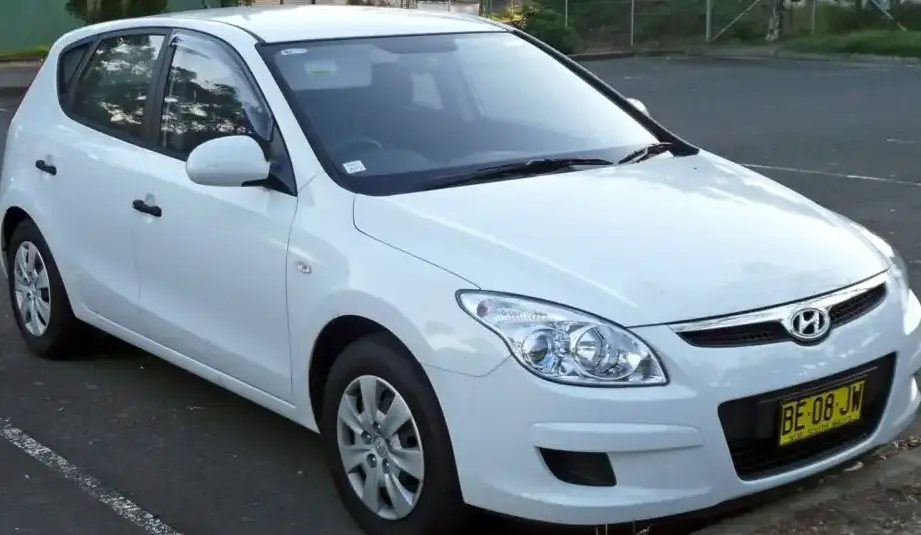
The Hyundai i30 III Fastback, specifically the 1.5 T-GDI (140 hp) Mild Hybrid DCT variant, represents a significant offering in Hyundai’s European and global compact car lineup. Introduced with the facelift in June 2024, this model builds upon the established i30 III platform (codenamed PD) and aims to balance fuel efficiency, performance, and modern technology. Positioned as a mid-range option within the Fastback body style, it caters to buyers seeking a stylish and practical vehicle with a degree of hybrid assistance. The i30 range, since its inception, has been crucial for Hyundai in establishing a stronger foothold in the competitive C-segment, and this variant continues that trend.
Technical Specifications
| Brand | Hyundai |
| Model | i30 |
| Generation | i30 III Fastback (facelift 2024) |
| Type (Engine) | 1.5 T-GDI (140 Hp) Mild Hybrid DCT |
| Start of production | June, 2024 |
| Powertrain Architecture | MHEV (Mild Hybrid Electric Vehicle) |
| Body type | Fastback |
| Seats | 5 |
| Doors | 5 |
| Fuel consumption at Low speed (WLTP) | 8.2 l/100 km (28.7 US mpg) |
| Fuel consumption at Medium speed (WLTP) | 5.9 l/100 km (39.9 US mpg) |
| Fuel consumption at high speed (WLTP) | 5.2 l/100 km (45.2 US mpg) |
| Fuel consumption at very high speed (WLTP) | 6.5 l/100 km (36.2 US mpg) |
| Combined fuel consumption (WLTP) | 6.2 l/100 km (37.9 US mpg) |
| CO2 emissions (WLTP) | 141 g/km |
| Fuel Type | Petrol (Gasoline) |
| Acceleration 0 – 100 km/h | 9.9 sec |
| Acceleration 0 – 62 mph | 9.9 sec |
| Acceleration 0 – 60 mph | 9.4 sec |
| Maximum speed | 197 km/h (122.41 mph) |
| Emission standard | Euro 6e |
| Weight-to-power ratio | 9.5 kg/Hp |
| Weight-to-torque ratio | 5.3 kg/Nm |
| Battery voltage | 48 V |
| Power | 140 Hp @ 5500 rpm |
| Torque | 253 Nm @ 1500-3000 rpm (186.6 lb.-ft.) |
| Engine layout | Front, Transverse |
| Engine Model/Code | G4LK |
| Engine displacement | 1482 cm3 (90.44 cu. in.) |
| Number of cylinders | 4 |
| Engine configuration | Inline |
| Cylinder Bore | 71.6 mm (2.82 in.) |
| Piston Stroke | 92 mm (3.62 in.) |
| Compression ratio | 10.5:1 |
| Number of valves per cylinder | 4 |
| Fuel injection system | Direct injection |
| Engine aspiration | Turbocharger, Intercooler |
| Valvetrain | DOHC |
| Engine oil capacity | 4.2 l (4.44 US qt | 3.7 UK qt) |
| Coolant | 6.6 l (6.97 US qt | 5.81 UK qt) |
| Kerb Weight | 1332-1459 kg (2936.56 – 3216.54 lbs.) |
| Max. weight | 1880 kg (4144.69 lbs.) |
| Max load | 421-548 kg (928.15 – 1208.13 lbs.) |
| Trunk (boot) space – minimum | 450 l (15.89 cu. ft.) |
| Trunk (boot) space – maximum | 1351 l (47.71 cu. ft.) |
| Fuel tank capacity | 50 l (13.21 US gal | 11 UK gal) |
| Max. roof load | 80 kg (176.37 lbs.) |
| Permitted trailer load with brakes (12%) | 1010 kg (2226.67 lbs.) |
| Permitted trailer load without brakes | 510 kg (1124.36 lbs.) |
| Length | 4455 mm (175.39 in.) |
| Width | 1795 mm (70.67 in.) |
| Height | 1425 mm (56.1 in.) |
| Wheelbase | 2650 mm (104.33 in.) |
| Front track | 1555-1565 mm (61.22 – 61.61 in.) |
| Rear (Back) track | 1563-1576 mm (61.54 – 62.05 in.) |
| Front overhang | 905 mm (35.63 in.) |
| Rear overhang | 900 mm (35.43 in.) |
| Ride height (ground clearance) | 135 mm (5.31 in.) |
| Minimum turning circle (turning diameter) | 10.6 m (34.78 ft.) |
| Drivetrain Architecture | ICE and electric motor drive front wheels |
| Drive wheel | Front wheel drive |
| Number of gears and type of gearbox | 7 gears, automatic transmission DCT |
| Front suspension | Independent type McPherson |
| Rear suspension | Independent multi-link suspension |
| Front brakes | Ventilated discs |
| Rear brakes | Disc |
| Tires size | 205/55 R16; 225/45 R17; 225/40 R18 |
| Wheel rims size | 6.5J x 16; 7.0J x 17; 7.5J x 18 |
INTRODUCTION
The Hyundai i30 III Fastback 1.5 T-GDI Mild Hybrid DCT, launched in June 2024 as part of the model’s facelift, is a five-door fastback designed to appeal to drivers seeking a blend of style, efficiency, and technology. It’s built on the i30 III platform, also known as the PD platform, which is shared with other Hyundai and Kia models. This variant specifically targets buyers who prioritize fuel economy and a smoother driving experience, thanks to the integration of a 48V mild hybrid system and a seven-speed dual-clutch transmission (DCT). The Fastback body style offers a more coupe-like silhouette compared to the standard hatchback, aiming for a more premium aesthetic.
Powertrain & Engine Architecture
At the heart of this i30 variant lies the Hyundai G4LK 1.5-liter turbocharged gasoline engine. This engine is part of Hyundai’s “Smartstream” engine family, designed for improved efficiency and reduced emissions. The G4LK utilizes direct injection technology and a single scroll turbocharger with intercooling to deliver 140 horsepower at 5500 rpm and 253 Nm (186.6 lb.-ft.) of torque between 1500 and 3000 rpm. The mild hybrid system incorporates a 48V battery and a belt-driven starter generator (BSG). The BSG allows for extended start-stop operation, regenerative braking to recapture energy, and a small boost during acceleration. The seven-speed DCT provides quick and seamless gear changes, contributing to both performance and fuel efficiency. This transmission is known for its responsiveness and ability to adapt to various driving conditions.
Driving Characteristics
The 1.5 T-GDI Mild Hybrid DCT i30 Fastback offers a comfortable and refined driving experience. The mild hybrid system provides a subtle but noticeable boost during acceleration, while the DCT ensures smooth gear transitions. Acceleration from 0 to 100 km/h (0-62 mph) takes approximately 9.9 seconds. While not a performance-oriented variant, the engine delivers adequate power for everyday driving and highway cruising. The DCT’s gear ratios are tuned for efficiency, prioritizing fuel economy over outright acceleration. Compared to higher-output i30 models, such as those with more powerful gasoline engines, this variant feels less eager to rev, but offers a more relaxed and economical driving experience. The steering is light and precise, making it easy to maneuver in urban environments.
Equipment & Trim Levels
The i30 III Fastback 1.5 T-GDI Mild Hybrid DCT typically comes well-equipped, even in base trim levels. Standard features often include air conditioning, a touchscreen infotainment system with Apple CarPlay and Android Auto compatibility, Bluetooth connectivity, and a suite of safety features such as lane keeping assist, forward collision avoidance assist, and automatic emergency braking. Higher trim levels add features like a larger touchscreen display, navigation system, premium audio system, leather upholstery, heated front seats, and a panoramic sunroof. Interior upholstery is typically cloth in lower trims, with leather options available on higher-spec models. The dashboard layout is modern and driver-focused, with intuitive controls and a clean design.
Chassis & Braking
The i30 Fastback utilizes a McPherson strut front suspension and a multi-link rear suspension, providing a good balance between ride comfort and handling. The suspension is tuned to prioritize comfort, but still offers decent body control in corners. Braking duties are handled by ventilated discs at the front and solid discs at the rear. Anti-lock Braking System (ABS) is standard, along with Electronic Stability Control (ESC) and Traction Control System (TCS). The chassis is designed to be lightweight yet rigid, contributing to improved handling and fuel efficiency. Stabilizer bars are fitted to both the front and rear axles to reduce body roll during cornering.
Market Reception & Comparison
The Hyundai i30 III Fastback 1.5 T-GDI Mild Hybrid DCT has been generally well-received by automotive critics. Reviewers have praised its stylish design, comfortable ride, and fuel-efficient powertrain. Compared to other trims in the i30 lineup, this variant offers a compelling balance between performance and economy. The mild hybrid system helps to reduce fuel consumption and emissions, making it an attractive option for environmentally conscious buyers. Compared to the diesel-powered i30 models, the 1.5 T-GDI offers a smoother and quieter driving experience, although it may not achieve the same level of fuel economy in certain driving conditions. Its main competitors include the Volkswagen Golf, Ford Focus, and Peugeot 308.
Legacy
The Hyundai G4LK engine, coupled with the 7-speed DCT, has proven to be a reliable powertrain in other Hyundai and Kia models. While long-term reliability data for this specific i30 variant is still emerging, the underlying technology has a good track record. The mild hybrid system is relatively simple and less prone to issues compared to more complex full hybrid systems. In the used car market, this i30 variant is expected to hold its value well, thanks to its fuel efficiency, modern features, and Hyundai’s reputation for reliability. The integration of mild hybrid technology positions this model as a forward-thinking option in the compact car segment, and it is likely to remain a popular choice for years to come.