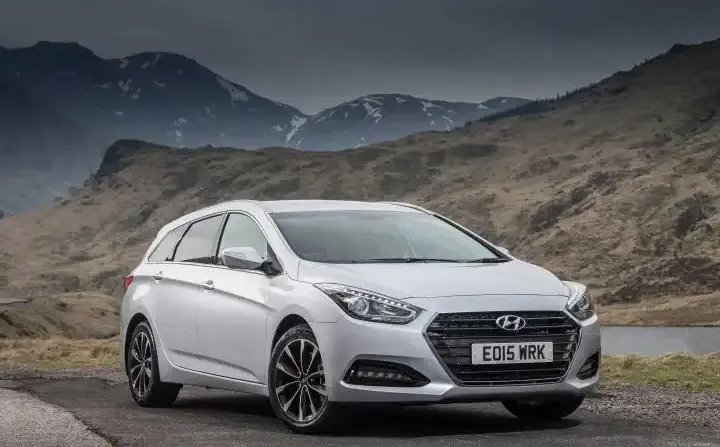
The Hyundai i40 Combi 1.7 CRDi Automatic, produced between 2011 and 2015, represents Hyundai’s entry into the competitive European D-segment station wagon market. Positioned as a practical and well-equipped family vehicle, the i40 Combi aimed to challenge established rivals like the Ford Mondeo, Volkswagen Passat, and Opel/Vauxhall Insignia. This particular variant, powered by the 1.7-liter diesel engine paired with a six-speed automatic transmission, was designed to offer a balance of fuel efficiency and ease of driving, appealing to buyers prioritizing comfort and practicality over outright performance. It was part of the first generation of the i40 (codenamed VF), which was specifically tailored for the European market, differing significantly from the Sonata sold in other regions.
Technical Specifications
| Brand | Hyundai |
| Model | i40 |
| Generation | i40 Combi |
| Type (Engine) | 1.7 CRDi (136 Hp) Automatic |
| Start of production | 2011 |
| End of production | 2015 |
| Powertrain Architecture | Internal Combustion engine |
| Body type | Station wagon (estate) |
| Seats | 5 |
| Doors | 5 |
| Fuel consumption (urban) | 7.6 l/100 km (30.9 US mpg) |
| Fuel consumption (extra urban) | 5.1 l/100 km (46.1 US mpg) |
| Fuel consumption (combined) | 6 l/100 km (39.2 US mpg) |
| Fuel Type | Diesel |
| Acceleration 0 – 100 km/h | 12 sec |
| Acceleration 0 – 62 mph | 12 sec |
| Acceleration 0 – 60 mph | 11.4 sec |
| Maximum speed | 190 km/h (118.06 mph) |
| Emission standard | Euro 5 |
| Weight-to-power ratio | 11.1 kg/Hp |
| Weight-to-torque ratio | 4.7 kg/Nm |
| Power | 136 Hp @ 4000 rpm |
| Torque | 325 Nm @ 2000-2500 rpm (239.71 lb.-ft.) |
| Engine layout | Front, Transverse |
| Engine Model/Code | U II / D4FD |
| Engine displacement | 1685 cm3 (102.83 cu. in.) |
| Number of cylinders | 4 |
| Engine configuration | Inline |
| Cylinder Bore | 77.2 mm (3.04 in.) |
| Piston Stroke | 90 mm (3.54 in.) |
| Compression ratio | 17:1 |
| Number of valves per cylinder | 4 |
| Fuel injection system | Diesel Commonrail |
| Engine aspiration | Turbocharger, Intercooler |
| Valvetrain | DOHC |
| Engine oil capacity | 5.3 l (5.6 US qt | 4.66 UK qt) |
| Coolant capacity | 6.9 l (7.29 US qt | 6.07 UK qt) |
| Kerb Weight | 1514 kg (3337.8 lbs.) |
| Max. weight | 2150 kg (4739.94 lbs.) |
| Max load | 636 kg (1402.14 lbs.) |
| Trunk (boot) space – minimum | 553 l (19.53 cu. ft.) |
| Trunk (boot) space – maximum | 1719 l (60.71 cu. ft.) |
| Fuel tank capacity | 70 l (18.49 US gal | 15.4 UK gal) |
| Length | 4770 mm (187.8 in.) |
| Width | 1815 mm (71.46 in.) |
| Height | 1470 mm (57.87 in.) |
| Wheelbase | 2770 mm (109.06 in.) |
| Front track | 1591 mm (62.64 in.) |
| Rear track | 1597 mm (62.87 in.) |
| Minimum turning circle | 10.94 m (35.89 ft.) |
| Drivetrain | Front wheel drive |
| Number of gears | 6 |
| Gearbox type | Automatic transmission |
| Front suspension | Independent type McPherson |
| Rear suspension | Independent coil spring |
| Front brakes | Ventilated discs |
| Rear brakes | Disc |
| Steering type | Steering rack and pinion |
| Power steering | Electric |
| Tires size | 205/60 R16; 215/50 R17; 225/45 R18 |
| Wheel rims size | 7.0J x 16; 7.5J x 17; 8.0J x 18 |
Powertrain & Engine Architecture
The heart of the i40 Combi 1.7 CRDi Automatic is the U II / D4FD engine, a 1.7-liter inline-four cylinder diesel. This engine utilizes a second-generation common rail direct injection system, delivering fuel at extremely high pressures for optimized combustion. A turbocharger with an intercooler is employed to boost power and torque, mitigating turbo lag and improving responsiveness. The engine features a double overhead camshaft (DOHC) valvetrain with four valves per cylinder, contributing to efficient gas exchange. The compression ratio of 17:1 is typical for a diesel engine, maximizing thermal efficiency. The six-speed automatic transmission, while providing convenience, was not known for particularly rapid shifts compared to some contemporary automatics. It was chosen for its smooth operation and contribution to overall fuel economy.
Driving Characteristics
The 136 horsepower and 239.71 lb-ft of torque offered by the 1.7 CRDi engine provided adequate, but not exhilarating, performance. Acceleration from 0-60 mph took around 11.4 seconds, making it suitable for everyday driving and highway cruising. The automatic transmission, while smooth, did slightly diminish the engine’s potential, as it inherently loses some power through the torque converter. Compared to the more powerful 1.6 GDI gasoline engine or the 1.7 CRDi with a manual transmission, this variant felt less responsive. However, the automatic transmission made it easier to drive in congested urban environments. The gear ratios were tuned for fuel efficiency, prioritizing comfortable cruising over sporty acceleration.
Equipment & Trim Levels
The i40 Combi 1.7 CRDi Automatic typically came with a respectable level of standard equipment. Base models included air conditioning, electric front and rear windows, a radio/CD player with USB connectivity, and alloy wheels. Higher trim levels, such as Style or Premium, added features like leather upholstery, a panoramic sunroof, a touchscreen navigation system, rear parking sensors, and automatic climate control. Safety features included ABS, Electronic Stability Control (ESC), and multiple airbags. Interior upholstery was generally cloth on lower trims, with leather options available on higher-spec models. The dashboard layout was functional and user-friendly, though not particularly luxurious.
Chassis & Braking
The i40 Combi featured an independent McPherson strut suspension at the front and an independent coil spring suspension at the rear, providing a comfortable ride quality. Front brakes were ventilated discs, while rear brakes were solid discs. The steering was electrically assisted, offering a light and easy driving experience. Stabilizer bars were fitted to both the front and rear axles to reduce body roll during cornering. The suspension tuning was geared towards comfort rather than sporty handling, prioritizing a smooth ride over sharp responsiveness.
Market Reception & Comparison
The Hyundai i40 Combi 1.7 CRDi Automatic was generally well-received by automotive critics for its practicality, spacious interior, and competitive pricing. However, some reviewers noted that the engine lacked the refinement and performance of some of its rivals, particularly the Volkswagen Passat and Ford Mondeo. Fuel economy was a strong point, consistently achieving around 39.2 US mpg in combined driving. Compared to the gasoline-powered i40 models, the diesel offered significantly better fuel efficiency, but at the cost of some refinement. Reliability was generally good, though some owners reported minor issues with the automatic transmission.
Legacy
The Hyundai i40 Combi 1.7 CRDi Automatic has proven to be a relatively reliable and durable vehicle in the used car market. The 1.7 CRDi engine, while not the most powerful, is known for its longevity and fuel efficiency. The automatic transmission, while not a performance standout, has generally held up well over time. Today, these vehicles represent a good value proposition for buyers seeking a practical and affordable family station wagon. Parts availability is generally good, and maintenance costs are reasonable. The i40 Combi helped establish Hyundai as a serious contender in the European D-segment, paving the way for future models like the i64.