Technical Specifications
| Brand | Hyundai |
| Model | i40 |
| Generation | i40 Combi |
| Type (Engine) | 2.0 GDI (177 Hp) |
| Start of production | 2011 |
| End of production | 2015 |
| Powertrain Architecture | Internal Combustion engine |
| Body type | Station wagon (estate) |
| Seats | 5 |
| Doors | 5 |
| Fuel consumption (urban) | 9 l/100 km (26.1 US mpg) |
| Fuel consumption (extra urban) | 5.6 l/100 km (42 US mpg) |
| Fuel consumption (combined) | 6.8 l/100 km (34.6 US mpg) |
| Fuel Type | Petrol (Gasoline) |
| Acceleration 0 – 100 km/h | 9.7 sec |
| Acceleration 0 – 62 mph | 9.7 sec |
| Acceleration 0 – 60 mph | 9.2 sec |
| Maximum speed | 210 km/h (130.49 mph) |
| Emission standard | Euro 5 |
| Weight-to-power ratio | 8 kg/Hp |
| Weight-to-torque ratio | 6.7 kg/Nm |
| Power | 177 Hp @ 6500 rpm |
| Torque | 213 Nm @ 4700 rpm (157.1 lb.-ft. @ 4700 rpm) |
| Engine layout | Front, Transverse |
| Engine Model/Code | G4NC |
| Engine displacement | 1999 cm3 (121.99 cu. in.) |
| Number of cylinders | 4 |
| Engine configuration | Inline |
| Cylinder Bore | 81 mm (3.19 in.) |
| Piston Stroke | 97 mm (3.82 in.) |
| Compression ratio | 11.5:1 |
| Number of valves per cylinder | 4 |
| Fuel injection system | Direct injection |
| Engine aspiration | Naturally aspirated engine |
| Valvetrain | D-CVVT |
| Engine oil capacity | 4 l (4.23 US qt | 3.52 UK qt) |
| Coolant capacity | 7.1 l (7.5 US qt | 6.25 UK qt) |
| Kerb Weight | 1420 kg (3130.56 lbs.) |
| Max. weight | 2050 kg (4519.48 lbs.) |
| Max load | 630 kg (1388.91 lbs.) |
| Trunk (boot) space – minimum | 553 l (19.53 cu. ft.) |
| Trunk (boot) space – maximum | 1719 l (60.71 cu. ft.) |
| Fuel tank capacity | 70 l (18.49 US gal | 15.4 UK gal) |
| Length | 4770 mm (187.8 in.) |
| Width | 1815 mm (71.46 in.) |
| Height | 1470 mm (57.87 in.) |
| Wheelbase | 2770 mm (109.06 in.) |
| Front track | 1591 mm (62.64 in.) |
| Rear track | 1597 mm (62.87 in.) |
| Minimum turning circle | 10.94 m (35.89 ft.) |
| Drivetrain Architecture | Front wheel drive |
| Number of gears | 6 |
| Gearbox type | Manual transmission |
| Front suspension | Independent type McPherson |
| Rear suspension | Independent coil spring |
| Front brakes | Ventilated discs |
| Rear brakes | Disc |
| Assisting systems | ABS (Anti-lock braking system) |
| Steering type | Steering rack and pinion |
| Power steering | Electric Steering |
| Tires size | 205/60 R16; 215/50 R17; 225/45 R18 |
| Wheel rims size | 7.0J x 16; 7.5J x 17; 8.0J x 18 |
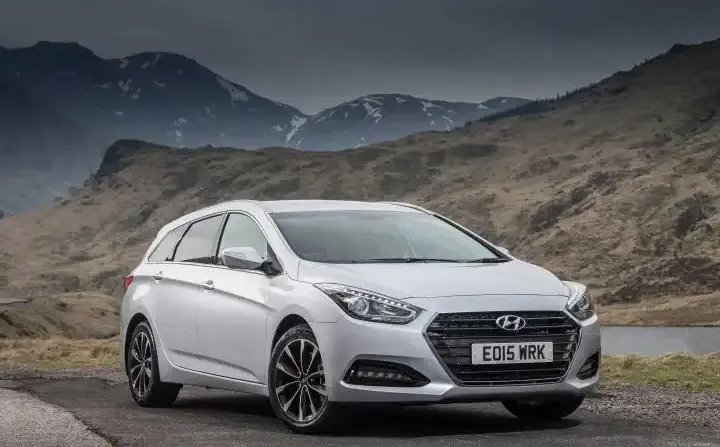
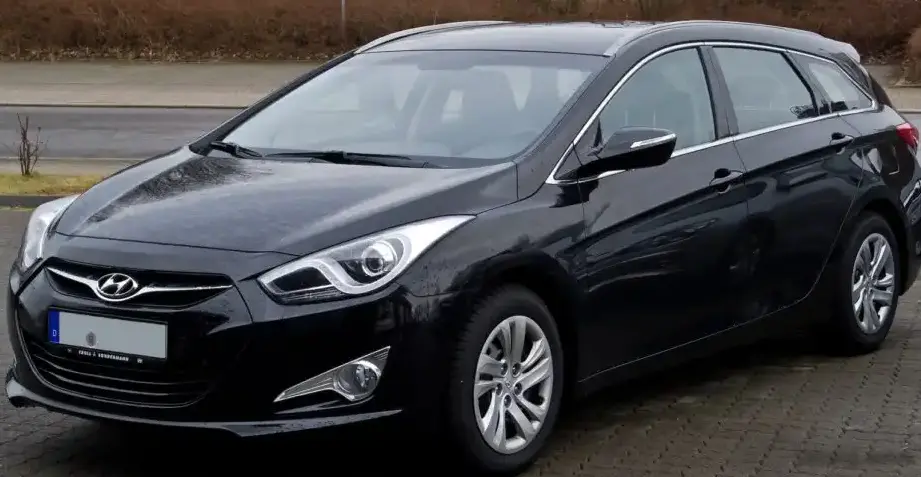
The Hyundai i40 Combi 2.0 GDI, produced from 2011 to 2015, marked Hyundai’s serious attempt to penetrate the competitive European D-segment wagon market. Positioned as a practical and stylish alternative to established rivals like the Ford Mondeo, Volkswagen Passat, and Opel/Vauxhall Insignia, the i40 Combi (estate) aimed to deliver a compelling combination of space, comfort, and value. This specific 2.0-liter GDI (Gasoline Direct Injection) variant, generating 177 horsepower, served as a mid-range offering within the i40 lineup, bridging the gap between the more economical base engines and potentially available higher-performance options in some markets. Notably, the i40 was never officially sold in the United States, making it a distinctly European-focused model.
Powertrain & Engine Architecture
The core of the i40 Combi 2.0 GDI is the Hyundai G4NC engine, a 1.999-liter inline-four cylinder gasoline engine. This engine employs direct fuel injection (GDI) technology, injecting fuel directly into the combustion chamber, which improves efficiency and power output compared to traditional port fuel injection systems. The G4NC also incorporates Hyundai’s Dual Continuously Variable Valve Timing (D-CVVT) system, optimizing valve timing for both intake and exhaust to enhance performance throughout the engine’s operating range. The engine produces 177 horsepower at 6500 rpm and 213 Nm (157 lb-ft) of torque at 4700 rpm. A six-speed manual transmission was standard on this variant, providing precise shifts and a relatively engaging driving experience. While an automatic transmission was offered on other i40 trims, the 2.0 GDI was primarily equipped with the manual gearbox in many European markets.
Driving Characteristics
The i40 Combi 2.0 GDI, paired with the manual transmission, delivers a balanced driving experience. Acceleration to 60 mph is achieved in approximately 9.2 seconds, with a top speed of 130.49 mph. The engine provides sufficient power for everyday driving and highway cruising, exhibiting a noticeable surge in the mid-range thanks to the direct injection system. The six-speed gearbox is well-matched to the engine’s characteristics, allowing drivers to maintain the engine within its optimal power band. Compared to the lower-powered i40 variants, the 2.0 GDI offers a more responsive and confident feel, especially when fully loaded or navigating hilly terrain. However, it doesn’t quite match the outright performance of some competitors’ turbocharged engines.
Equipment & Trim Levels
The i40 Combi 2.0 GDI generally came well-equipped, even in its base configuration. Standard features typically included air conditioning, power windows and mirrors, a CD/MP3 stereo system with USB connectivity, and ABS brakes. Higher trim levels added features such as alloy wheels, a touchscreen infotainment system with navigation, rear parking sensors, and automatic climate control. Interior upholstery was typically cloth, with leather options available on higher-specification models. The i40 Combi prioritized practicality and comfort, offering a spacious cabin and a generous cargo area.
Chassis & Braking
The i40 Combi utilizes a front-wheel-drive layout with an independent McPherson strut suspension at the front and an independent coil spring suspension at the rear. This configuration provides a comfortable ride quality and predictable handling characteristics. The front brakes are ventilated discs, while the rear brakes are solid discs. ABS (Anti-lock Braking System) is standard, enhancing safety and stability during braking maneuvers. The steering is electrically assisted, offering a light and responsive feel.
Market Reception & Comparison
The Hyundai i40 Combi was generally well-received by automotive critics, who commended its spacious interior, comfortable ride, and competitive pricing. The 2.0 GDI engine was considered a solid all-rounder, offering a reasonable balance of performance and fuel economy. However, some reviewers pointed out that the engine lacked the refinement and punch of some competitors’ turbocharged offerings. Fuel economy figures of around 34.6 US mpg combined were respectable for its class. Compared to the diesel-powered i40 variants, the 2.0 GDI offered a lower initial purchase price but potentially higher running costs due to fuel consumption.
Legacy
The Hyundai i40 Combi, while not a runaway success in all markets, firmly established Hyundai as a credible contender in the European D-segment. The 2.0 GDI engine proved to be relatively reliable, with few widespread mechanical issues reported. On the used car market, the i40 Combi 2.0 GDI represents a good value proposition, offering a spacious and practical wagon at an affordable price point. Maintenance costs are generally reasonable, and parts availability remains good. The i40 Combi was eventually superseded by the Hyundai i64, continuing Hyundai’s presence in the European wagon segment.