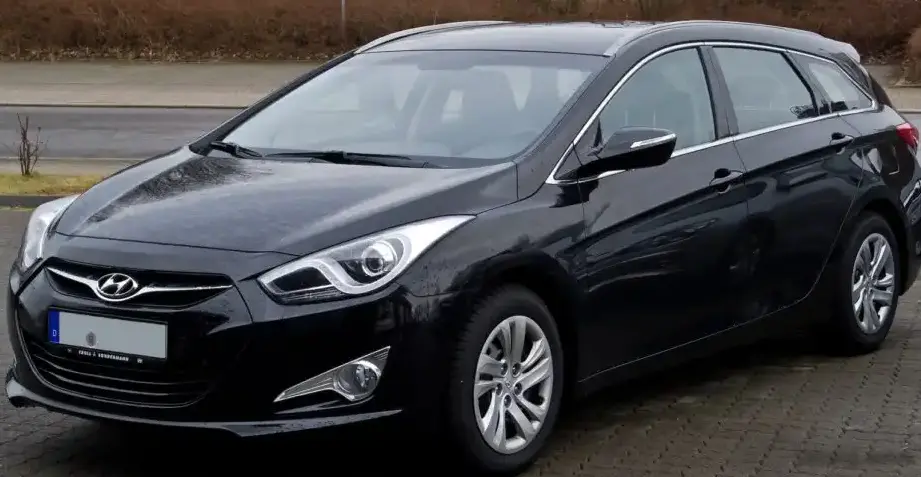
The Hyundai i40 Combi (facelift, introduced in 2018) 1.6 CRDi producing 116 horsepower represents a key variant within the i40 range, Hyundai’s D-segment offering aimed primarily at the European market. Positioned as a practical and fuel-efficient option, this version of the i40 Combi – a station wagon (estate) – targeted buyers seeking a spacious vehicle for family or work use without the higher costs associated with more powerful engine options. The facelift brought styling updates and revised technology, enhancing the i40’s appeal in a competitive segment. Production of this variant ran from 2018 onwards, building upon the initial i40 launch which began in 2011 as a replacement for the Sonata Tourer in Europe.
Technical Specifications
| Brand | Hyundai |
| Model | i40 |
| Generation | i40 Combi (facelift 2018) |
| Type (Engine) | 1.6 CRDi (116 Hp) |
| Start of production | 2018 |
| Powertrain Architecture | Internal Combustion engine |
| Body type | Station wagon (estate) |
| Seats | 5 |
| Doors | 5 |
| Fuel consumption (urban) | 5.1 l/100 km (46.1 US mpg, 55.4 UK mpg, 19.6 km/l) |
| Fuel consumption (extra urban) | 4.2 l/100 km (56 US mpg, 67.3 UK mpg, 23.8 km/l) |
| Fuel consumption (combined) | 4.6 l/100 km (51.1 US mpg, 61.4 UK mpg, 21.7 km/l) |
| CO2 emissions | 120 g/km |
| Fuel Type | Diesel |
| Acceleration 0 – 100 km/h | 12.6 sec |
| Acceleration 0 – 62 mph | 12.6 sec |
| Acceleration 0 – 60 mph | 12 sec |
| Maximum speed | 187 km/h (116.2 mph) |
| Emission standard | Euro 6d |
| Weight-to-power ratio | 13.1 kg/Hp, 76.6 Hp/tonne |
| Weight-to-torque ratio | 5.4 kg/Nm, 184.9 Nm/tonne |
| Power | 116 Hp @ 4000 rpm |
| Power per litre | 72.6 Hp/l |
| Torque | 280 Nm @ 1500-2750 rpm (206.52 lb.-ft. @ 1500-2750 rpm) |
| Engine layout | Front, Transverse |
| Engine Model/Code | D4FE |
| Engine displacement | 1598 cm3 (97.52 cu. in.) |
| Number of cylinders | 4 |
| Engine configuration | Inline |
| Cylinder Bore | 77 mm (3.03 in.) |
| Piston Stroke | 85.8 mm (3.38 in.) |
| Compression ratio | 15.9:1 |
| Number of valves per cylinder | 4 |
| Fuel injection system | Diesel Commonrail |
| Engine aspiration | Turbocharger, Intercooler |
| Engine oil capacity | 4.4 l (4.65 US qt | 3.87 UK qt) |
| Coolant | 6.7 l (7.08 US qt | 5.9 UK qt) |
| Kerb Weight | 1514-1667 kg (3337.8 – 3675.11 lbs.) |
| Max. weight | 2130 kg (4695.85 lbs.) |
| Max load | 463-616 kg (1020.74 – 1358.05 lbs.) |
| Trunk (boot) space – minimum | 553 l (19.53 cu. ft.) |
| Trunk (boot) space – maximum | 1719 l (60.71 cu. ft.) |
| Fuel tank capacity | 70 l (18.49 US gal | 15.4 UK gal) |
| AdBlue tank | 14 l (3.7 US gal | 3.08 UK gal) |
| Max. roof load | 100 kg (220.46 lbs.) |
| Permitted trailer load with brakes (12%) | 1500 kg (3306.93 lbs.) |
| Permitted trailer load without brakes | 700 kg (1543.24 lbs.) |
| Permitted towbar download | 80 kg (176.37 lbs.) |
| Length | 4775 mm (187.99 in.) |
| Width | 1815 mm (71.46 in.) |
| Height | 1470 mm (57.87 in.) |
| Wheelbase | 2770 mm (109.06 in.) |
| Front track | 1579-1591 mm (62.17 – 62.64 in.) |
| Rear (Back) track | 1585-1597 mm (62.4 – 62.87 in.) |
| Ride height (ground clearance) | 140 mm (5.51 in.) |
| Drag coefficient (Cd) | 0.29 |
| Minimum turning circle (turning diameter) | 10.9 m (35.76 ft.) |
| Drivetrain Architecture | The Internal combustion engine (ICE) drives the front wheels of the vehicle. |
| Drive wheel | Front wheel drive |
| Number of gears and type of gearbox | 6 gears, manual transmission |
| Front suspension | Independent, type McPherson with coil spring and anti-roll bar |
| Rear suspension | Independent multi-link spring suspension with stabilizer |
| Front brakes | Ventilated discs |
| Rear brakes | Disc |
| Assisting systems | ABS (Anti-lock braking system) |
| Steering type | Steering rack and pinion |
| Tires size | 205/60 R16; 215/50 R17; 225/45 R18 |
| Wheel rims size | 7.0J x 16; 7.5J x 17; 8.0J x 18 |
Powertrain & Engine Architecture
The i40 Combi 1.6 CRDi utilizes the Hyundai D4FE engine, a 1.6-liter inline-four cylinder diesel engine. This engine is a common rail direct injection (CRDi) unit, meaning fuel is delivered to the cylinders at very high pressure via electronically controlled injectors. This system optimizes combustion for improved efficiency and reduced emissions. The D4FE is turbocharged and intercooled, enhancing power output and torque. The turbocharger forces more air into the engine, while the intercooler cools the compressed air, further increasing density and improving combustion. The engine produces 116 horsepower at 4000 rpm and 280 Nm (206.52 lb-ft) of torque between 1500 and 2750 rpm. This torque curve provides good low-end responsiveness, making it suitable for everyday driving. The engine features a compression ratio of 15.9:1. The transmission is a 6-speed manual gearbox, chosen for its efficiency and driver engagement.
Driving Characteristics
The 1.6 CRDi engine, paired with the manual transmission, delivers adequate performance for typical driving scenarios. Acceleration from 0 to 100 km/h (0-62 mph) takes approximately 12.6 seconds. While not particularly sporty, the engine provides sufficient power for highway cruising and overtaking. The manual gearbox allows for precise control over gear selection, enabling drivers to optimize fuel economy or extract more performance when needed. Compared to higher-output versions of the i40, such as those with the 1.7 CRDi engine, this variant feels less powerful, especially when fully loaded. However, it offers a more economical driving experience. The gear ratios are tuned for fuel efficiency, with taller gearing in higher gears to reduce engine speed at cruising speeds.
Equipment & Trim Levels
The 1.6 CRDi variant of the i40 Combi typically came with a reasonable level of standard equipment. This included air conditioning, electric front and rear windows, a USB audio connection, Bluetooth connectivity, and a multi-function steering wheel. Safety features such as ABS, Electronic Stability Control (ESC), and multiple airbags were also standard. Higher trim levels offered additional features like alloy wheels, a touchscreen infotainment system with navigation, rear parking sensors, and a sunroof. Interior upholstery was typically cloth, with options for leather upgrades on higher trims. The dashboard layout was functional and user-friendly, with a focus on practicality.
Chassis & Braking
The i40 Combi features a front-wheel-drive layout with independent suspension on all four wheels. The front suspension utilizes a McPherson strut design with coil springs and an anti-roll bar, while the rear suspension employs a multi-link setup, also with a stabilizer bar. This suspension configuration provides a comfortable ride quality and good handling characteristics. Braking duties are handled by ventilated discs on the front wheels and solid discs on the rear. ABS (Anti-lock Braking System) is standard, enhancing braking performance and stability. The steering system is a rack and pinion type, providing precise and responsive steering feel.
Market Reception & Comparison
The Hyundai i40 Combi 1.6 CRDi was generally well-received by automotive critics as a practical and fuel-efficient estate car. It was praised for its spacious interior, comfortable ride, and competitive pricing. However, some reviewers noted that the engine lacked the outright performance of some rivals. Compared to other engines in the i40 lineup, the 1.6 CRDi offered the best fuel economy, making it an attractive option for drivers prioritizing efficiency. The 1.7 CRDi provided more power but at the expense of fuel consumption. The 1.6 GDI gasoline engine offered a smoother driving experience but was less economical than the diesel options.
Legacy
The Hyundai i40 Combi 1.6 CRDi has proven to be a reliable and durable vehicle in the used car market. The D4FE engine is known for its robustness, and with regular maintenance, it can provide many years of trouble-free service. While diesel engines have faced increased scrutiny regarding emissions in recent years, the i40 Combi 1.6 CRDi, being a Euro 6d compliant model, meets modern emission standards. The i40 Combi, in general, has established itself as a solid and dependable estate car, offering a compelling alternative to more established European rivals.