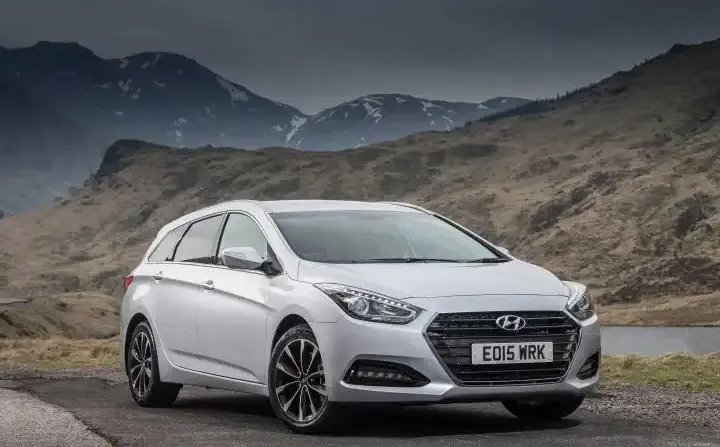
The Hyundai i40 Combi (facelift, produced from 2015 to 2018) 1.6 GDI, generating 135 horsepower, represented a key offering in Hyundai’s European D-segment lineup. Positioned as a practical and well-equipped station wagon (estate), it aimed to compete with established rivals like the Ford Mondeo, Volkswagen Passat, and Opel/Vauxhall Insignia. The facelift brought styling updates and refinements to the original i40, enhancing its appeal to families and those requiring substantial cargo space. This variant, with its 1.6-liter gasoline direct injection engine, served as a mid-range option, balancing affordability with reasonable performance and fuel efficiency.
Technical Specifications
| Brand | Hyundai |
| Model | i40 |
| Generation | i40 Combi (facelift 2015) |
| Type (Engine) | 1.6 GDI (135 Hp) |
| Start of production | 2015 |
| End of production | 2018 |
| Powertrain Architecture | Internal Combustion engine |
| Body type | Station wagon (estate) |
| Seats | 5 |
| Doors | 5 |
| Fuel consumption (urban) | 8.3-8.5 l/100 km (28.3 – 27.7 US mpg) |
| Fuel consumption (extra urban) | 5.2-5.5 l/100 km (45.2 – 42.8 US mpg) |
| Fuel consumption (combined) | 6.3-6.6 l/100 km (37.3 – 35.6 US mpg) |
| CO2 emissions | 147-153 g/km |
| Fuel Type | Petrol (Gasoline) |
| Acceleration 0 – 100 km/h | 11.6 sec |
| Acceleration 0 – 62 mph | 11.6 sec |
| Acceleration 0 – 60 mph | 11 sec |
| Maximum speed | 195 km/h (121.17 mph) |
| Emission standard | Euro 6 |
| Weight-to-power ratio | 10.6 kg/Hp |
| Weight-to-torque ratio | 8.7 kg/Nm |
| Power | 135 Hp @ 6300 rpm |
| Torque | 164 Nm @ 4850 rpm (120.96 lb.-ft. @ 4850 rpm) |
| Engine layout | Front, Transverse |
| Engine Model/Code | G4FD |
| Engine displacement | 1591 cm3 (97.09 cu. in.) |
| Number of cylinders | 4 |
| Engine configuration | Inline |
| Cylinder Bore | 77 mm (3.03 in.) |
| Piston Stroke | 85.44 mm (3.36 in.) |
| Compression ratio | 11:1 |
| Number of valves per cylinder | 4 |
| Fuel injection system | Direct injection |
| Engine aspiration | Naturally aspirated engine |
| Valvetrain | DOHC |
| Engine oil capacity | 3.3 l (3.49 US qt | 2.9 UK qt) |
| Coolant | 6.8 l (7.19 US qt | 5.98 UK qt) |
| Kerb Weight | 1428 kg (3148.2 lbs.) |
| Max. weight | 2030 kg (4475.38 lbs.) |
| Max load | 602 kg (1327.18 lbs.) |
| Trunk (boot) space – minimum | 506 l (17.87 cu. ft.) |
| Trunk (boot) space – maximum | 1672 l (59.05 cu. ft.) |
| Fuel tank capacity | 70 l (18.49 US gal | 15.4 UK gal) |
| Max. roof load | 100 kg (220.46 lbs.) |
| Length | 4775 mm (187.99 in.) |
| Width | 1815 mm (71.46 in.) |
| Height | 1470 mm (57.87 in.) |
| Wheelbase | 2770 mm (109.06 in.) |
| Front track | 1591 mm (62.64 in.) |
| Rear (Back) track | 1597 mm (62.87 in.) |
| Ride height (ground clearance) | 140 mm (5.51 in.) |
| Minimum turning circle | 10.94 m (35.89 ft.) |
| Drivetrain Architecture | Front wheel drive |
| Drive wheel | Front wheel drive |
| Number of gears and type of gearbox | 6 gears, manual transmission |
| Front suspension | Independent type McPherson |
| Rear suspension | Independent coil spring |
| Front brakes | Ventilated discs |
| Rear brakes | Disc |
| Assisting systems | ABS (Anti-lock braking system) |
| Steering type | Steering rack and pinion |
| Tires size | 205/60 R16; 215/50 R17; 225/45 R18 |
| Wheel rims size | 7.0J x 16; 7.5J x 17; 8.0J x 18 |
Powertrain & Engine Architecture
The heart of the i40 Combi 1.6 GDI is the Hyundai G4FD engine, a 1.6-liter inline-four cylinder gasoline engine. This engine utilizes Gasoline Direct Injection (GDI) technology, where fuel is injected directly into the combustion chamber, improving efficiency and power output compared to traditional port fuel injection. The G4FD features a dual continuously variable valve timing (D-CVVT) system, optimizing valve timing for both intake and exhaust to enhance performance across the rev range. The engine produces 135 horsepower at 6,300 rpm and 164 Nm (120.96 lb-ft) of torque at 4,850 rpm. The engine’s 11:1 compression ratio contributes to its efficiency. The i40 1.6 GDI was typically paired with a six-speed manual transmission, although a six-speed automatic transmission was also available. The automatic transmission offered smooth shifts but slightly impacted fuel economy and acceleration compared to the manual.
Driving Characteristics
The 1.6 GDI engine in the i40 Combi provided adequate performance for everyday driving. Acceleration from 0 to 60 mph took around 11 seconds, and the top speed was approximately 195 km/h (121 mph). While not a particularly sporty setup, the engine offered sufficient power for highway cruising and overtaking maneuvers. The six-speed manual transmission allowed drivers to maintain optimal engine speed for efficiency or performance. The automatic transmission, while convenient, felt somewhat less responsive and could occasionally hunt for gears, especially during uphill climbs. The i40 Combi’s suspension provided a comfortable ride, absorbing bumps and imperfections in the road well. Steering was light and precise, making it easy to maneuver in urban environments.
Equipment & Trim Levels
The i40 Combi 1.6 GDI typically came with a respectable level of standard equipment. Base models included air conditioning, electric front and rear windows, a USB audio input, and Bluetooth connectivity. Higher trim levels added features such as a touchscreen infotainment system with navigation, a rearview camera, parking sensors, leather upholstery, heated front seats, and a panoramic sunroof. Safety features included ABS, Electronic Stability Control (ESC), and multiple airbags. The interior design was functional and modern, with a focus on practicality and user-friendliness. Interior upholstery was typically cloth on base models, with leather options available on higher trims.
Chassis & Braking
The i40 Combi featured a front-wheel-drive layout with an independent McPherson strut suspension at the front and an independent multi-link suspension at the rear. This suspension setup provided a good balance between ride comfort and handling. Braking duties were handled by ventilated discs at the front and solid discs at the rear, providing adequate stopping power. ABS (Anti-lock Braking System) was standard, enhancing safety during emergency braking situations. The i40 Combi’s chassis was designed to provide a stable and predictable driving experience, even when fully loaded with passengers and cargo.
Market Reception & Comparison
The Hyundai i40 Combi 1.6 GDI was generally well-received by automotive critics. It was praised for its spacious interior, comfortable ride, and generous equipment levels. However, some reviewers noted that the 1.6 GDI engine could feel underpowered, especially when the car was fully loaded. Compared to other engines in the i40 lineup, such as the 1.7 CRDi diesel, the 1.6 GDI offered less torque but better refinement and a lower initial purchase price. Fuel economy was competitive, but not class-leading, falling slightly behind the more efficient diesel options. The i40 Combi offered a compelling alternative to established rivals, providing a good value proposition for buyers seeking a practical and well-equipped station wagon.
Legacy
The Hyundai i40 Combi 1.6 GDI has proven to be a relatively reliable vehicle in the used car market. The G4FD engine is generally considered durable, although regular maintenance is essential to prevent issues such as carbon buildup on the intake valves (a common issue with direct injection engines). The six-speed automatic transmission, while smooth, can be prone to occasional issues if not properly maintained. Overall, the i40 Combi 1.6 GDI remains a practical and affordable option for buyers seeking a spacious and well-equipped station wagon. Its combination of comfort, practicality, and reasonable running costs has ensured its continued popularity in the used car market.