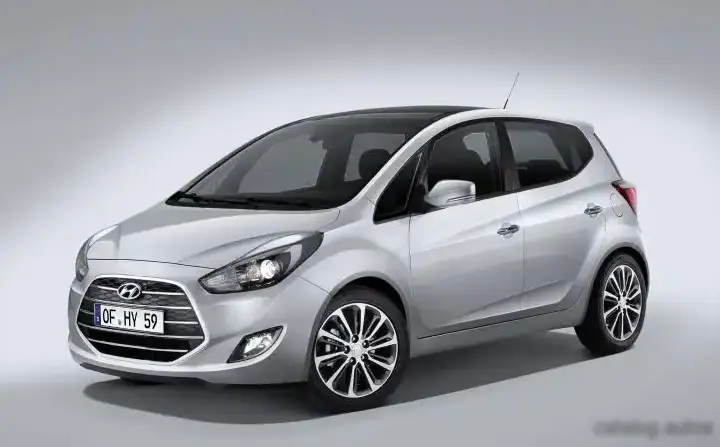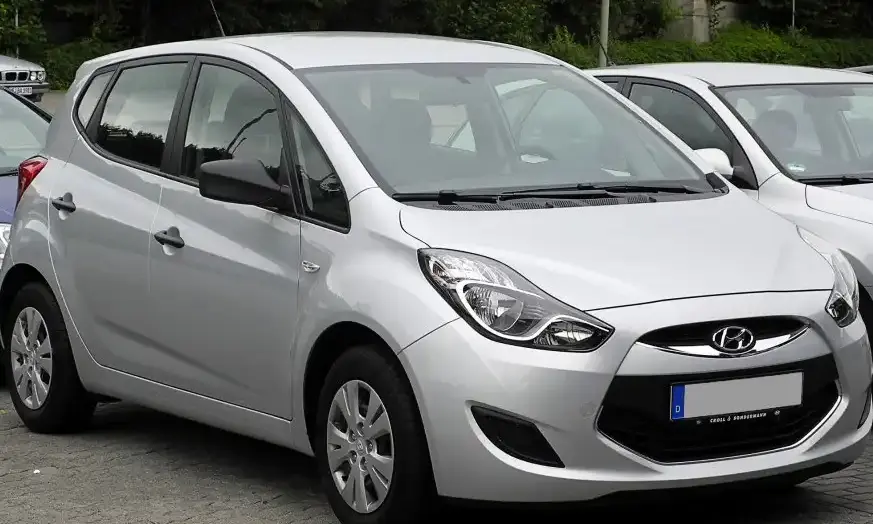
The Hyundai ix20 1.4 CRDi (90 hp) was a subcompact multi-purpose vehicle (MPV), marketed by Hyundai from October 2010 to 2015. Positioned as an entry-level offering within the ix20 range, it aimed to provide affordable and fuel-efficient transportation for small families and urban commuters. The ix20, specifically designed for the European market, was Hyundai’s attempt to gain a stronger foothold in the highly competitive B-segment MPV class, competing with vehicles like the Renault Modus and Opel Meriva. This particular variant, with its 1.4-liter diesel engine and modest power output, represented the most economical option in the lineup.
Technical Specifications
| Brand | Hyundai |
| Model | ix20 |
| Generation | ix20 |
| Type (Engine) | 1.4 CRDi (90 Hp) |
| Start of production | October, 2010 |
| End of production | 2015 |
| Powertrain Architecture | Internal Combustion engine |
| Body type | Hatchback |
| Seats | 5 |
| Doors | 5 |
| Fuel consumption (urban) | 5 l/100 km (47 US mpg, 56.5 UK mpg, 20 km/l) |
| Fuel consumption (extra urban) | 4.2 l/100 km (56 US mpg, 67.3 UK mpg, 23.8 km/l) |
| Fuel consumption (combined) | 4.5 l/100 km (52.3 US mpg, 62.8 UK mpg, 22.2 km/l) |
| CO2 emissions | 119 g/km |
| Fuel Type | Diesel |
| Acceleration 0 – 100 km/h | 14.5 sec |
| Acceleration 0 – 62 mph | 14.5 sec |
| Acceleration 0 – 60 mph | 13.8 sec |
| Maximum speed | 167 km/h (103.77 mph) |
| Emission standard | Euro 5 |
| Weight-to-power ratio | 15.2 kg/Hp, 65.7 Hp/tonne |
| Weight-to-torque ratio | 6.2 kg/Nm, 160.6 Nm/tonne |
| Power | 90 Hp @ 4000 rpm |
| Power per litre | 64.5 Hp/l |
| Torque | 220 Nm @ 1750-2750 rpm (162.26 lb.-ft. @ 1750-2750 rpm) |
| Engine layout | Front, Transverse |
| Engine Model/Code | U / D4FC |
| Engine displacement | 1396 cm3 (85.19 cu. in.) |
| Number of cylinders | 4 |
| Engine configuration | Inline |
| Cylinder Bore | 75 mm (2.95 in.) |
| Piston Stroke | 79 mm (3.11 in.) |
| Compression ratio | 17:1 |
| Number of valves per cylinder | 4 |
| Fuel injection system | Diesel Commonrail |
| Engine aspiration | Turbocharger, Intercooler |
| Valvetrain | DOHC |
| Engine oil capacity | 5.3 l (5.6 US qt | 4.66 UK qt) |
| Coolant | 6.3 l (6.66 US qt | 5.54 UK qt) |
| Kerb Weight | 1370 kg (3020.33 lbs.) |
| Max. weight | 1800 kg (3968.32 lbs.) |
| Max load | 430 kg (947.99 lbs.) |
| Trunk (boot) space – minimum | 440 l (15.54 cu. ft.) |
| Trunk (boot) space – maximum | 1486 l (52.48 cu. ft.) |
| Fuel tank capacity | 48 l (12.68 US gal | 10.56 UK gal) |
| Max. roof load | 70 kg (154.32 lbs.) |
| Permitted trailer load with brakes (12%) | 1300 kg (2866.01 lbs.) |
| Permitted trailer load without brakes | 550 kg (1212.54 lbs.) |
| Permitted towbar download | 75 kg (165.35 lbs.) |
| Length | 4100 mm (161.42 in.) |
| Width | 1765 mm (69.49 in.) |
| Height | 1600 mm (62.99 in.) |
| Wheelbase | 2615 mm (102.95 in.) |
| Front track | 1547-1553 mm (60.91 – 61.14 in.) |
| Rear (Back) track | 1551-1557 mm (61.06 – 61.3 in.) |
| Drivetrain Architecture | The Internal combustion engine (ICE) drives the front wheels of the vehicle. |
| Drive wheel | Front wheel drive |
| Number of gears and type of gearbox | 6 gears, manual transmission |
| Front suspension | Independent type McPherson |
| Rear suspension | Torsion |
| Front brakes | Disc |
| Rear brakes | Disc |
| Assisting systems | ABS (Anti-lock braking system) |
| Steering type | Steering rack and pinion |
| Power steering | Electric Steering |
| Tires size | 195/65 R15 |
| Wheel rims size | 6.0J x 15 |
Powertrain & Engine Architecture
The ix20 1.4 CRDi utilized Hyundai’s D4FC engine, a 1.4-liter inline-four cylinder diesel engine. This engine was part of Hyundai’s ‘U’ engine family. The ‘CRDi’ designation signifies Common Rail Direct Injection, a fuel delivery system that uses high pressure to inject fuel directly into the combustion chamber, improving efficiency and reducing emissions. The D4FC engine featured a turbocharger with an intercooler, which helped to boost power and torque. The engine employed a Double Overhead Camshaft (DOHC) valvetrain with four valves per cylinder, optimizing gas flow for improved performance. The engine produced 90 horsepower at 4,000 rpm and 220 Nm (162 lb-ft) of torque between 1,750 and 2,750 rpm. The engine was paired with a six-speed manual transmission, delivering power to the front wheels. While an automatic transmission was offered on other ix20 variants, the 1.4 CRDi 90 hp model was exclusively available with the manual gearbox.
Driving Characteristics
The 1.4 CRDi 90 hp ix20 offered modest performance, prioritizing fuel economy over outright speed. Acceleration from 0 to 60 mph took approximately 13.8 seconds, and the top speed was around 103.77 mph. The engine’s torque delivery was relatively flat, providing adequate pulling power for everyday driving situations. However, overtaking maneuvers required careful planning. The six-speed manual transmission allowed drivers to keep the engine in its optimal power band, but the gear ratios were spaced to favor fuel efficiency rather than spirited driving. Compared to higher-powered ix20 variants, such as those equipped with the 1.6-liter gasoline engine, the 1.4 CRDi felt noticeably slower. However, it offered significantly better fuel economy, making it a practical choice for those primarily concerned with running costs.
Equipment & Trim Levels
The 1.4 CRDi 90 hp ix20 typically came with a base level of equipment, reflecting its position as the entry-level model. Standard features generally included air conditioning, power steering, electric front windows, a basic audio system with USB connectivity, and ABS brakes. Interior upholstery was typically cloth. Optional extras included alloy wheels, a panoramic sunroof, rear parking sensors, and a more advanced audio system with Bluetooth connectivity. Trim levels varied slightly depending on the specific market, but the core focus remained on providing a functional and affordable MPV.
Chassis & Braking
The ix20 featured a McPherson strut front suspension and a torsion beam rear suspension. This setup provided a comfortable ride quality, suitable for everyday driving. The front brakes were ventilated discs, while the rear brakes were solid discs. ABS (Anti-lock Braking System) was standard, enhancing safety. The ix20’s suspension was tuned for comfort rather than sporty handling, prioritizing ride quality over sharp cornering. The relatively lightweight nature of the vehicle, at around 1370 kg (3020 lbs), helped to mitigate the effects of the modest engine power.
Market Reception & Comparison
The Hyundai ix20 1.4 CRDi (90 hp) was generally well-received by critics as a practical and fuel-efficient MPV. Its affordability and spacious interior were key selling points. However, some reviewers noted its lack of power and relatively basic interior trim. Compared to other trims in the ix20 lineup, the 1.4 CRDi offered the best fuel economy but the slowest performance. Against competitors like the Renault Modus and Opel Meriva, the ix20 offered a competitive package, particularly in terms of value for money. Its fuel economy figures of around 52.3 US mpg combined were particularly attractive to budget-conscious buyers.
Legacy
The Hyundai ix20 1.4 CRDi (90 hp) has proven to be a relatively reliable vehicle in the used car market. The D4FC engine is known for its durability, and the six-speed manual transmission is generally robust. Common issues are typically related to wear and tear on suspension components and the occasional failure of sensors. Today, these vehicles can be found at very affordable prices, making them a practical choice for those seeking an economical and spacious MPV. While not a performance standout, the ix20 1.4 CRDi remains a viable option for those prioritizing fuel efficiency and practicality.