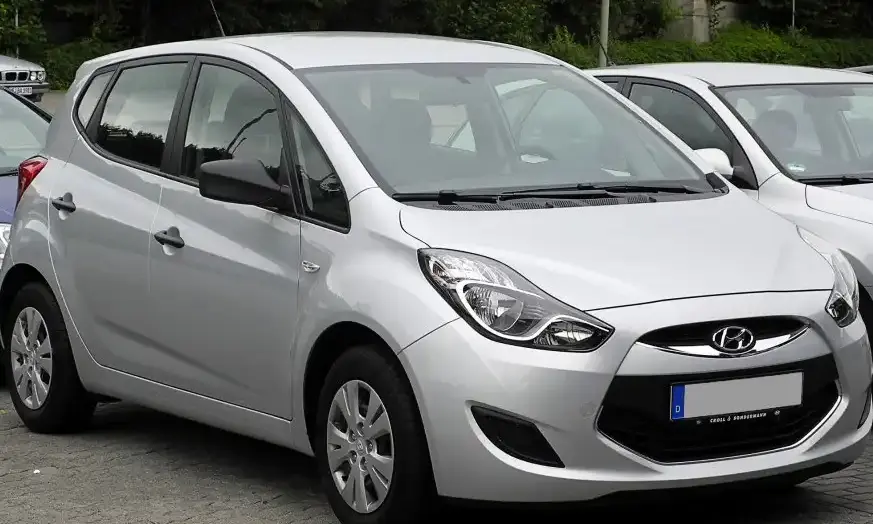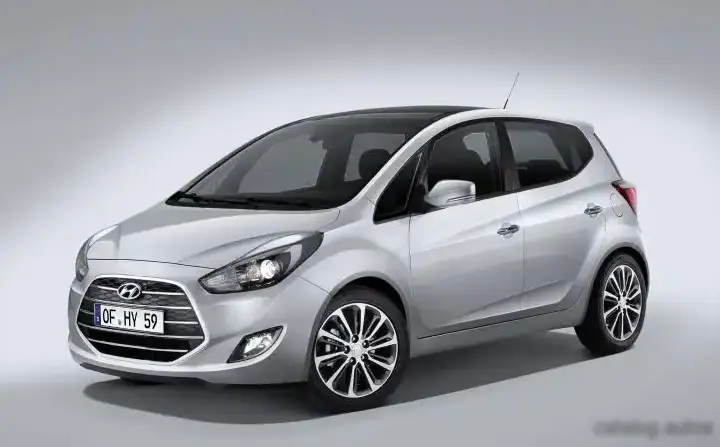
The Hyundai ix20 1.6d (116 Hp) represents a significant offering in the European B-segment multi-purpose vehicle (MPV) market. Introduced with the 2015 facelift, this variant was produced through 2018 and aimed to provide a practical and fuel-efficient option for families and individuals seeking a compact yet spacious vehicle. Positioned as a mid-range trim within the ix20 lineup, it bridged the gap between the base 1.4-liter gasoline engine and the more powerful, though less common, 1.6-liter gasoline options. The ix20, while not sold extensively in the United States, was a key model for Hyundai in Europe, designed to compete with vehicles like the Renault Modus and Opel Meriva.
Technical Specifications
| Brand | Hyundai |
| Model | ix20 |
| Generation | ix20 (facelift 2015) |
| Type (Engine) | 1.6d (116 Hp) |
| Start of production | 2015 |
| End of production | 2018 |
| Powertrain Architecture | Internal Combustion engine |
| Body type | Hatchback |
| Seats | 5 |
| Doors | 5 |
| Fuel consumption (urban) | 5.1 l/100 km (46.1 US mpg, 55.4 UK mpg, 19.6 km/l) |
| Fuel consumption (extra urban) | 4 l/100 km (58.8 US mpg, 70.6 UK mpg, 25 km/l) |
| Fuel consumption (combined) | 4.4 l/100 km (53.5 US mpg, 64.2 UK mpg, 22.7 km/l) |
| CO2 emissions | 115 g/km |
| Fuel Type | Diesel |
| Acceleration 0 – 100 km/h | 11.4 sec |
| Acceleration 0 – 62 mph | 11.4 sec |
| Acceleration 0 – 60 mph | 10.8 sec |
| Maximum speed | 183 km/h (113.71 mph) |
| Emission standard | Euro 6 |
| Weight-to-power ratio | 11 kg/Hp, 90.6 Hp/tonne |
| Weight-to-torque ratio | 4.9 kg/Nm, 203 Nm/tonne |
| Power | 116 Hp @ 4000 rpm |
| Power per litre | 73.3 Hp/l |
| Torque | 260 Nm @ 1500-2750 rpm (191.77 lb.-ft. @ 1500-2750 rpm) |
| Engine layout | Front, Transverse |
| Engine Model/Code | U / D4FB |
| Engine displacement | 1582 cm3 (96.54 cu. in.) |
| Number of cylinders | 4 |
| Engine configuration | Inline |
| Cylinder Bore | 77.2 mm (3.04 in.) |
| Piston Stroke | 84.5 mm (3.33 in.) |
| Compression ratio | 16:1 |
| Number of valves per cylinder | 4 |
| Fuel injection system | Diesel Commonrail |
| Engine aspiration | Turbocharger, Intercooler |
| Valvetrain | DOHC |
| Engine oil capacity | 5.3 l (5.6 US qt | 4.66 UK qt) |
| Coolant | 6.3 l (6.66 US qt | 5.54 UK qt) |
| Kerb Weight | 1281 kg (2824.12 lbs.) |
| Max. weight | 1810 kg (3990.37 lbs.) |
| Max load | 529 kg (1166.25 lbs.) |
| Trunk (boot) space – minimum | 440 l (15.54 cu. ft.) |
| Trunk (boot) space – maximum | 1486 l (52.48 cu. ft.) |
| Fuel tank capacity | 50 l (13.21 US gal | 11 UK gal) |
| Max. roof load | 70 kg (154.32 lbs.) |
| Permitted trailer load with brakes (12%) | 1300 kg (2866.01 lbs.) |
| Permitted trailer load without brakes | 550 kg (1212.54 lbs.) |
| Permitted towbar download | 75 kg (165.35 lbs.) |
| Length | 4115 mm (162.01 in.) |
| Width | 1765 mm (69.49 in.) |
| Height | 1600 mm (62.99 in.) |
| Wheelbase | 2615 mm (102.95 in.) |
| Front overhang | 820 mm (32.28 in.) |
| Rear overhang | 680 mm (26.77 in.) |
| Minimum turning circle | 10.42 m (34.19 ft.) |
| Drivetrain Architecture | The Internal combustion engine (ICE) drives the front wheels of the vehicle. |
| Drive wheel | Front wheel drive |
| Number of gears and type of gearbox | 6 gears, manual transmission |
| Front suspension | Independent, type McPherson with coil spring and anti-roll bar |
| Rear suspension | Semi-independent, coil spring |
| Front brakes | Ventilated discs |
| Rear brakes | Disc |
| Assisting systems | ABS (Anti-lock braking system) |
| Steering type | Steering rack and pinion |
| Power steering | Electric Steering |
| Tires size | 195/65 R15; 205/55 R16; 205/50 R17 |
| Wheel rims size | 15; 16; 17 |
Powertrain & Engine Architecture
The heart of the ix20 1.6d is the Hyundai D4FB engine, a 1.6-liter inline-four cylinder diesel. This engine falls under the ‘U’ engine family developed by Hyundai. It utilizes a common-rail direct injection system, delivering fuel at extremely high pressure for optimized combustion. The D4FB is turbocharged with an intercooler, enhancing power output and efficiency. The engine produces 116 horsepower at 4,000 rpm and a respectable 260 Nm (191.77 lb-ft) of torque between 1,500 and 2,750 rpm. This torque curve provides good low-end responsiveness, suitable for everyday driving. The engine features a double overhead camshaft (DOHC) valvetrain with four valves per cylinder, contributing to its breathing efficiency. The 6-speed manual transmission was standard, offering a balance between fuel economy and driver control. While an automatic transmission was available on some ix20 models, it was not typically paired with the 1.6d engine.
Driving Characteristics
The ix20 1.6d with the manual transmission delivers a practical and economical driving experience. Acceleration from 0-60 mph takes around 10.8 seconds, which is adequate for most driving situations but doesn’t offer particularly sporty performance. The strength of this powertrain lies in its mid-range torque, making it easy to maintain highway speeds and navigate hills without excessive gear changes. The gear ratios are well-spaced, contributing to a comfortable and refined driving experience. Compared to the base 1.4-liter gasoline engine, the 1.6d offers significantly more power and torque, resulting in improved acceleration and towing capacity. However, it doesn’t match the performance of the higher-output 1.6-liter gasoline variants. The steering is light and precise, making it easy to maneuver in urban environments.
Equipment & Trim Levels
The ix20 1.6d typically came equipped with a reasonable level of standard features. These included air conditioning, power windows, central locking, and a basic audio system with USB connectivity. Higher trim levels added features such as alloy wheels, fog lights, a touchscreen infotainment system with Bluetooth, and parking sensors. Interior upholstery was typically cloth, with options for upgraded materials on higher trims. Safety features included ABS, airbags, and electronic stability control. The ix20 was designed with practicality in mind, offering a flexible interior with folding rear seats and a generous amount of storage space.
Chassis & Braking
The ix20 utilizes a McPherson strut front suspension and a semi-independent coil spring rear suspension. This setup provides a comfortable ride quality, absorbing bumps and imperfections in the road surface effectively. The front brakes are ventilated discs, offering good stopping power, while the rear brakes are solid discs. The electric power steering provides a light and responsive feel. The chassis is designed to prioritize comfort and practicality over outright handling performance. Stabilizer bars are fitted to both the front and rear axles to reduce body roll during cornering.
Market Reception & Comparison
The Hyundai ix20 1.6d was generally well-received by automotive critics for its practicality, fuel efficiency, and value for money. It was praised for its spacious interior, comfortable ride, and generous equipment levels. However, some critics noted that its styling was somewhat conservative and that its driving dynamics were not as engaging as some of its rivals. Compared to other diesel-powered MPVs in its class, the ix20 offered a competitive fuel economy of around 53.5 US mpg. Its reliability was also considered to be good, with few reported issues.
Legacy
The Hyundai ix20 1.6d has proven to be a reliable and durable vehicle in the used car market. The D4FB engine is known for its longevity, provided it has been properly maintained. Common maintenance items include regular oil changes, filter replacements, and timing belt replacement (if applicable). The ix20 remains a popular choice for budget-conscious buyers seeking a practical and fuel-efficient family vehicle. Its spacious interior and comfortable ride continue to appeal to a wide range of drivers. While no longer in production, the ix20 1.6d represents a solid offering from Hyundai during its time in the European B-segment MPV market.