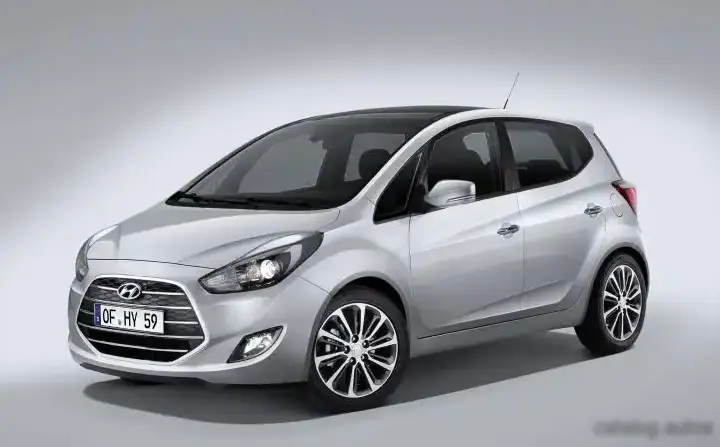
The Hyundai ix20 1.6i (125 hp) represents a significant iteration of Hyundai’s foray into the European subcompact MPV (Multi-Purpose Vehicle) segment. Introduced with the 2015 facelift, this variant aimed to provide a practical and affordable option for families and individuals seeking a versatile vehicle. Production spanned from 2015 onwards, positioning the ix20 as a competitor to vehicles like the Renault Modus, Opel Meriva, and Ford Fusion (in Europe). This specific engine and transmission combination occupied a mid-range position within the ix20 lineup, offering a balance between performance and fuel efficiency. It was designed primarily for the European market, where smaller, space-efficient vehicles are highly valued.
Technical Specifications
| Brand | Hyundai |
| Model | ix20 |
| Generation | ix20 (facelift 2015) |
| Type (Engine) | 1.6i (125 Hp) |
| Start of production | 2015 |
| Powertrain Architecture | Internal Combustion engine |
| Body type | Hatchback |
| Seats | 5 |
| Doors | 5 |
| Fuel Type | Petrol (Gasoline) |
| Acceleration 0 – 100 km/h | 10.8 sec |
| Acceleration 0 – 62 mph | 10.8 sec |
| Acceleration 0 – 60 mph | 10.3 sec |
| Maximum speed | 185 km/h (114.95 mph) |
| Emission standard | Euro 6 |
| Weight-to-power ratio | 9.4 kg/Hp, 105.9 Hp/tonne |
| Weight-to-torque ratio | 7.6 kg/Nm, 132.2 Nm/tonne |
| Power | 125 Hp @ 6300 rpm |
| Power per litre | 78.6 Hp/l |
| Torque | 156 Nm @ 4200 rpm (115.06 lb.-ft. @ 4200 rpm) |
| Engine layout | Front, Transverse |
| Engine Model/Code | Gamma I / G4FC |
| Engine displacement | 1591 cm3 (97.09 cu. in.) |
| Number of cylinders | 4 |
| Engine configuration | Inline |
| Cylinder Bore | 77 mm (3.03 in.) |
| Piston Stroke | 85.44 mm (3.36 in.) |
| Compression ratio | 10.5:1 |
| Number of valves per cylinder | 4 |
| Fuel injection system | Multi-port manifold injection |
| Engine aspiration | Naturally aspirated engine |
| Valvetrain | DOHC |
| Engine oil capacity | 3.6 l (3.8 US qt | 3.17 UK qt) |
| Coolant | 5.8 l (6.13 US qt | 5.1 UK qt) |
| Kerb Weight | 1180 kg (2601.45 lbs) |
| Trunk (boot) space – minimum | 440 l (15.54 cu. ft.) |
| Trunk (boot) space – maximum | 1486 l (52.48 cu. ft.) |
| Fuel tank capacity | 50 l (13.21 US gal | 11 UK gal) |
| Length | 4115 mm (162.01 in.) |
| Width | 1765 mm (69.49 in.) |
| Height | 1600 mm (62.99 in.) |
| Wheelbase | 2615 mm (102.95 in.) |
| Front overhang | 820 mm (32.28 in.) |
| Rear overhang | 680 mm (26.77 in.) |
| Minimum turning circle | 10.42 m (34.19 ft.) |
| Drivetrain Architecture | The Internal combustion engine (ICE) drives the front wheels of the vehicle. |
| Drive wheel | Front wheel drive |
| Number of gears and type of gearbox | 6 gears, manual transmission |
| Front suspension | Independent, type McPherson with coil spring and anti-roll bar |
| Rear suspension | Semi-independent, coil spring |
| Front brakes | Ventilated discs |
| Rear brakes | Disc |
| Assisting systems | ABS (Anti-lock braking system) |
| Steering type | Steering rack and pinion |
| Power steering | Electric Steering |
| Tires size | 195/65 R15; 205/55 R16; 205/50 R17 |
| Wheel rims size | 15; 16; 17 |
INTRODUCTION
The Hyundai ix20, launched in 2010 and receiving a significant facelift in 2015, was Hyundai’s attempt to capture a share of the increasingly popular subcompact MPV market in Europe. The 1.6i (125 hp) variant, introduced with the facelift, was positioned as a practical and efficient choice for buyers prioritizing fuel economy and everyday usability. Built on the Hyundai-Kia ‘PB’ platform (internally known as 1HX0/A3), the ix20 offered a surprisingly spacious interior for its footprint, a key selling point in densely populated European cities. The facelift brought revised styling, improved interior materials, and updated technology, enhancing the ix20’s appeal.
Powertrain & Engine Architecture
At the heart of the ix20 1.6i lies the Hyundai Gamma I engine, specifically the G4FC code. This 1.6-liter inline-four cylinder engine is a naturally aspirated powerplant utilizing multi-point fuel injection. The engine features a double overhead camshaft (DOHC) valvetrain with four valves per cylinder, contributing to its relatively efficient operation. The 125 hp output is achieved at 6300 rpm, while peak torque of 156 Nm (115 lb-ft) arrives at 4200 rpm. The engine is known for its generally reliable operation, though it lacks the complexity of direct injection systems found in later Hyundai engines. The ix20 1.6i was primarily offered with a six-speed manual transmission, which provided a good balance of fuel economy and driver engagement. The transmission’s gear ratios were tuned for everyday driving, prioritizing smooth shifts and reasonable acceleration rather than outright performance.
Driving Characteristics
The ix20 1.6i, with its 125 hp and six-speed manual transmission, delivers adequate performance for urban and highway driving. Acceleration from 0-60 mph takes around 10.3 seconds, which is competitive within its class but doesn’t offer particularly sporty acceleration. The engine feels responsive enough for overtaking maneuvers, but requires downshifting for quicker bursts of speed. The six-speed gearbox is well-matched to the engine’s characteristics, providing smooth and precise shifts. Compared to the more powerful (but less common) 1.6 GDI direct injection version, the 1.6i feels less eager to rev, but offers a more linear power delivery. Against diesel variants, the 1.6i sacrifices fuel economy for a smoother and quieter driving experience.
Equipment & Trim Levels
The ix20 1.6i typically came equipped with a reasonable level of standard features. Base models included air conditioning, power windows, central locking, and a basic audio system. Higher trim levels, such as Style or Premium, added features like alloy wheels, fog lights, a touchscreen infotainment system with Bluetooth connectivity, and parking sensors. Interior upholstery was typically cloth, with options for upgraded materials on higher trims. Optional extras included a panoramic sunroof, automatic climate control, and a rear-view camera. The interior design was functional and well-laid-out, prioritizing practicality and ease of use.
Chassis & Braking
The ix20 utilizes a McPherson strut front suspension and a semi-independent coil spring rear suspension. This setup provides a comfortable ride quality, absorbing bumps and imperfections in the road effectively. The suspension is tuned for comfort rather than sporty handling, resulting in a slight degree of body roll during cornering. Braking duties are handled by ventilated discs at the front and solid discs at the rear. Anti-lock Braking System (ABS) is standard, providing enhanced stopping power and stability. The steering is electrically assisted, offering light and precise control. The ix20’s chassis is designed to prioritize space efficiency and practicality, rather than outright performance.
Market Reception & Comparison
The Hyundai ix20 1.6i was generally well-received by automotive critics as a practical and affordable MPV. Reviewers praised its spacious interior, comfortable ride, and competitive pricing. However, some criticized its somewhat bland styling and lack of a truly engaging driving experience. Compared to its rivals, the ix20 offered a compelling value proposition, often undercutting competitors on price while offering a similar level of equipment. Fuel economy was respectable, averaging around 38-45 mpg in mixed driving conditions. Reliability proved to be generally good, with few reported issues with the 1.6-liter engine or transmission.
Legacy
The Hyundai ix20, while not a massive sales success, established Hyundai as a credible player in the European subcompact MPV segment. The 1.6i variant, in particular, has proven to be a reliable and affordable option on the used car market. The Gamma I engine is known for its durability, and with regular maintenance, can provide many years of trouble-free service. Today, the ix20 1.6i represents a sensible choice for buyers seeking a practical, economical, and well-equipped family vehicle. Its spacious interior and comfortable ride continue to make it a viable option for those prioritizing functionality over outright performance.