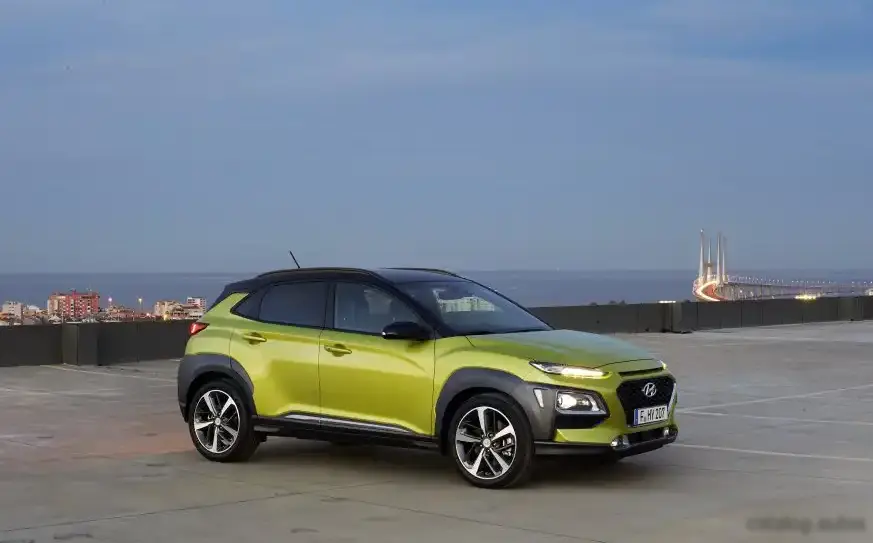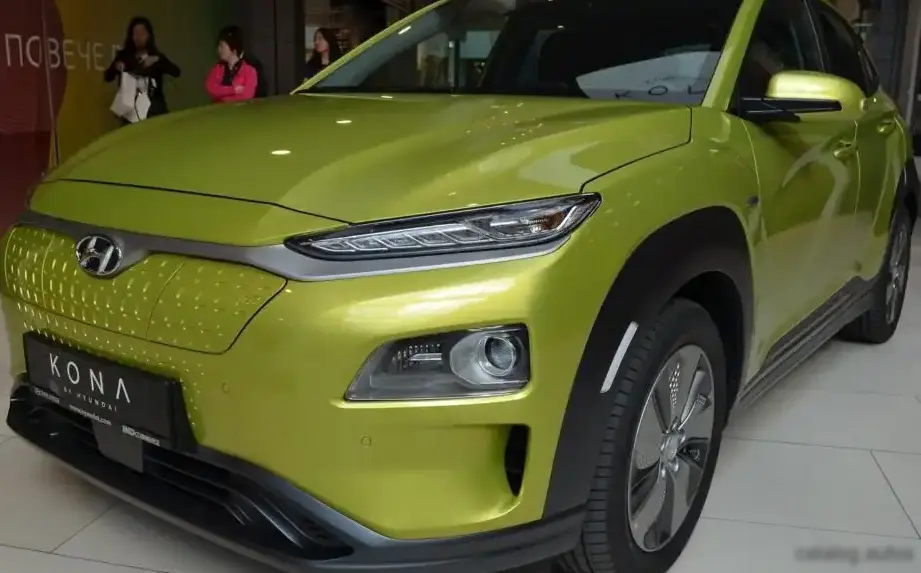
The Hyundai Kona Electric, specifically the 67 kWh variant producing 204 horsepower, represents Hyundai’s early and significant foray into the burgeoning all-electric SUV market. Introduced for the 2018 model year and continuing through December 2018 for this specific configuration, it was a key component of the first-generation Kona (internal designation: Kona I), built on the Hyundai-Kia B-platform. This model aimed to provide a practical, long-range electric vehicle option in a compact SUV package, appealing to consumers seeking a zero-emission alternative without compromising on versatility. It quickly became a popular choice, establishing the Kona as a serious contender in the EV space.
Technical Specifications
| Brand | Hyundai |
| Model | Kona |
| Generation | Kona I |
| Type (Engine) | 67 kWh (204 Hp) Electric |
| Start of production | 2018 |
| End of production | December, 2018 |
| Powertrain Architecture | BEV (Electric Vehicle) |
| Body type | SUV |
| Seats | 5 |
| Doors | 5 |
| Fuel Type | Electricity |
| Acceleration 0 – 100 km/h | 7.6 sec |
| Acceleration 0 – 62 mph | 7.6 sec |
| Acceleration 0 – 60 mph | 7.2 sec |
| Maximum speed | 167 km/h (103.77 mph) |
| Weight-to-power ratio | 8.3 kg/Hp, 121.1 Hp/tonne |
| Weight-to-torque ratio | 4.3 kg/Nm, 234.4 Nm/tonne |
| Gross battery capacity | 67 kWh |
| Net (usable) battery capacity | 64 kWh |
| Battery voltage | 356 V |
| Battery technology | Lithium-polymer (LiPo) |
| Battery location | Below the floor |
| All-electric range (WLTP) | 482 km (299.5 mi) |
| Average Energy consumption (WLTP) | 14.3 kWh/100 km (23.01 kWh/100 mi) |
| MPGe | 146 |
| km/kWh | 7 |
| mi/kWh | 4.3 |
| Electric motor power | 204 Hp |
| Electric motor Torque | 395 Nm (291.34 lb.-ft.) |
| Electric motor model/code | EM16 |
| Electric motor location | Front axle, Transverse |
| System power | 204 Hp |
| System torque | 395 Nm (291.34 lb.-ft.) |
| Kerb Weight | 1685 kg (3714.79 lbs.) |
| Max. weight | 2170 kg (4784.03 lbs.) |
| Max load | 485 kg (1069.24 lbs.) |
| Trunk (boot) space – minimum | 332 l (11.72 cu. ft.) |
| Trunk (boot) space – maximum | 1114 l (39.34 cu. ft.) |
| Max. roof load | 80 kg (176.37 lbs.) |
| Length | 4180 mm (164.57 in.) |
| Width | 1800 mm (70.87 in.) |
| Width including mirrors | 2070 mm (81.5 in.) |
| Height | 1570 mm (61.81 in.) |
| Wheelbase | 2600 mm (102.36 in.) |
| Front track | 1564 mm (61.57 in.) |
| Rear (Back) track | 1575 mm (62.01 in.) |
| Front overhang | 860 mm (33.86 in.) |
| Rear overhang | 720 mm (28.35 in.) |
| Ride height (ground clearance) | 158 mm (6.22 in.) |
| Minimum turning circle | 10.6 m (34.78 ft.) |
| Drivetrain Architecture | One electric motor drives the front wheels. |
| Drive wheel | Front wheel drive |
| Number of gears | 1 |
| Gearbox type | Automatic transmission |
| Front suspension | Independent type McPherson |
| Rear suspension | Independent multi-link suspension |
| Front brakes | Ventilated discs |
| Rear brakes | Disc |
| Assisting systems | ABS (Anti-lock braking system) |
| Steering type | Steering rack and pinion |
| Power steering | Electric Steering |
| Tires size | 215/55 R17 |
| Wheel rims size | 7J x 17 |
INTRODUCTION
The 67 kWh Hyundai Kona Electric represented a significant step forward for the brand, offering a compelling blend of practicality, range, and affordability in the rapidly expanding electric vehicle market. Positioned as the higher-capacity battery option within the Kona Electric lineup (the other being a 39.2 kWh version), this variant prioritized extended range over the base model. It was aimed at drivers who frequently undertake longer journeys or simply desired the peace of mind of a greater driving range. The Kona Electric quickly gained recognition for its efficient powertrain and surprisingly spacious interior for a subcompact SUV.
Powertrain & Engine Architecture
At the heart of the Kona Electric 67 kWh lies a permanent magnet synchronous motor (PMSM) designated EM16, producing 204 horsepower and 291 lb-ft of torque. This motor is transversely mounted on the front axle, driving the front wheels. The power is supplied by a 64 kWh lithium-polymer (LiPo) battery pack located under the floor of the vehicle, contributing to a low center of gravity and improved handling. The battery pack utilizes a sophisticated thermal management system to maintain optimal operating temperatures, crucial for maximizing battery life and performance. The Kona Electric employs a single-speed automatic transmission, typical of most electric vehicles, providing seamless acceleration. The vehicle utilizes a sophisticated power electronics system to convert the DC power from the battery to AC power for the motor, and vice versa during regenerative braking.
Driving Characteristics
The 67 kWh Kona Electric delivers brisk acceleration, achieving 0-60 mph in approximately 7.2 seconds. The instant torque characteristic of electric motors provides a responsive and engaging driving experience. While not a performance-oriented vehicle, the Kona Electric offers ample power for everyday driving situations, including highway merging and overtaking. The single-speed transmission ensures smooth and linear acceleration. Compared to the 39.2 kWh version, the 67 kWh model offers significantly improved range, making it more suitable for longer trips. The regenerative braking system allows for one-pedal driving in many situations, enhancing efficiency and driver convenience. The front-wheel-drive configuration provides predictable handling, although it may exhibit some torque steer under hard acceleration.
Equipment & Trim Levels
The Kona Electric 67 kWh was typically offered in well-equipped trims, often including features such as a 7-inch touchscreen infotainment system with Apple CarPlay and Android Auto compatibility, a rearview camera, lane keep assist, forward collision warning, and automatic emergency braking. Higher trims added features like a larger touchscreen display, a premium audio system, leather upholstery, heated and ventilated front seats, and a sunroof. Interior upholstery was typically cloth in base trims, with leather options available on higher-spec models. The dashboard layout was clean and modern, with a focus on usability.
Chassis & Braking
The Kona Electric utilizes a McPherson strut front suspension and a multi-link rear suspension, providing a comfortable and controlled ride. The suspension was tuned to balance ride comfort with handling agility. The vehicle is equipped with ventilated front disc brakes and solid rear disc brakes, providing adequate stopping power. The electronic stability control (ESC) system and anti-lock braking system (ABS) enhance safety and stability. The steering is electrically assisted, offering light and precise steering feel. The Kona Electric’s relatively low center of gravity, thanks to the underfloor battery pack, contributes to reduced body roll during cornering.
Market Reception & Comparison
The Hyundai Kona Electric 67 kWh was generally well-received by automotive critics, praised for its long range, efficient powertrain, and spacious interior. It was often compared to other electric SUVs such as the Nissan Leaf Plus and the Chevrolet Bolt EV. The Kona Electric offered a more refined driving experience and a more stylish design than some of its competitors. Fuel economy, expressed as MPGe, was consistently high, making it an attractive option for environmentally conscious consumers. Reliability reports have generally been positive, with few major issues reported.
Legacy
The Hyundai Kona Electric 67 kWh played a pivotal role in establishing Hyundai as a major player in the electric vehicle market. It demonstrated the brand’s commitment to electrification and paved the way for future EV models. On the used car market, these early Kona Electrics remain relatively desirable, particularly those with well-maintained batteries. Battery degradation is a common concern with older EVs, but the Kona Electric’s battery management system has proven to be relatively effective in mitigating this issue. The Kona Electric continues to be a popular choice for buyers seeking an affordable and practical electric SUV.