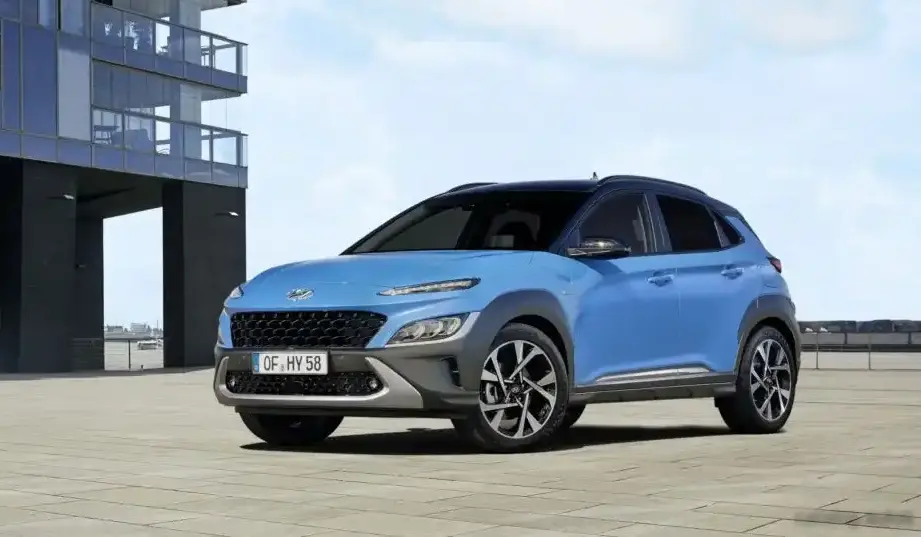
The Hyundai Kona I (facelift, introduced in 2020) 2.0 MPI (147 hp) with Intelligent Variable Transmission (IVT) represents a significant offering within the subcompact SUV segment. Production of this specific configuration ran from 2021 through April 2023. Positioned as a mainstream trim level, it aimed to provide a balance of affordability, practicality, and Hyundai’s increasingly sophisticated technology. This variant played a key role in expanding the Kona’s appeal to a broader customer base, particularly those seeking a comfortable and fuel-efficient daily driver. It was part of the first generation Kona (internal designation OS), which utilized the Hyundai-Kia B-platform, shared with models like the Kia Soul and Hyundai Venue.
Technical Specifications
| Brand | Hyundai |
| Model | Kona |
| Generation | Kona I (facelift 2020) |
| Type (Engine) | 2.0 MPI (147 Hp) IVT |
| Start of production | 2021 |
| End of production | April, 2023 |
| Powertrain Architecture | Internal Combustion engine |
| Body type | SUV |
| Seats | 5 |
| Doors | 5 |
| Fuel Type | Petrol (Gasoline) |
| Weight-to-power ratio | 8.9 kg/Hp, 111.8 Hp/tonne |
| Weight-to-torque ratio | 7.3 kg/Nm, 136.1 Nm/tonne |
| Power | 147 Hp @ 6200 rpm |
| Power per litre | 73.5 Hp/l |
| Torque | 179 Nm @ 4500 rpm (132.02 lb.-ft. @ 4500 rpm) |
| Engine layout | Front, Transverse |
| Engine Model/Code | Smartstream / G4NS |
| Engine displacement | 1999 cm3 (121.99 cu. in.) |
| Number of cylinders | 4 |
| Engine configuration | Inline |
| Cylinder Bore | 81 mm (3.19 in.) |
| Piston Stroke | 97 mm (3.82 in.) |
| Compression ratio | 12.5:1 |
| Number of valves per cylinder | 4 |
| Fuel injection system | Multi-port manifold injection |
| Valvetrain | DOHC, DCVVT |
| Engine oil capacity | 4.3 l (4.54 US qt | 3.78 UK qt) |
| Coolant | 6 l (6.34 US qt | 5.28 UK qt) |
| Kerb Weight | 1315-1379 kg (2899.08 – 3040.17 lbs.) |
| Max. weight | 1800 kg (3968.32 lbs.) |
| Max load | 421-485 kg (928.15 – 1069.24 lbs.) |
| Trunk (boot) space – minimum | 544 l (19.21 cu. ft.) |
| Trunk (boot) space – maximum | 1297 l (45.8 cu. ft.) |
| Fuel tank capacity | 50 l (13.21 US gal | 11 UK gal) |
| Length | 4206 mm (165.59 in.) |
| Width | 1801 mm (70.91 in.) |
| Height | 1565 mm (61.61 in.) |
| Wheelbase | 2601 mm (102.4 in.) |
| Front track | 1560-1575 mm (61.42 – 62.01 in.) |
| Rear (Back) track | 1567-1585 mm (61.69 – 62.4 in.) |
| Front overhang | 871 mm (34.29 in.) |
| Rear overhang | 734 mm (28.9 in.) |
| Ride height (ground clearance) | 170 mm (6.69 in.) |
| Drag coefficient (Cd) | 0.32 |
| Minimum turning circle (turning diameter) | 10.6 m (34.78 ft.) |
| Drivetrain Architecture | The Internal combustion engine (ICE) drives the front wheels of the vehicle. |
| Drive wheel | Front wheel drive |
| Number of gears and type of gearbox | automatic transmission IVT |
| Front suspension | Independent, type McPherson with coil spring and anti-roll bar |
| Rear suspension | Torsion |
| Front brakes | Ventilated discs, 280×23 mm |
| Rear brakes | Disc, 262×10 mm |
| Assisting systems | ABS (Anti-lock braking system) |
| Steering type | Steering rack and pinion |
| Power steering | Electric Steering |
| Tires size | 205/60 R16 92H; 215/55 R17 94V |
| Wheel rims size | 6.5J x 16; 7J x 17 |
Powertrain & Engine Architecture
At the heart of the Kona 2.0 MPI IVT lies the Hyundai Smartstream G4NS engine, a naturally aspirated 2.0-liter inline-four cylinder gasoline engine. This engine utilizes multi-point fuel injection and a double overhead camshaft (DOHC) valvetrain with Dual Continuous Variable Valve Timing (DCVVT). The DCVVT system optimizes valve timing based on engine load and speed, improving both fuel efficiency and performance. The engine produces 147 horsepower at 6,200 rpm and 179 Nm (132 lb-ft) of torque at 4,500 rpm. The high compression ratio of 12.5:1 contributes to the engine’s efficiency.
The “IVT” designation refers to Hyundai’s Intelligent Variable Transmission, a continuously variable transmission (CVT) marketed under a different name. Unlike traditional stepped automatic transmissions, the IVT uses a belt and pulley system to provide a seamless and theoretically infinite number of gear ratios. This allows the engine to operate at its most efficient rpm range for a given driving condition. The IVT in the Kona is programmed with simulated shift points to provide a more familiar driving experience for those accustomed to conventional automatics.
Driving Characteristics
The 2.0-liter MPI engine paired with the IVT delivers adequate, though not exhilarating, performance. Acceleration is linear and predictable, making it well-suited for city driving and highway cruising. The IVT minimizes engine drone during acceleration, contributing to a more refined driving experience. However, compared to the more powerful turbocharged engines offered in the Kona lineup, this variant feels noticeably slower, particularly when fully loaded or tackling steep inclines. The IVT’s programming prioritizes fuel economy over outright performance, resulting in a less responsive feel than a traditional automatic or a manual transmission. The gear ratios are tuned for efficiency, meaning quick overtaking maneuvers require more planning.
Equipment & Trim Levels
The 2.0 MPI IVT trim typically served as a mid-range offering in the Kona lineup. Standard features generally included air conditioning, a touchscreen infotainment system with Apple CarPlay and Android Auto compatibility, Bluetooth connectivity, a rearview camera, and a suite of active safety features such as lane keeping assist and forward collision avoidance assist. Interior upholstery was typically cloth, with options for upgraded materials available. Common optional extras included a sunroof, heated seats, and a premium audio system. The specific feature set varied slightly depending on the model year and regional market.
Chassis & Braking
The Kona 2.0 MPI IVT utilizes a front-wheel-drive layout with an independent McPherson strut suspension in the front and a torsion beam suspension in the rear. The front suspension incorporates a stabilizer bar to reduce body roll during cornering. Braking duties are handled by ventilated discs in the front and solid discs in the rear. The braking system is equipped with Anti-lock Braking System (ABS) to enhance stability during emergency stops. The suspension tuning is geared towards comfort, providing a relatively smooth ride over most road surfaces. The steering is electrically assisted, offering light and precise control.
Market Reception & Comparison
Critics generally praised the Kona 2.0 MPI IVT for its fuel efficiency, comfortable ride, and well-equipped interior. However, the engine’s lack of outright power was a common criticism, particularly when compared to the turbocharged options. Fuel economy figures typically ranged from 28-32 mpg combined, making it a competitive offering in the subcompact SUV segment. Compared to the 1.6L Turbo engine, the 2.0 MPI offered a more affordable entry point but sacrificed performance. The 2.0 MPI was also seen as a more reliable option than the more complex turbocharged engines, potentially leading to lower long-term maintenance costs.
Legacy
The Hyundai Kona 2.0 MPI IVT has proven to be a relatively reliable powertrain combination. The Smartstream engine is known for its durability, and the IVT, while not as sporty as a traditional automatic, has demonstrated reasonable longevity with proper maintenance. In the used car market, these Konas represent a good value proposition for buyers seeking an affordable, fuel-efficient, and well-equipped subcompact SUV. The simplicity of the naturally aspirated engine and IVT transmission contributes to its appeal for those prioritizing reliability and lower maintenance costs over high performance.