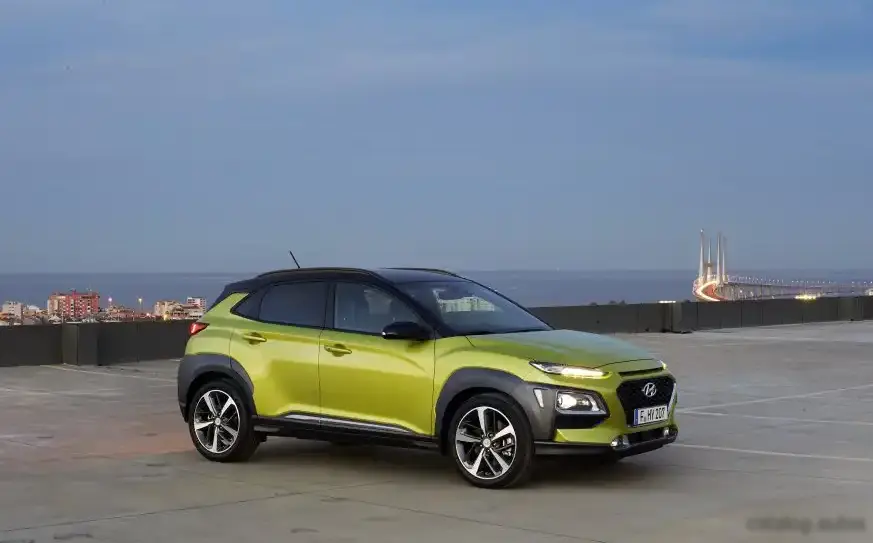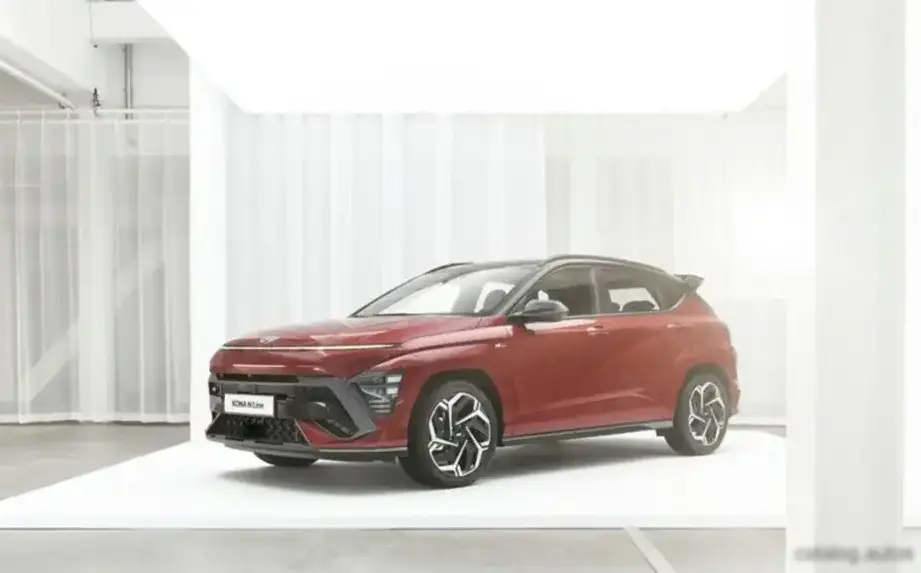
The Hyundai Kona II 1.6T (198 hp) DCT represents a significant offering within the second generation of Hyundai’s popular subcompact SUV, the Kona. Introduced in April 2023 and continuing through August 2024, this variant aimed to balance performance and efficiency, slotting into the mid-range of the Kona II lineup. It builds upon the foundation of the 1HX0/SX2 platform, offering a more refined driving experience and updated technology compared to its predecessor. This specific configuration, pairing the 1.6-liter turbocharged engine with a 7-speed dual-clutch transmission (DCT), was primarily targeted towards drivers seeking a responsive and fuel-efficient vehicle for daily commuting and recreational use.
Technical Specifications
| Brand | Hyundai |
| Model | Kona |
| Generation | Kona II |
| Type (Engine) | 1.6T (198 Hp) DCT |
| Start of production | April, 2023 |
| End of production | August, 2024 |
| Powertrain Architecture | Internal Combustion engine |
| Body type | SUV |
| Seats | 5 |
| Doors | 5 |
| CO2 emissions (WLTP) | 131-150 g/km |
| Fuel Type | Petrol (Gasoline) |
| Acceleration 0 – 100 km/h | 7.8 sec |
| Acceleration 0 – 62 mph | 7.8 sec |
| Acceleration 0 – 60 mph | 7.4 sec |
| Maximum speed | 209 km/h (129.87 mph) |
| Emission standard | Euro 6d |
| Weight-to-power ratio | 6.9 kg/Hp, 145.6 Hp/tonne |
| Weight-to-torque ratio | 5.1 kg/Nm, 194.9 Nm/tonne |
| Power | 198 Hp @ 6000 rpm |
| Power per litre | 123.9 Hp/l |
| Torque | 265 Nm @ 1600-4500 rpm (195.45 lb.-ft. @ 1600-4500 rpm) |
| Engine layout | Front, Transverse |
| Engine Model/Code | Smartstream |
| Engine displacement | 1598 cm3 (97.52 cu. in.) |
| Number of cylinders | 4 |
| Engine configuration | Inline |
| Cylinder Bore | 75.6 mm (2.98 in.) |
| Piston Stroke | 89 mm (3.5 in.) |
| Compression ratio | 10:1 |
| Number of valves per cylinder | 4 |
| Fuel injection system | Direct injection |
| Engine aspiration | Turbocharger, Intercooler |
| Valvetrain | DOHC |
| Engine systems | Start & Stop System, Particulate filter |
| Kerb Weight | 1360-1490 kg (2998.29 – 3284.89 lbs.) |
| Max. weight | 1915 kg (4221.85 lbs.) |
| Max load | 425-555 kg (936.96 – 1223.57 lbs.) |
| Trunk (boot) space – minimum | 466 l (16.46 cu. ft.) |
| Trunk (boot) space – maximum | 1300 l (45.91 cu. ft.) |
| Fuel tank capacity | 47 l (12.42 US gal | 10.34 UK gal) |
| Max. roof load | 100 kg (220.46 lbs.) |
| Permitted trailer load with brakes (12%) | 1300 kg (2866.01 lbs.) |
| Permitted towbar download | 80 kg (176.37 lbs.) |
| Length | 4350 mm (171.26 in.) |
| Width | 1825 mm (71.85 in.) |
| Height | 1585 mm (62.4 in.) |
| Wheelbase | 2660 mm (104.72 in.) |
| Front track | 1591 mm (62.64 in.) |
| Rear (Back) track | 1600 mm (62.99 in.) |
| Minimum turning circle | 10.6 m (34.78 ft.) |
| Drivetrain Architecture | The Internal combustion engine (ICE) drives the front wheels of the vehicle. |
| Drive wheel | Front wheel drive |
| Number of gears and type of gearbox | 7 gears, automatic transmission DCT |
| Front suspension | Independent type McPherson |
| Rear suspension | Torsion |
| Front brakes | Ventilated discs |
| Rear brakes | Disc |
| Assisting systems | ABS (Anti-lock braking system) |
| Steering type | Steering rack and pinion |
| Power steering | Electric Steering |
| Tires size | 215/60 R17; 215/55 R18 |
| Wheel rims size | 7.0J x 17; 7J x 18 |
Powertrain & Engine Architecture
At the heart of the Kona II 1.6T DCT lies Hyundai’s Smartstream 1.6-liter turbocharged four-cylinder engine. This engine, internally designated as part of the Gamma family, utilizes direct injection and a twin-scroll turbocharger to deliver a responsive and efficient power output. The engine’s design emphasizes reduced friction and optimized combustion for improved fuel economy. The 1.6T produces 198 horsepower at 6,000 rpm and 265 Nm (195 lb-ft) of torque between 1,600 and 4,500 rpm. This broad torque curve contributes to strong acceleration in everyday driving situations. The engine is paired with a 7-speed dual-clutch transmission (DCT), which offers quick and smooth gear changes, enhancing both performance and fuel efficiency. The DCT’s programming prioritizes comfort and efficiency in normal driving modes, with a sport mode available for more aggressive shifting.
Driving Characteristics
The 1.6T DCT variant of the Kona II delivers a noticeably more spirited driving experience compared to lower-powered engine options. Acceleration from 0 to 60 mph takes approximately 7.4 seconds, making it competitive within the subcompact SUV segment. The DCT provides seamless gear transitions, minimizing power interruption during acceleration. While not as overtly sporty as some rivals, the Kona II 1.6T offers a balanced and engaging driving experience. The steering is light and precise, making it easy to maneuver in urban environments. The suspension is tuned for comfort, absorbing bumps and imperfections in the road surface effectively. However, it may exhibit some body roll during aggressive cornering. The DCT’s gear ratios are well-matched to the engine’s torque curve, providing ample power for highway merging and overtaking.
Equipment & Trim Levels
The Kona II 1.6T DCT was typically offered in SEL Convenience, and Limited trim levels. Standard features generally included automatic climate control, a touchscreen infotainment system with Apple CarPlay and Android Auto compatibility, a rearview camera, and a suite of advanced driver-assistance systems (ADAS) such as lane-keeping assist and forward collision warning. Higher trim levels added features such as a larger touchscreen display, a premium sound system, leather upholstery, heated and ventilated front seats, and a sunroof. Optional extras included a head-up display, adaptive cruise control, and a wireless charging pad.
Chassis & Braking
The Kona II utilizes a front-wheel-drive platform with an independent McPherson strut suspension in the front and a torsion beam suspension in the rear. This setup provides a good balance of ride comfort and handling. The front brakes are ventilated discs, while the rear brakes are solid discs. The braking system is equipped with ABS (Anti-lock Braking System) and electronic stability control (ESC) for enhanced safety. The steering system is an electric power-assisted rack and pinion system, providing precise and responsive steering feel.
Market Reception & Comparison
The Hyundai Kona II 1.6T DCT was generally well-received by automotive critics. Reviewers praised its responsive engine, smooth-shifting DCT, and comfortable ride. Fuel economy was also a strong point, with the Kona II 1.6T achieving an estimated 30 mpg combined. Compared to other trims in the Kona lineup, the 1.6T offered a significant performance upgrade over the base engine while remaining more affordable than the N Line performance variant. It competed with other subcompact SUVs such as the Mazda CX-30, Honda HR-V, and Toyota C-HR.
Legacy
The Hyundai Kona II 1.6T DCT has proven to be a reliable and durable powertrain. The Smartstream engine and DCT transmission have demonstrated good long-term reliability, with few reported issues. In the used car market, the Kona II 1.6T DCT holds its value well, thanks to its combination of performance, efficiency, and features. It remains a popular choice for buyers seeking a well-rounded and affordable subcompact SUV.