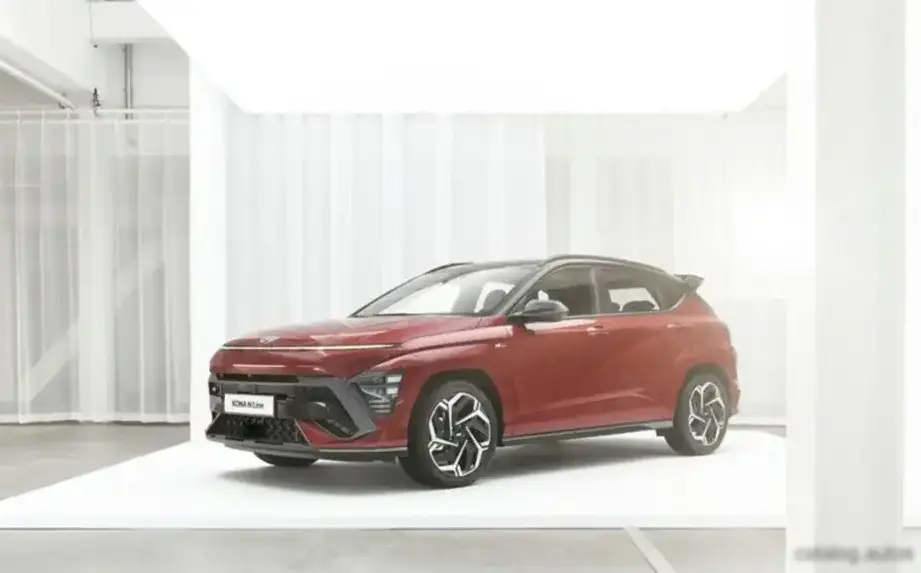
The Hyundai Kona II 2.0 MPI (147 Hp) AWD IVT is a compact SUV introduced in April 2023 as part of the second generation (Kona II) of the Hyundai Kona. This variant occupies a mid-range position within the Kona II lineup, offering a balance between fuel efficiency, all-weather capability with its all-wheel-drive system, and a relatively accessible price point. It’s designed to appeal to buyers seeking a versatile and practical small SUV for daily commuting and light adventure. The Kona II platform (internally designated as SX2) represents a significant evolution over the first-generation model, with increased dimensions and a more refined driving experience.
Technical Specifications
| Brand | Hyundai |
| Model | Kona |
| Generation | Kona II |
| Type (Engine) | 2.0 MPI (147 Hp) AWD IVT |
| Start of production | April, 2023 |
| Powertrain Architecture | Internal Combustion engine |
| Body type | SUV |
| Seats | 5 |
| Doors | 5 |
| Fuel Type | Petrol (Gasoline) |
| Emission standard | WCC + UCC / SULEV 30 |
| Weight-to-power ratio | 9.9 kg/Hp, 101.2 Hp/tonne |
| Weight-to-torque ratio | 8.1 kg/Nm, 123.2 Nm/tonne |
| Power | 147 Hp @ 6200 rpm |
| Power per litre | 73.5 Hp/l |
| Torque | 179 Nm @ 4500 rpm (132.02 lb.-ft. @ 4500 rpm) |
| Engine layout | Front, Transverse |
| Engine Model/Code | Nu PE |
| Engine displacement | 1999 cm3 (121.99 cu. in.) |
| Number of cylinders | 4 |
| Engine configuration | Inline |
| Cylinder Bore | 81 mm (3.19 in.) |
| Piston Stroke | 97 mm (3.82 in.) |
| Compression ratio | 12.5:1 |
| Number of valves per cylinder | 4 |
| Fuel injection system | Multi-port manifold injection |
| Engine aspiration | Naturally aspirated engine |
| Valvetrain | DOHC, DCVVT |
| Engine systems | Start & Stop System |
| Kerb Weight | 1453-1515 kg (3203.32 – 3340 lbs.) |
| Max. weight | 1940 kg (4276.97 lbs.) |
| Max load | 425-487 kg (936.96 – 1073.65 lbs.) |
| Trunk (boot) space – minimum | 722 l (25.5 cu. ft.) |
| Trunk (boot) space – maximum | 1804 l (63.71 cu. ft.) |
| Fuel tank capacity | 47 l (12.42 US gal | 10.34 UK gal) |
| Max. roof load | 100 kg (220.46 lbs.) |
| Length | 4351 mm (171.3 in.) |
| Width | 1826 mm (71.89 in.) |
| Height | 1610-1615 mm (63.39 – 63.58 in.) |
| Wheelbase | 2659 mm (104.69 in.) |
| Front track | 1590 mm (62.6 in.) |
| Rear (Back) track | 1598-1600 mm (62.91 – 62.99 in.) |
| Front overhang | 861 mm (33.9 in.) |
| Rear overhang | 831 mm (32.72 in.) |
| Ride height (ground clearance) | 206-211 mm (8.11 – 8.31 in.) |
| Drag coefficient (Cd) | 0.302 |
| Minimum turning circle (turning diameter) | 10.6 m (34.78 ft.) |
| Drivetrain Architecture | The Internal combustion engine (ICE) drives the front wheels permanently, and the rear wheels are driven through an electrically or mechanically operated clutch if necessary. |
| Drive wheel | All wheel drive (4×4) |
| Number of gears and type of gearbox | automatic transmission IVT |
| Front suspension | Independent type McPherson, Transverse stabilizer |
| Rear suspension | Independent multi-link spring suspension with stabilizer |
| Front brakes | Ventilated discs, 304.8 mm |
| Rear brakes | Disc, 284.48 mm |
| Assisting systems | ABS (Anti-lock braking system) |
| Steering type | Steering rack and pinion |
| Power steering | Electric Steering |
| Tires size | 215/60 R17; 215/55 R18; 235/50 R18; 235/45 R19 |
| Wheel rims size | 7J x 17; 7J x 18; 7.5J x 18; 8J x 19 |
Powertrain & Engine Architecture
The Kona II 2.0 MPI AWD utilizes Hyundai’s Nu PE four-cylinder engine, a naturally aspirated 2.0-liter powerplant. This engine produces 147 horsepower at 6,200 rpm and 179 Nm (132.02 lb-ft) of torque at 4,500 rpm. It features multi-port fuel injection and a double overhead camshaft (DOHC) valvetrain with continuously variable valve timing (DCVVT) on both intake and exhaust sides. The engine’s design prioritizes reliability and fuel efficiency over outright performance. The engine is transversely mounted at the front of the vehicle.
Power is transmitted to all four wheels via Hyundai’s Intelligent Variable Transmission (IVT), a type of continuously variable transmission (CVT). Unlike traditional stepped automatic transmissions, the IVT uses a belt and pulley system to provide a seamless and continuously adjustable gear ratio. This contributes to smoother acceleration and improved fuel economy. The all-wheel-drive system operates primarily as a front-wheel-drive system, engaging the rear wheels automatically when traction is lost or during specific driving modes.
Driving Characteristics
The 147 hp and 179 Nm of torque delivered by the 2.0 MPI engine, coupled with the IVT, results in adequate, but not particularly exhilarating, performance. Acceleration from 0 to 60 mph is estimated to be around 9.5-10.5 seconds. The IVT prioritizes smooth operation and fuel efficiency, sometimes resulting in a “rubber band” feel during hard acceleration, where engine rpm rises before vehicle speed catches up. Compared to the more powerful turbocharged engines offered in the Kona II lineup, this variant feels less responsive. However, the IVT’s seamless operation makes it well-suited for city driving and relaxed highway cruising. The all-wheel-drive system provides enhanced stability and traction in inclement weather conditions.
Equipment & Trim Levels
The 2.0 MPI AWD trim typically includes standard features such as automatic climate control, a touchscreen infotainment system with Apple CarPlay and Android Auto compatibility, a rearview camera, and a suite of driver-assistance technologies including lane keeping assist and forward collision avoidance assist. Interior upholstery is typically cloth, with options for upgraded leatherette or leather available on higher sub-trims. Optional extras often include a sunroof, heated seats, and a premium audio system. The specific standard and optional equipment can vary depending on the market and package selections.
Chassis & Braking
The Kona II utilizes a McPherson strut front suspension and a multi-link rear suspension, providing a comfortable and controlled ride. Stabilizer bars are fitted to both the front and rear axles to reduce body roll during cornering. The braking system consists of ventilated discs at the front and solid discs at the rear. Anti-lock braking system (ABS) is standard. The suspension tuning is geared towards comfort and everyday usability, rather than sporty handling.
Market Reception & Comparison
The Kona II 2.0 MPI AWD is generally well-received as a practical and affordable entry point into the Kona lineup. Critics praise its comfortable ride, spacious interior, and comprehensive suite of standard features. However, some reviewers note that the engine can feel underpowered, particularly when fully loaded or driving uphill. Compared to the turbocharged engine options, the 2.0 MPI offers lower performance but typically achieves better fuel economy. The 2.0 MPI is often positioned as a competitor to other compact SUVs such as the Mazda CX-5, Honda HR-V, and Toyota Corolla Cross.
Legacy
The Nu PE engine family has a proven track record of reliability in Hyundai vehicles. While the IVT is a relatively new transmission technology for Hyundai, it has demonstrated good durability in other models. The Kona II 2.0 MPI AWD is expected to hold its value reasonably well in the used car market, appealing to buyers seeking a reliable and fuel-efficient compact SUV. Long-term reliability will depend on proper maintenance and driving habits, but the engine and transmission combination is generally considered to be robust.