
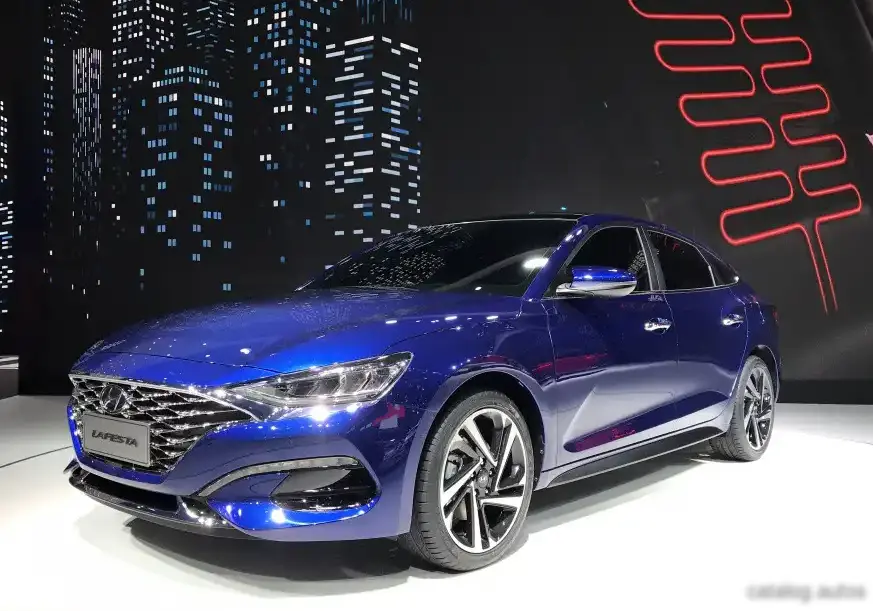
The Hyundai Lafesta 280 T GDi, introduced in 2018, represents a significant offering in the compact sedan segment, particularly within the Chinese automotive market where it was primarily sold. Positioned as a more stylish and technologically advanced alternative to the Elantra (Avante in some markets), the Lafesta aimed to appeal to a younger demographic seeking a blend of performance, fuel efficiency, and modern design. This specific variant, equipped with the 1.6-liter turbocharged G4FJ engine producing 190 horsepower and a 7-speed dual-clutch transmission (DCT), occupied a mid-to-upper trim level within the Lafesta lineup, offering a step up in performance from the base engine options.
Technical Specifications
| Brand | Hyundai |
| Model | Lafesta |
| Type (Engine) | 280 T GDi (190 Hp) DCT |
| Start of production | 2018 |
| Powertrain Architecture | Internal Combustion engine |
| Body type | Sedan |
| Seats | 5 |
| Doors | 4 |
| Fuel consumption (combined) | 5.7 l/100 km (41.3 US mpg, 49.6 UK mpg, 17.5 km/l) |
| Fuel Type | Petrol (Gasoline) |
| Maximum speed | 218 km/h (135.46 mph) |
| Weight-to-power ratio | 7 kg/Hp, 143.4 Hp/tonne |
| Weight-to-torque ratio | 5 kg/Nm, 200 Nm/tonne |
| Power | 190 Hp @ 6000 rpm |
| Power per litre | 119.4 Hp/l |
| Torque | 265 Nm @ 1500-4500 rpm (195.45 lb.-ft. @ 1500-4500 rpm) |
| Engine layout | Front, Transverse |
| Engine Model/Code | Gamma II / G4FJ |
| Engine displacement | 1591 cm3 (97.09 cu. in.) |
| Number of cylinders | 4 |
| Engine configuration | Inline |
| Fuel injection system | Direct injection |
| Engine aspiration | Turbocharger, Intercooler |
| Engine oil capacity | 4.5 l (4.76 US qt | 3.96 UK qt) |
| Coolant | 6.4 l (6.76 US qt | 5.63 UK qt) |
| Kerb Weight | 1325 kg (2921.12 lbs) |
| Trunk (boot) space – maximum | 475 l (16.77 cu. ft) |
| Fuel tank capacity | 53 l (14 US gal | 11.66 UK gal) |
| Length | 4660 mm (183.46 in) |
| Width | 1790 mm (70.47 in) |
| Height | 1425 mm (56.1 in) |
| Wheelbase | 2700 mm (106.3 in) |
| Drivetrain Architecture | The Internal combustion engine (ICE) drives the front wheels of the vehicle. |
| Drive wheel | Front wheel drive |
| Number of gears and type of gearbox | 7 gears, automatic transmission DCT |
| Front suspension | Independent type McPherson |
| Rear suspension | Independent multi-link suspension |
| Tires size | 225/45 R17 |
| Wheel rims size | 17 |
Powertrain & Engine Architecture
The heart of the Lafesta 280 T GDi is Hyundai’s Gamma II engine family, specifically the G4FJ 1.6-liter inline-four. This engine utilizes direct injection technology, allowing for precise fuel delivery and improved combustion efficiency. A single scroll twin-scroll turbocharger, coupled with an intercooler, boosts power output and mitigates turbo lag. The engine’s architecture is designed for both performance and fuel economy, featuring a relatively high compression ratio and optimized intake and exhaust port designs. The 7-speed dual-clutch transmission (DCT) plays a crucial role in delivering smooth and rapid gear changes, enhancing both acceleration and driving experience. This DCT, sourced from Hyundai’s own development, offers quicker shifts compared to traditional automatic transmissions, contributing to the car’s sporty character.
Driving Characteristics
The 190 horsepower and 265 Nm (195 lb-ft) of torque provided by the 1.6T GDi engine and 7-speed DCT combination deliver a noticeably more engaging driving experience than the base engine options available on the Lafesta. Acceleration is brisk, with the car feeling responsive in everyday driving situations. The DCT’s quick shifts contribute to a sense of immediacy, particularly during overtaking maneuvers. While not a dedicated sports sedan, the Lafesta 280 T GDi offers a good balance between comfort and performance. The DCT is programmed with a focus on fuel efficiency in normal driving modes, but switching to Sport mode sharpens throttle response and holds gears longer for more spirited driving. Compared to a manual transmission equipped Lafesta, the DCT offers convenience and ease of use, though some purists might miss the direct control of a manual gearbox.
Equipment & Trim Levels
The 280 T GDi trim typically included a generous array of standard features. Interior appointments generally featured cloth or leatherette upholstery, depending on optional packages. Standard equipment often included a touchscreen infotainment system with Apple CarPlay and Android Auto compatibility, a rearview camera, automatic climate control, and keyless entry. Higher-spec versions could be equipped with features like a panoramic sunroof, leather seats, a premium sound system, and advanced driver-assistance systems (ADAS) such as lane keeping assist and adaptive cruise control. The overall interior design aimed for a modern and upscale feel, with a focus on ergonomics and user-friendliness.
Chassis & Braking
The Lafesta utilizes a front-wheel-drive platform with independent suspension at all four corners. The front suspension employs a McPherson strut setup, while the rear features a multi-link design. This configuration provides a good balance between ride comfort and handling precision. The steering is typically electrically assisted, offering a light and responsive feel. Braking duties are handled by disc brakes on all four wheels, providing adequate stopping power for everyday driving. The car’s weight distribution is relatively balanced, contributing to predictable handling characteristics. Stabilizer bars are included both front and rear to minimize body roll during cornering.
Market Reception & Comparison
The Hyundai Lafesta 280 T GDi was generally well-received by automotive critics in the Chinese market. Reviewers praised its stylish design, comfortable interior, and responsive powertrain. The 1.6T engine and DCT combination were highlighted as a significant improvement over the base engine options. Fuel economy was also considered competitive within its segment. Compared to rivals like the Volkswagen Lavida and the Honda Civic, the Lafesta offered a more modern and feature-rich package, though some critics noted that the ride quality wasn’t quite as refined as some of its competitors. The Lafesta aimed to attract a younger, more style-conscious buyer than the more conservatively styled Elantra.
Legacy
The Hyundai Lafesta, while not widely available outside of China, represents an important step in Hyundai’s design and engineering evolution. The 1.6T GDi engine and 7-speed DCT powertrain have proven to be relatively reliable, with few widespread issues reported. On the used car market, the Lafesta 280 T GDi holds its value reasonably well, particularly well-maintained examples with low mileage. Its combination of style, performance, and technology continues to appeal to buyers seeking a modern and efficient compact sedan. The Lafesta’s success in the Chinese market demonstrated Hyundai’s ability to cater to the specific preferences of local consumers, and its design language influenced subsequent Hyundai models.
