
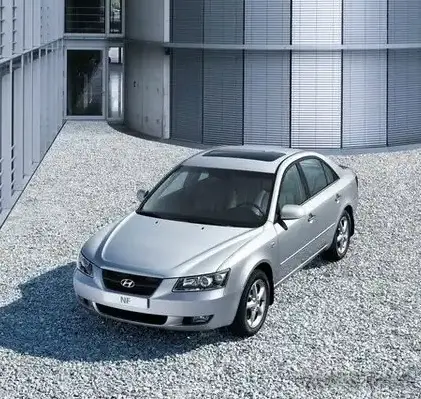
The Hyundai NF 2.4 i 16V Automatic, produced between 2004 and 2010, represents a significant step forward for Hyundai in the mid-size sedan segment. Part of the NF generation, this variant was positioned as a comfortable and well-equipped option, appealing to buyers prioritizing a smooth driving experience over outright performance. It served as a key model within Hyundai’s lineup, aiming to compete with established Japanese and American sedans in both domestic and export markets. The NF series, internally designated as the third generation Sonata, marked a departure from previous designs with a more refined aesthetic and improved mechanical components.
Technical Specifications
| Brand | Hyundai |
| Model | NF |
| Generation | NF |
| Type (Engine) | 2.4 i 16V (161 Hp) Automatic |
| Start of production | 2004 |
| End of production | 2010 |
| Powertrain Architecture | Internal Combustion engine |
| Body type | Sedan |
| Seats | 5 |
| Doors | 4 |
| Fuel Type | Petrol (Gasoline) |
| Acceleration 0 – 100 km/h | 10.4 sec |
| Acceleration 0 – 62 mph | 10.4 sec |
| Acceleration 0 – 60 mph | 9.9 sec |
| Maximum speed | 201 km/h (124.9 mph) |
| Weight-to-power ratio | 9.1 kg/Hp, 110 Hp/tonne |
| Weight-to-torque ratio | 6.7 kg/Nm, 149.7 Nm/tonne |
| Power | 161 Hp @ 5800 rpm |
| Power per litre | 68.2 Hp/l |
| Torque | 219 Nm @ 4250 rpm (161.53 lb.-ft. @ 4250 rpm) |
| Engine layout | Front, Transverse |
| Engine Model/Code | Theta / G4KC |
| Engine displacement | 2359 cm3 (143.96 cu. in.) |
| Number of cylinders | 4 |
| Engine configuration | Inline |
| Cylinder Bore | 88 mm (3.46 in.) |
| Piston Stroke | 97 mm (3.82 in.) |
| Compression ratio | 10.5:1 |
| Number of valves per cylinder | 4 |
| Fuel injection system | Multi-port manifold injection |
| Engine aspiration | Naturally aspirated engine |
| Valvetrain | DOHC |
| Engine oil capacity | 4.4 l (4.65 US qt | 3.87 UK qt) |
| Coolant | 6.5 l (6.87 US qt | 5.72 UK qt) |
| Kerb Weight | 1463 kg (3225.36 lbs.) |
| Max. weight | 2030 kg (4475.38 lbs.) |
| Max load | 567 kg (1250.02 lbs.) |
| Trunk (boot) space – minimum | 523 l (18.47 cu. ft.) |
| Fuel tank capacity | 70 l (18.49 US gal | 15.4 UK gal) |
| Length | 4800 mm (188.98 in.) |
| Width | 1832 mm (72.13 in.) |
| Height | 1474 mm (58.03 in.) |
| Wheelbase | 2730 mm (107.48 in.) |
| Front track | 1565 mm (61.61 in.) |
| Rear (Back) track | 1550 mm (61.02 in.) |
| Drivetrain Architecture | The Internal combustion engine (ICE) drives the front wheels of the vehicle. |
| Drive wheel | Front wheel drive |
| Number of gears and type of gearbox | 4 gears, automatic transmission |
| Front suspension | Double wishbone |
| Rear suspension | Transverse stabilizer |
| Front brakes | Ventilated discs |
| Rear brakes | Disc |
| Assisting systems | ABS (Anti-lock braking system) |
| Steering type | Steering rack and pinion |
| Tires size | 215/60 R16 |
| Wheel rims size | 6.5J X 16 |
INTRODUCTION
The Hyundai NF 2.4 i 16V Automatic, launched in 2004, was a crucial model for Hyundai as it sought to establish itself as a serious competitor in the global mid-size sedan market. Building upon the success of its predecessors, the NF generation (also known as the Sonata in many markets) offered a more sophisticated design, improved interior quality, and a range of modern features. This 2.4-liter, four-cylinder engine paired with a four-speed automatic transmission was a popular choice, offering a balance between fuel efficiency and adequate performance for everyday driving. It occupied a mid-range position in the NF lineup, slotting between the base 2.0-liter models and the more powerful 2.7-liter V6 options.
Powertrain & Engine Architecture
At the heart of the NF 2.4 i is the Hyundai Theta engine, specifically the G4KC code. This 2.4-liter inline-four engine utilizes a cast iron block with an aluminum cylinder head, a common configuration for balancing durability and weight. The engine employs multi-port fuel injection (MPI), delivering fuel directly into the intake ports rather than directly into the combustion chamber. This system, while not as advanced as direct injection, was reliable and cost-effective. The dual overhead camshaft (DOHC) valvetrain, with four valves per cylinder, contributes to improved breathing and overall engine efficiency. The four-speed automatic transmission, while not offering the efficiency of more modern gearboxes, provided smooth and predictable shifts, catering to drivers prioritizing comfort. The transmission was designed for durability and ease of maintenance, a key consideration for Hyundai at the time.
Driving Characteristics
The 2.4-liter engine, producing 161 horsepower and 219 Nm (161.53 lb.-ft.) of torque, delivered adequate performance for typical commuting and highway driving. Acceleration from 0-60 mph took approximately 9.9 seconds, which was competitive within its class but noticeably slower than the V6-powered variants. The four-speed automatic transmission, while smooth, lacked the responsiveness of manual transmissions or more modern automatics with additional gears. Gear ratios were tuned for fuel economy and comfortable cruising, resulting in a somewhat leisurely driving experience. The emphasis was on providing a relaxed and refined ride rather than sporty handling. Compared to the manual transmission versions, the automatic offered less driver engagement but greater convenience, appealing to a broader range of buyers.
Equipment & Trim Levels
The NF 2.4 i Automatic typically came standard with features such as air conditioning, power windows and locks, a basic audio system, and anti-lock brakes (ABS). Higher trim levels added features like alloy wheels, a sunroof, upgraded audio systems, and leather upholstery. Interior materials were generally of good quality for the price point, with a focus on providing a comfortable and spacious cabin. Optional extras included a CD changer, cruise control, and upgraded seat fabrics. The dashboard layout was functional and user-friendly, with clearly labeled controls and a straightforward instrument cluster.
Chassis & Braking
The NF utilized a front-wheel-drive layout with a double wishbone suspension in the front and a transverse stabilizer in the rear. This suspension setup provided a comfortable ride, absorbing bumps and irregularities in the road effectively. Braking duties were handled by ventilated discs in the front and solid discs in the rear, providing adequate stopping power for everyday driving. ABS was standard, enhancing safety by preventing wheel lockup during hard braking. The chassis was designed to prioritize ride comfort and stability over sporty handling, reflecting the target audience for this particular variant.
Market Reception & Comparison
The Hyundai NF 2.4 i Automatic was generally well-received by critics as a solid and reliable mid-size sedan. It was praised for its comfortable ride, spacious interior, and competitive price. However, some reviewers noted that the engine lacked the refinement and power of some of its Japanese competitors. Fuel economy was considered average for its class. Compared to the 2.0-liter models, the 2.4-liter offered a noticeable performance improvement, while the 2.7-liter V6 provided significantly more power but at the expense of fuel efficiency. The automatic transmission was seen as a convenient option, but some drivers preferred the greater control offered by the manual transmission.
Legacy
The Hyundai NF 2.4 i Automatic has proven to be a relatively reliable vehicle, with many examples still on the road today. The Theta engine, while not without its potential issues (such as oil consumption in some cases), is generally considered durable and long-lasting. The four-speed automatic transmission is also known for its reliability. In the used car market, the NF 2.4 i Automatic represents a good value proposition, offering a comfortable and practical sedan at an affordable price. It played a significant role in establishing Hyundai as a credible competitor in the mid-size sedan segment, paving the way for the company’s continued success in the years that followed.
