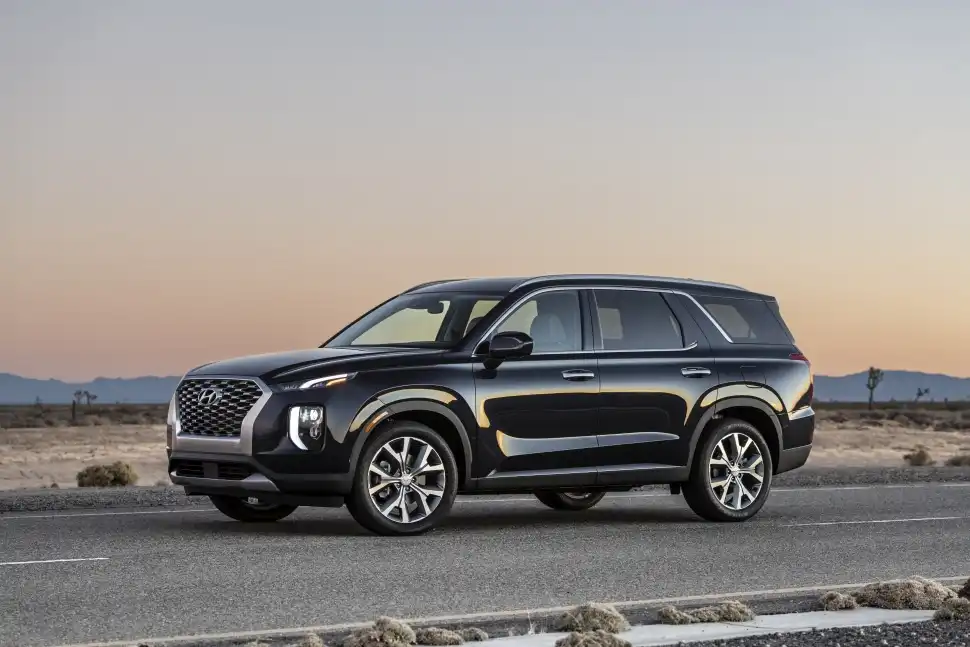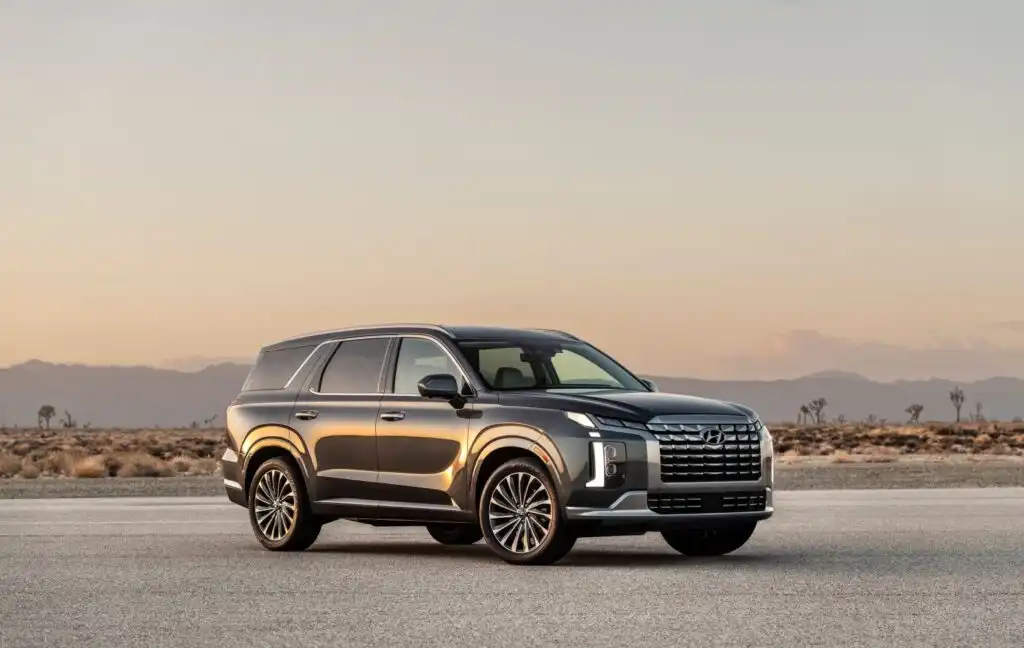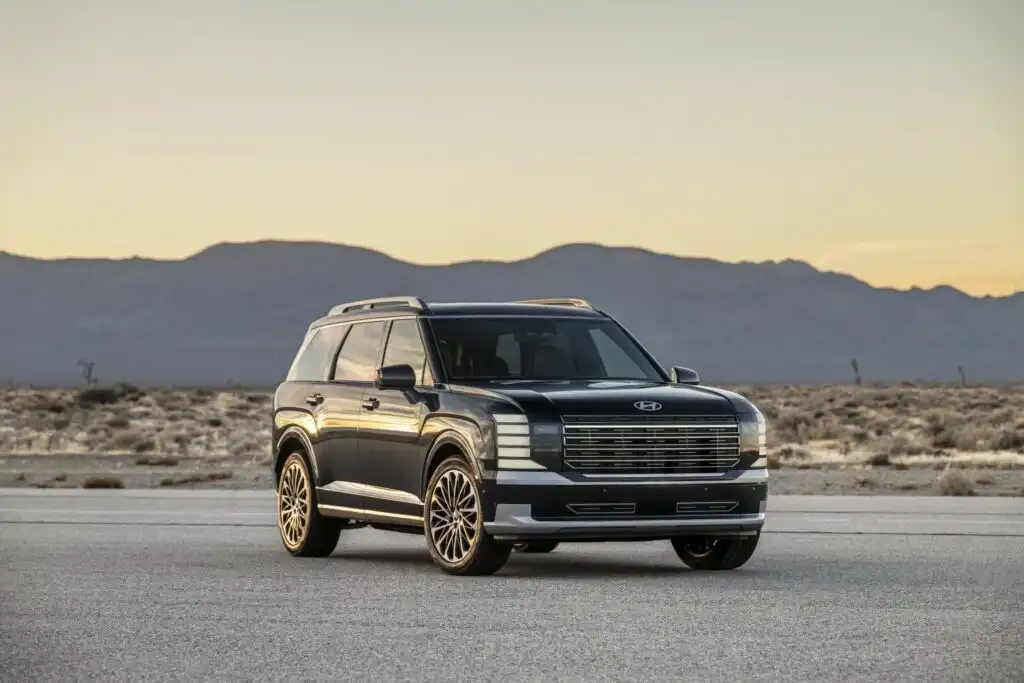
The Hyundai Palisade II 3.5 V6 HTRAC AWD Automatic represents the second generation of Hyundai’s flagship three-row SUV, launched in April 2025. Building upon the success of the first-generation Palisade, this variant aims to deliver a refined and technologically advanced driving experience within the highly competitive mid-size SUV segment. Positioned as a premium offering within the Palisade lineup, the 3.5 V6 HTRAC AWD Automatic caters to buyers seeking a blend of power, capability, and luxury features. It serves as a direct competitor to vehicles like the Toyota Highlander, Honda Pilot, and Kia Telluride, offering a compelling alternative with Hyundai’s signature value proposition.
Technical Specifications
| Brand | Hyundai |
| Model | Palisade |
| Generation | Palisade II |
| Type (Engine) | 3.5 V6 (287 Hp) HTRAC AWD Automatic |
| Start of production | April, 2025 |
| Powertrain Architecture | Internal Combustion engine |
| Body type | SUV, Crossover |
| Seats | 7-8 |
| Doors | 5 |
| Fuel Type | Petrol (Gasoline) |
| Power | 287 Hp @ 6400 rpm |
| Power per litre | 82.7 Hp/l |
| Torque | 353 Nm @ 5000 rpm |
| Torque (lb.-ft.) | 260.36 lb.-ft. @ 5000 rpm |
| Engine layout | Front, Longitudinal |
| Engine Model/Code | Smartstream |
| Engine displacement | 3470 cm3 |
| Engine displacement (cu. in.) | 211.75 cu. in. |
| Number of cylinders | 6 |
| Engine configuration | V-engine |
| Cylinder Bore | 92 mm |
| Cylinder Bore (in.) | 3.62 in. |
| Piston Stroke | 87 mm |
| Piston Stroke (in.) | 3.43 in. |
| Compression ratio | 12.3:1 |
| Number of valves per cylinder | 4 |
| Fuel injection system | Direct injection and Multi-port manifold injection |
| Engine aspiration | Naturally aspirated engine |
| Valvetrain | DOHC |
| Engine oil capacity | 6.6 l |
| Engine oil capacity (US qt) | 6.97 US qt |
| Engine oil capacity (UK qt) | 5.81 UK qt |
| Trunk (boot) space – minimum | 541 l |
| Trunk (boot) space – minimum (cu. ft.) | 19.11 cu. ft. |
| Trunk (boot) space – maximum | 2455 l |
| Trunk (boot) space – maximum (cu. ft.) | 86.7 cu. ft. |
| Fuel tank capacity | 72 l |
| Fuel tank capacity (US gal) | 19.02 US gal |
| Fuel tank capacity (UK gal) | 15.84 UK gal |
| Max. roof load | 100 kg |
| Max. roof load (lbs.) | 220.46 lbs. |
| Permitted trailer load with brakes (12%) | 2268 kg |
| Permitted trailer load with brakes (lbs.) | 5000.08 lbs. |
| Permitted trailer load without brakes | 748 kg |
| Permitted trailer load without brakes (lbs.) | 1649.06 lbs. |
| Length | 5060 mm |
| Length (in.) | 199.21 in. |
| Width | 1981 mm |
| Width (in.) | 77.99 in. |
| Height | 1765 mm |
| Height (in.) | 69.49 in. |
| Wheelbase | 2969 mm |
| Wheelbase (in.) | 116.89 in. |
| Front track | 1720 mm |
| Front track (in.) | 67.72 in. |
| Rear (Back) track | 1732 mm |
| Rear (Back) track (in.) | 68.19 in. |
| Front overhang | 925 mm |
| Front overhang (in.) | 36.42 in. |
| Rear overhang | 1166 mm |
| Rear overhang (in.) | 45.91 in. |
| Ride height (ground clearance) | 188 mm |
| Ride height (ground clearance) (in.) | 7.4 in. |
| Drag coefficient (Cd) | 0.31 |
| Minimum turning circle (turning diameter) | 11.9 m |
| Minimum turning circle (turning diameter) (ft.) | 39.04 ft. |
| Approach angle | 18.6° |
| Departure angle | 21.1° |
| Ramp-over (brakeover) angle | 16.3° |
| Drivetrain Architecture | The Internal combustion engine (ICE) drives the front wheels permanently, and the rear wheels are driven through an electrically or mechanically operated clutch if necessary. |
| Drive wheel | All wheel drive (4×4) |
| Number of gears and type of gearbox | 8 gears, automatic transmission |
| Front suspension | Independent, type McPherson with coil spring and anti-roll bar |
| Rear suspension | Independent multi-link spring suspension with stabilizer |
| Front brakes | Ventilated discs, 345×30 mm |
| Rear brakes | Disc, 325×20 mm |
| Assisting systems | ABS (Anti-lock braking system) |
| Steering type | Steering rack and pinion |
| Power steering | Electric Steering |
| Tires size | 235/65 R18 106H |
| Wheel rims size | 8.0J x 18 |
Powertrain & Engine Architecture
At the heart of the Palisade II 3.5 V6 HTRAC AWD Automatic lies Hyundai’s Smartstream 3.5-liter naturally aspirated V6 engine. This engine, part of Hyundai’s newer engine family, produces 287 horsepower at 6,400 rpm and 260 lb-ft of torque at 5,000 rpm. It features direct injection combined with multi-port fuel injection, optimizing both power delivery and fuel efficiency. The engine utilizes a dual overhead camshaft (DOHC) valvetrain with four valves per cylinder, contributing to its smooth operation and responsive performance. The engine is longitudinally mounted, powering all four wheels through Hyundai’s HTRAC all-wheel-drive system.
The HTRAC system is a multi-drive mode system, allowing drivers to select from various settings including Comfort, Sport, and Smart modes, as well as dedicated Snow mode. The system actively distributes torque between the front and rear axles based on driving conditions and driver input. The engine is paired with an eight-speed automatic transmission, specifically tuned for smooth and efficient shifting. This transmission offers a wide range of gear ratios, optimizing both acceleration and highway cruising.
Driving Characteristics
The 3.5 V6 engine delivers ample power for everyday driving and confident highway passing. While not as overtly sporty as some turbocharged competitors, the naturally aspirated V6 provides a linear and predictable power delivery. The eight-speed automatic transmission contributes to a refined driving experience, with smooth gear changes and minimal hesitation. The HTRAC all-wheel-drive system enhances traction and stability, particularly in inclement weather conditions. Compared to lower-trim Palisade models with the base engine, the 3.5 V6 offers a noticeable improvement in acceleration and overall performance. The gear ratios are optimized for a balance between fuel economy and responsiveness, making it a comfortable and capable daily driver.
Equipment & Trim Levels
The 3.5 V6 HTRAC AWD Automatic trim typically comes well-equipped with standard features such as leather upholstery, heated and ventilated front seats, a large touchscreen infotainment system with navigation, a premium sound system, and a suite of advanced driver-assistance systems (ADAS) including adaptive cruise control, lane-keeping assist, and automatic emergency braking. Optional extras often include a panoramic sunroof, a head-up display, and premium interior trim materials. The specific features available can vary depending on the package selected.
Chassis & Braking
The Palisade II utilizes an independent suspension setup at all four corners, featuring a McPherson strut design in the front and a multi-link setup in the rear. This suspension configuration provides a comfortable ride quality while maintaining good handling characteristics. The vehicle is equipped with ventilated disc brakes in the front and solid disc brakes in the rear, providing adequate stopping power for its weight class. An anti-lock braking system (ABS) is standard, along with electronic stability control and traction control systems.
Market Reception & Comparison
The Hyundai Palisade II 3.5 V6 HTRAC AWD Automatic has been well-received by automotive critics and consumers alike. It is praised for its spacious interior, comfortable ride, and comprehensive list of features. Compared to other trims in the Palisade lineup, the 3.5 V6 offers a significant performance upgrade, making it a popular choice for buyers who prioritize power and capability. Fuel economy is comparable to other V6-powered SUVs in its class, and reliability ratings have been generally positive.
Legacy
The Smartstream 3.5 V6 engine and eight-speed automatic transmission are expected to be reliable powertrains, based on Hyundai’s track record. While long-term reliability data is still emerging for the second-generation Palisade, the first-generation model demonstrated good durability. The 3.5 V6 HTRAC AWD Automatic variant is likely to hold its value well in the used car market, due to its desirable combination of features, performance, and all-wheel-drive capability. It represents a significant step forward for Hyundai in the mid-size SUV segment, offering a compelling alternative to established competitors.