
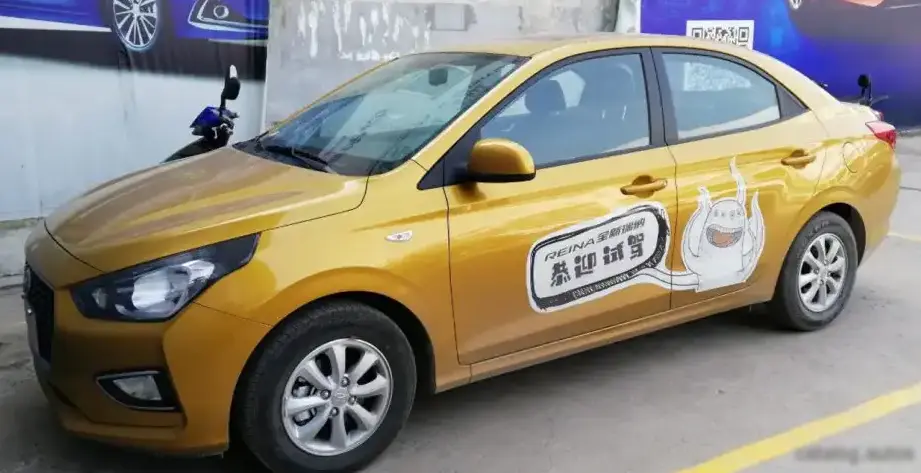
The Hyundai Reina 1.4 MPI (95 hp) Automatic is a subcompact sedan produced by the South Korean manufacturer Hyundai from September 2017 onwards. Positioned as an entry-level offering, the Reina aimed to provide affordable transportation in emerging markets, particularly in regions where Hyundai sought to expand its presence. It slots below the Accent in Hyundai’s global lineup, offering a more budget-conscious alternative. The Reina is based on the same platform as the Accent, but with a focus on cost-effectiveness and practicality. This specific 1.4-liter MPI engine paired with a four-speed automatic transmission represents a key configuration within the Reina range, targeting buyers prioritizing ease of use over outright performance.
Technical Specifications
| Brand | Hyundai |
| Model | Reina |
| Generation | Reina |
| Type (Engine) | 1.4 MPI (95 Hp) Automatic |
| Start of production | September, 2017 |
| Powertrain Architecture | Internal Combustion engine |
| Body type | Sedan |
| Seats | 5 |
| Doors | 4 |
| Fuel Type | Petrol (Gasoline) |
| Weight-to-power ratio | 10.9 kg/Hp, 91.5 Hp/tonne |
| Weight-to-torque ratio | 7.9 kg/Nm, 127.2 Nm/tonne |
| Power | 95 Hp @ 6000 rpm |
| Power per litre | 69.4 Hp/l |
| Torque | 132 Nm @ 4000 rpm (97.36 lb.-ft. @ 4000 rpm) |
| Engine layout | Front, Transverse |
| Engine Model/Code | Kappa II / G4LC |
| Engine displacement | 1368 cm3 (83.48 cu. in.) |
| Number of cylinders | 4 |
| Engine configuration | Inline |
| Number of valves per cylinder | 4 |
| Fuel injection system | Multi-port manifold injection |
| Engine aspiration | Naturally aspirated engine |
| Engine oil capacity | 3.5 l (3.7 US qt | 3.08 UK qt) |
| Coolant | 5.3 l (5.6 US qt | 4.66 UK qt) |
| Kerb Weight | 1038-1047 kg (2288.4 – 2308.24 lbs.) |
| Max. weight | 1500 kg (3306.93 lbs.) |
| Max load | 453-462 kg (998.69 – 1018.54 lbs.) |
| Fuel tank capacity | 43 l (11.36 US gal | 9.46 UK gal) |
| Length | 4300 mm (169.29 in.) |
| Width | 1705 mm (67.13 in.) |
| Height | 1460 mm (57.48 in.) |
| Wheelbase | 2570 mm (101.18 in.) |
| Drivetrain Architecture | The Internal combustion engine (ICE) drives the front wheels of the vehicle. |
| Drive wheel | Front wheel drive |
| Number of gears and type of gearbox | 4 gears, automatic transmission |
| Front suspension | Independent, type McPherson with coil spring and anti-roll bar |
| Rear suspension | Torsion |
| Front brakes | Disc |
| Rear brakes | Drum |
| Assisting systems | ABS (Anti-lock braking system) |
| Power steering | Hydraulic Steering |
| Wheel rims size | 5.0J x 14 |
Powertrain & Engine Architecture
The Reina 1.4 MPI Automatic utilizes Hyundai’s Kappa II engine family, specifically the G4LC code. This 1.4-liter inline-four engine is a naturally aspirated powerplant employing multi-point fuel injection. The engine’s design prioritizes fuel efficiency and reliability over high-performance output. The four-cylinder configuration provides a reasonable level of refinement for its class. The engine features a dual overhead camshaft (DOHC) valvetrain with four valves per cylinder, contributing to improved breathing and efficiency. The automatic transmission is a conventional four-speed unit. While not the most modern transmission available, it provides smooth and predictable shifts, catering to drivers who prefer the convenience of an automatic over a manual gearbox. The four-speed configuration is a cost-saving measure, as newer transmissions with more gears offer improved fuel economy and performance, but at a higher price point.
Driving Characteristics
The 95 hp output and four-speed automatic transmission result in a driving experience focused on practicality and ease of use. Acceleration is adequate for city driving and highway merging, but it’s not particularly brisk. The automatic transmission is tuned for smooth shifts and fuel economy, rather than aggressive performance. The gear ratios are spaced to provide reasonable acceleration from a standstill, but the limited number of gears means the engine can feel strained at higher speeds. Compared to a manual transmission version of the same engine, the automatic sacrifices some responsiveness and fuel efficiency. However, it offers a more relaxed driving experience, particularly in stop-and-go traffic. The Reina 1.4 Automatic is not designed for spirited driving; its strengths lie in providing comfortable and reliable transportation.
Equipment & Trim Levels
The Reina 1.4 MPI Automatic typically came with a basic level of standard equipment. This generally included air conditioning, power windows, central locking, and a basic audio system. Safety features such as ABS (Anti-lock Braking System) were also standard. Interior upholstery was typically cloth, with a simple and durable design. Optional extras could include alloy wheels, a more advanced audio system, and rear parking sensors. The trim level for this configuration was generally the base or mid-range offering, depending on the specific market. Hyundai aimed to keep the price point competitive, so the focus was on providing essential features rather than luxury amenities.
Chassis & Braking
The Reina utilizes a McPherson strut front suspension with a coil spring and anti-roll bar, providing a comfortable ride and reasonable handling. The rear suspension employs a torsion beam setup, which is a cost-effective solution that offers adequate stability. The front brakes are disc brakes, providing good stopping power, while the rear brakes are drum brakes, a cost-saving measure common in this segment. Hydraulic power steering is standard, offering a light and easy steering feel. The suspension tuning is geared towards comfort rather than sporty handling, prioritizing a smooth ride over sharp cornering.
Market Reception & Comparison
The Hyundai Reina 1.4 MPI Automatic was generally well-received in its target markets as an affordable and practical sedan. Critics praised its value for money and its comfortable ride. However, some reviewers noted its lack of refinement and its relatively low power output. Compared to other trims in the Reina lineup, such as those with manual transmissions or higher-output engines, the 1.4 Automatic offered less performance but greater convenience. Fuel economy was generally considered to be good for its class, but not exceptional. Reliability was also a positive point, with the Kappa II engine proving to be a durable and dependable unit.
Legacy
The Hyundai Reina, and specifically the 1.4 MPI Automatic variant, has established a reputation as a reliable and affordable used car. The Kappa II engine is known for its durability, and the four-speed automatic transmission, while not the most advanced, is generally dependable. Maintenance costs are relatively low, making it an attractive option for budget-conscious buyers. While it may not offer the performance or features of more modern vehicles, the Reina 1.4 Automatic remains a practical and economical choice for those seeking basic transportation. Its simplicity and proven mechanicals contribute to its continued appeal in the used car market.
