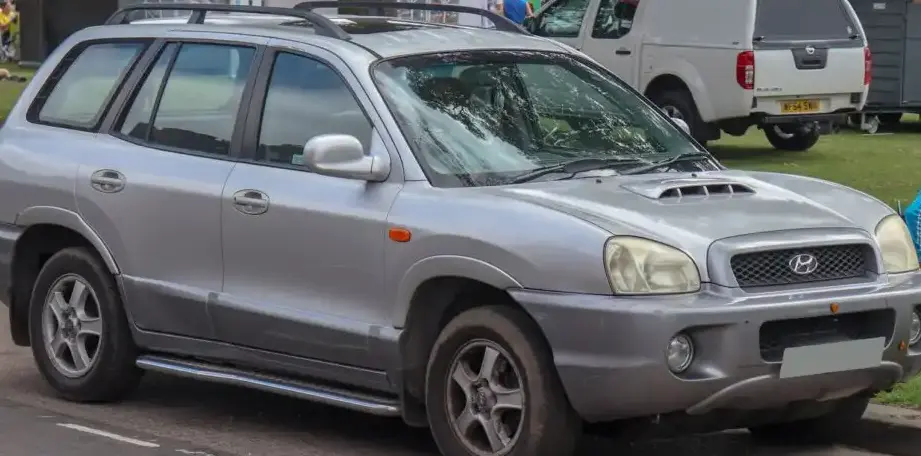
The Hyundai Santa Fe I (SM), produced from 2000 to 2006, represented a significant step for the South Korean automaker into the burgeoning compact SUV market. This first-generation Santa Fe, built on the SM platform, aimed to provide a more affordable and spacious alternative to established Japanese and American competitors. The 2.4 i 16V 4WD Automatic variant, powered by the Sirius/G4JS engine, occupied a middle ground in the Santa Fe lineup, offering a balance between price, fuel economy, and all-weather capability. It was positioned as a practical family vehicle, appealing to buyers seeking a versatile SUV without the expense of higher trim levels or more powerful engines.
Technical Specifications
| Brand | Hyundai |
| Model | Santa Fe |
| Generation | Santa Fe I (SM) |
| Type | 2.4 i 16V 4WD (146 Hp) Automatic |
| Start of production | 2000 |
| End of production | 2006 |
| Powertrain Architecture | Internal Combustion engine |
| Body type | SUV |
| Seats | 5 |
| Doors | 5 |
| Fuel Type | Petrol (Gasoline) |
| Acceleration 0 – 100 km/h | 11.4 sec |
| Acceleration 0 – 62 mph | 11.4 sec |
| Acceleration 0 – 60 mph | 10.8 sec |
| Maximum speed | 173 km/h (107.5 mph) |
| Weight-to-power ratio | 12.2 kg/Hp, 82.2 Hp/tonne |
| Weight-to-torque ratio | 8.9 kg/Nm, 112.6 Nm/tonne |
| Power | 146 Hp @ 5500 rpm |
| Power per litre | 62.1 Hp/l |
| Torque | 200 Nm @ 4000 rpm (147.51 lb.-ft. @ 4000 rpm) |
| Engine layout | Front, Transverse |
| Engine Model/Code | Sirius / G4JS |
| Engine displacement | 2351 cm3 (143.47 cu. in.) |
| Number of cylinders | 4 |
| Engine configuration | Inline |
| Cylinder Bore | 86.5 mm (3.41 in.) |
| Piston Stroke | 100 mm (3.94 in.) |
| Compression ratio | 10:1 |
| Number of valves per cylinder | 4 |
| Fuel injection system | Multi-port manifold injection |
| Engine aspiration | Naturally aspirated engine |
| Valvetrain | DOHC |
| Engine oil capacity | 4.3 l (4.54 US qt | 3.78 UK qt) |
| Coolant capacity | 7 l (7.4 US qt | 6.16 UK qt) |
| Kerb Weight | 1776 kg (3915.41 lbs.) |
| Max. weight | 2380 kg (5247 lbs.) |
| Max load | 604 kg (1331.59 lbs.) |
| Trunk (boot) space – minimum | 469 l (16.56 cu. ft.) |
| Trunk (boot) space – maximum | 1473 l (52.02 cu. ft.) |
| Fuel tank capacity | 65 l (17.17 US gal | 14.3 UK gal) |
| Length | 4500 mm (177.17 in.) |
| Width | 1820 mm (71.65 in.) |
| Height | 1675 mm (65.94 in.) |
| Wheelbase | 2620 mm (103.15 in.) |
| Front track | 1540 mm (60.63 in.) |
| Rear (Back) track | 1540 mm (60.63 in.) |
| Drive wheel | All wheel drive (4×4) |
| Number of gears | 4 |
| Gearbox type | Automatic transmission |
| Front suspension | Wishbone |
| Rear suspension | Coil spring |
| Front brakes | Ventilated discs |
| Rear brakes | Disc |
| Assisting systems | ABS (Anti-lock braking system) |
| Steering type | Steering rack and pinion |
| Power steering | Hydraulic Steering |
| Tires size | 225/70 R16 H |
| Wheel rims size | 16 |
Powertrain & Engine Architecture
The heart of the 2.4 i 4WD Santa Fe is the Hyundai Sirius engine, internally designated G4JS. This 2.4-liter inline-four cylinder engine utilizes a dual overhead camshaft (DOHC) valvetrain with four valves per cylinder, contributing to its respectable power output for its displacement. Fuel delivery is managed by a multi-port fuel injection system, a common setup for the era, providing adequate atomization for efficient combustion. The engine produces 146 horsepower at 5,500 rpm and 200 Nm (147.51 lb-ft) of torque at 4,000 rpm. The engine’s design prioritized reliability and ease of maintenance over outright performance. Paired with the engine is a four-speed automatic transmission. While not offering the responsiveness of a manual gearbox, this automatic provided smooth shifts and ease of use, appealing to a broader range of drivers. The transmission was tuned for comfort and fuel efficiency rather than sporty acceleration.
Driving Characteristics
The 2.4L engine and four-speed automatic combination in the Santa Fe delivered adequate, but not exhilarating, performance. Acceleration from 0-60 mph took around 10.8 seconds, making it competitive with other SUVs in its class, but noticeably slower than models equipped with V6 engines. The automatic transmission’s gear ratios were optimized for everyday driving, providing sufficient power for highway cruising and city commutes. However, passing maneuvers required careful planning. The all-wheel-drive system provided enhanced traction in inclement weather, making it a capable vehicle for regions experiencing snow or rain. The suspension, tuned for comfort, absorbed bumps and irregularities in the road well, but didn’t offer particularly sporty handling.
Equipment & Trim Levels
The 2.4 i 4WD Automatic Santa Fe typically came standard with features such as air conditioning, power windows and locks, and an AM/FM radio with a CD player. Higher trim levels added options like a sunroof, upgraded audio systems, leather upholstery, and alloy wheels. The interior was generally functional and well-built for its price point, with durable materials and a straightforward layout. Safety features included dual front airbags and ABS (Anti-lock Braking System). The 4WD system was a key feature of this trim, adding to its appeal in regions with challenging weather conditions.
Chassis & Braking
The Santa Fe I utilized a traditional body-on-frame construction, providing a robust and durable chassis. The front suspension employed a wishbone design, while the rear suspension featured coil springs. This setup prioritized ride comfort over handling precision. Braking duties were handled by ventilated discs at the front and solid discs at the rear. The ABS system helped to maintain steering control during hard braking. The Santa Fe’s weight of approximately 1776 kg (3915.41 lbs) contributed to its stable feel on the road, but also impacted its acceleration and fuel economy.
Market Reception & Comparison
The Hyundai Santa Fe I was generally well-received by critics as a value-oriented SUV. The 2.4L engine and automatic transmission combination was often praised for its fuel efficiency and ease of use, but criticized for its lack of power compared to V6-equipped rivals. Compared to the more powerful V6 models within the Santa Fe lineup, the 2.4L offered lower running costs and a more affordable price tag, making it attractive to budget-conscious buyers. Against competitors like the Honda CR-V and Toyota RAV4, the Santa Fe offered more interior space and a lower price point, but lacked the established reputation for reliability of the Japanese brands.
Legacy
The Hyundai Santa Fe I, particularly the 2.4 i 4WD Automatic variant, has proven to be a relatively reliable vehicle in the used car market. The Sirius engine is known for its durability, and the four-speed automatic transmission, while not technologically advanced, is generally dependable. Common maintenance issues include routine wear items such as brakes, tires, and suspension components. The Santa Fe I laid the foundation for Hyundai’s success in the SUV segment, establishing the brand as a viable alternative to established competitors. Today, well-maintained examples of the first-generation Santa Fe can still be found on the road, offering affordable and practical transportation.