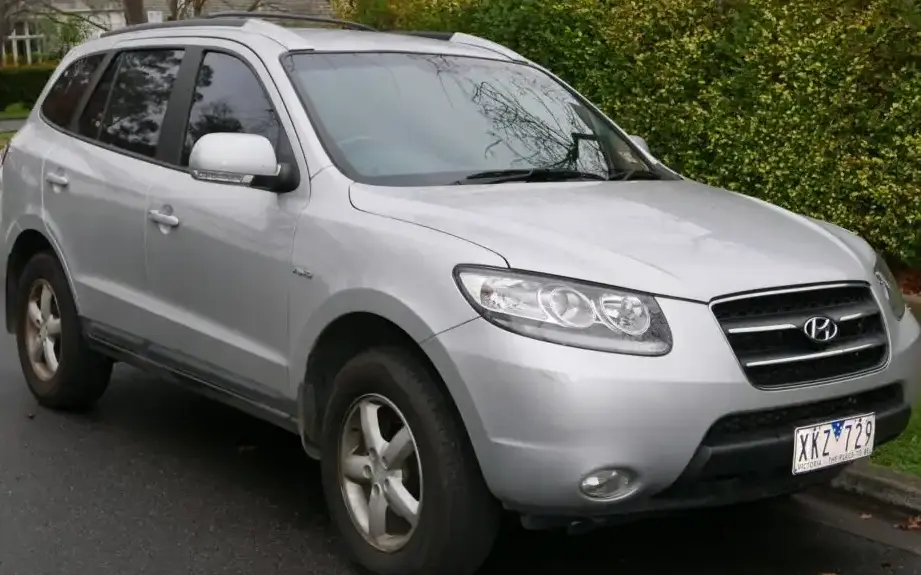
The Hyundai Santa Fe II (CM) 2.2 CRDi 4WD Automatic, produced between 2006 and 2009, represented a significant step forward for Hyundai in the mid-size SUV segment. This variant, powered by the D4EA 2.2-liter diesel engine and paired with a five-speed automatic transmission, was positioned as a comfortable and capable all-weather option within the CM Santa Fe lineup. It aimed to appeal to families and individuals seeking a practical SUV with the added security of four-wheel drive. The CM generation Santa Fe, introduced as a replacement for the first-generation Santa Fe (SM), offered increased interior space and improved refinement compared to its predecessor, and this 2.2 CRDi Automatic model was a key part of that evolution.
Technical Specifications
| Brand | Hyundai |
| Model | Santa Fe |
| Generation | Santa Fe II (CM) |
| Type (Engine) | 2.2 CRDi (150 Hp) 4WD Automatic |
| Start of production | 2006 |
| End of production | 2009 |
| Powertrain Architecture | Internal Combustion engine |
| Body type | SUV |
| Seats | 5-7 |
| Doors | 5 |
| Fuel consumption (urban) | 11 l/100 km (21.4 US mpg) |
| Fuel consumption (extra urban) | 6.4 l/100 km (36.8 US mpg) |
| Fuel consumption (combined) | 8.1 l/100 km (29 US mpg) |
| Fuel Type | Diesel |
| Acceleration 0 – 100 km/h | 12.9 sec |
| Acceleration 0 – 62 mph | 12.9 sec |
| Acceleration 0 – 60 mph | 12.3 sec |
| Maximum speed | 178 km/h (110.6 mph) |
| Emission standard | Euro 3 |
| Weight-to-power ratio | 12.2 kg/Hp |
| Weight-to-torque ratio | 5.4 kg/Nm |
| Power | 150 Hp @ 4000 rpm |
| Torque | 335 Nm @ 1800 rpm (247.08 lb.-ft. @ 1800 rpm) |
| Engine layout | Front, Transverse |
| Engine displacement | 2188 cm3 (133.52 cu. in.) |
| Number of cylinders | 4 |
| Engine configuration | Inline |
| Cylinder Bore | 87 mm (3.43 in.) |
| Piston Stroke | 92 mm (3.62 in.) |
| Compression ratio | 17.3:1 |
| Number of valves per cylinder | 4 |
| Fuel injection system | Diesel Commonrail |
| Engine aspiration | Turbocharger, Intercooler |
| Engine oil capacity | 5.9 l (6.23 US qt | 5.19 UK qt) |
| Coolant capacity | 8.4 l (8.88 US qt | 7.39 UK qt) |
| Kerb Weight | 1823 kg (4019.03 lbs.) |
| Max. weight | 2520 kg (5555.65 lbs.) |
| Max load | 697 kg (1536.62 lbs.) |
| Trunk (boot) space – minimum | 774 l (27.33 cu. ft.) |
| Trunk (boot) space – maximum | 2274 l (80.31 cu. ft.) |
| Fuel tank capacity | 75 l (19.81 US gal | 16.5 UK gal) |
| Length | 4650 mm (183.07 in.) |
| Width | 1890 mm (74.41 in.) |
| Height | 1725 mm (67.91 in.) |
| Wheelbase | 2700 mm (106.3 in.) |
| Front track | 1615 mm (63.58 in.) |
| Rear track | 1620 mm (63.78 in.) |
| Drive wheel | All wheel drive (4×4) |
| Number of gears | 5 |
| Gearbox type | Automatic transmission |
| Front suspension | Independent, McPherson with coil spring and anti-roll bar |
| Rear suspension | Independent multi-link with stabilizer |
| Front brakes | Disc |
| Rear brakes | Disc |
| Steering type | Steering rack and pinion |
| Power steering | Hydraulic |
| Tires size | 235/65 R17 |
Powertrain & Engine Architecture
The heart of this Santa Fe variant is the Hyundai D4EA 2.2-liter inline-four cylinder diesel engine. This engine utilizes a common-rail direct injection system, delivering fuel at extremely high pressure for improved combustion efficiency and reduced emissions. A variable geometry turbocharger (VGT) with an intercooler further enhances performance by providing increased boost across a wider RPM range. The D4EA engine features four valves per cylinder and a robust cast iron block, contributing to its durability. The five-speed automatic transmission, while not known for being particularly sporty, was chosen for its ease of use and suitability for everyday driving. It features electronically controlled shift points designed to balance fuel economy and performance. This transmission was a common choice in Hyundai and Kia vehicles of the era.
Driving Characteristics
The 150 horsepower and 335 Nm (247 lb-ft) of torque produced by the 2.2 CRDi engine provided adequate, though not exhilarating, performance for the Santa Fe. Acceleration from 0-60 mph took around 12.3 seconds, making it competitive with other mid-size SUVs of the time. The automatic transmission, while smooth, could feel somewhat sluggish during quick acceleration or overtaking maneuvers. Compared to the manual transmission versions of the same engine, the automatic resulted in a slight performance decrease. The four-wheel drive system provided enhanced traction in slippery conditions, making it a capable vehicle for inclement weather or light off-road use. The emphasis was on comfortable cruising and practicality rather than sporty handling.
Equipment & Trim Levels
The 2.2 CRDi 4WD Automatic Santa Fe typically came well-equipped, though specific features varied depending on the market and optional packages selected. Standard equipment generally included air conditioning, power windows and locks, a CD player with AM/FM radio, and alloy wheels. Higher trim levels added features such as leather upholstery, a sunroof, heated front seats, and a more advanced audio system. Safety features like ABS brakes and dual front airbags were standard. The interior design was functional and relatively spacious, with seating for up to seven passengers depending on the configuration.
Chassis & Braking
The Santa Fe II (CM) utilized a McPherson strut front suspension and a multi-link rear suspension, providing a comfortable ride quality. Stabilizer bars were fitted to both the front and rear axles to reduce body roll during cornering. The braking system consisted of disc brakes on all four wheels, offering adequate stopping power for the vehicle’s weight. The hydraulic power steering provided light and easy steering feel. The 235/65 R17 tires offered a good balance of comfort and grip.
Market Reception & Comparison
The Hyundai Santa Fe II (CM) 2.2 CRDi 4WD Automatic was generally well-received by automotive critics as a practical and value-for-money SUV. It offered a compelling alternative to more established competitors like the Honda CR-V and Toyota RAV4. Fuel economy was a strong point, with combined fuel consumption figures around 29 US mpg. However, some critics noted the automatic transmission could be slow to respond and the interior materials weren’t as premium as some rivals. Compared to the gasoline-powered versions of the Santa Fe, the 2.2 CRDi offered significantly better fuel economy and torque, making it a popular choice for those who frequently towed or carried heavy loads. The 2.0L petrol engine was the entry level option, while the 2.2 CRDi was the premium engine choice.
Legacy
The Hyundai Santa Fe II (CM) 2.2 CRDi 4WD Automatic has proven to be a relatively reliable vehicle in the used car market. The D4EA engine is known for its durability, although regular maintenance is crucial to prevent issues with the turbocharger and fuel injection system. The automatic transmission, while not the most refined, is generally dependable if properly serviced. Today, these Santa Fes represent an affordable and practical option for buyers seeking a spacious and capable SUV. They continue to be seen on roads, a testament to their build quality and enduring appeal.