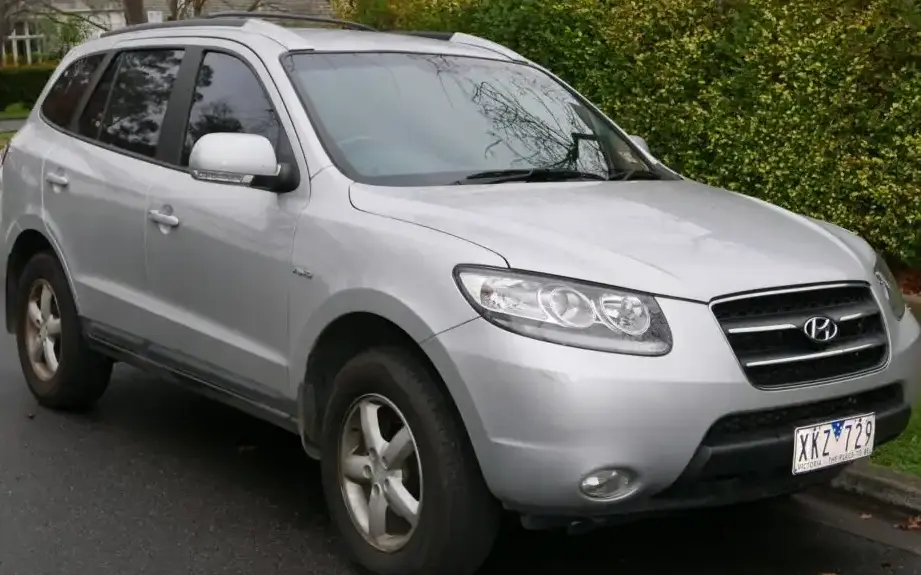
The Hyundai Santa Fe II (CM) 3.3 V6 4WD Automatic, produced from 2006 to 2009, represented a significant step forward for Hyundai in the mid-size SUV segment. Positioned as a premium offering within the CM generation Santa Fe lineup, it aimed to compete with established Japanese and American SUVs by providing a blend of space, comfort, and a relatively powerful V6 engine. This variant was a key component of Hyundai’s strategy to build brand recognition and appeal to a broader customer base in North America and other global markets. It utilized the 1HX0/A3 platform, shared with the Kia Sorento, providing a robust foundation for its capabilities.
Technical Specifications
| Brand | Hyundai |
| Model | Santa Fe |
| Generation | Santa Fe II (CM) |
| Type (Engine) | 3.3 V6 (242 Hp) 4WD Automatic |
| Start of production | 2006 |
| End of production | 2009 |
| Powertrain Architecture | Internal Combustion engine |
| Body type | SUV |
| Seats | 5 |
| Doors | 5 |
| Fuel consumption (economy) – urban (EPA) | 13.8 l/100 km (17 US mpg, 20.5 UK mpg, 7.2 km/l) |
| Fuel consumption (economy) – extra urban (EPA) | 9.8 l/100 km (24 US mpg, 28.8 UK mpg, 10.2 km/l) |
| Fuel Type | Petrol (Gasoline) |
| Emission standard | ULEV |
| Weight-to-power ratio | 7.5 kg/Hp, 132.7 Hp/tonne |
| Weight-to-torque ratio | 6 kg/Nm, 167.8 Nm/tonne |
| Power | 242 Hp @ 6000 rpm |
| Power per litre | 72.4 Hp/l |
| Torque | 306 Nm @ 4500 rpm (225.69 lb.-ft. @ 4500 rpm) |
| Engine layout | Front, Transverse |
| Engine Model/Code | Lambda / G6DB |
| Engine displacement | 3342 cm3 (203.94 cu. in.) |
| Number of cylinders | 6 |
| Engine configuration | V-engine |
| Cylinder Bore | 92 mm (3.62 in.) |
| Piston Stroke | 83.8 mm (3.3 in.) |
| Compression ratio | 10.4:1 |
| Number of valves per cylinder | 4 |
| Fuel injection system | Multi-port manifold injection |
| Engine aspiration | Naturally aspirated engine |
| Valvetrain | DOHC, CVVT |
| Engine oil capacity | 5.5 l (5.81 US qt | 4.84 UK qt) |
| Coolant | 7 l (7.4 US qt | 6.16 UK qt) |
| Kerb Weight | 1824 kg (4021.23 lbs.) |
| Trunk (boot) space – minimum | 968 l (34.18 cu. ft.) |
| Trunk (boot) space – maximum | 2214 l (78.19 cu. ft.) |
| Fuel tank capacity | 75 l (19.81 US gal | 16.5 UK gal) |
| Permitted trailer load with brakes (12%) | 1588 kg (3500.94 lbs.) |
| Permitted trailer load without brakes | 748 kg (1649.06 lbs.) |
| Length | 4675 mm (184.06 in.) |
| Width | 1890 mm (74.41 in.) |
| Height | 1725 mm (67.91 in.) |
| Wheelbase | 2700 mm (106.3 in.) |
| Front track | 1615 mm (63.58 in.) |
| Rear (Back) track | 1620 mm (63.78 in.) |
| Ride height (ground clearance) | 206 mm (8.11 in.) |
| Minimum turning circle (turning diameter) | 10.9 m (35.76 ft.) |
| Drivetrain Architecture | The Internal combustion engine (ICE) drives the front wheels permanently, and the rear wheels are driven through an electrically or mechanically operated clutch if necessary. |
| Drive wheel | All wheel drive (4×4) |
| Number of gears and type of gearbox | 5 gears, automatic transmission |
| Front suspension | Independent, type McPherson with coil spring and anti-roll bar |
| Rear suspension | Independent multi-link spring suspension with stabilizer |
| Front brakes | Ventilated discs |
| Rear brakes | Disc |
| Assisting systems | ABS (Anti-lock braking system) |
| Steering type | Steering rack and pinion |
| Power steering | Hydraulic Steering |
| Tires size | 235/60 R18 |
| Wheel rims size | 7J x 18 |
Powertrain & Engine Architecture
The heart of the Santa Fe 3.3 V6 was the Hyundai Lambda engine, specifically the G6DB variant. This 3.3-liter, naturally aspirated V6 engine featured a 60-degree V-angle and utilized a cast iron block with an aluminum cylinder head. It employed multi-port fuel injection and Hyundai’s Continuously Variable Valve Timing (CVVT) technology on both intake and exhaust valves, optimizing performance and fuel efficiency. The engine produced 242 horsepower at 6000 rpm and 306 Nm (225.69 lb-ft) of torque at 4500 rpm. The engine’s design prioritized smooth operation and adequate power for everyday driving and towing. Paired with the engine was a 5-speed automatic transmission, designed for comfortable shifting and reliable operation. This transmission wasn’t known for being particularly sporty, but it was well-suited to the engine’s characteristics and the SUV’s intended use.
Driving Characteristics
The 3.3 V6 Automatic Santa Fe offered a comfortable and capable driving experience. While not a performance-oriented SUV, the V6 provided sufficient power for merging onto highways and passing other vehicles. The automatic transmission, while smooth, wasn’t particularly quick to downshift, resulting in a slightly less responsive feel compared to the manual transmission options available in other Santa Fe trims. The all-wheel-drive system provided enhanced traction in inclement weather, making it a practical choice for drivers in regions with snow or rain. The gear ratios were tuned for fuel economy and relaxed cruising, rather than aggressive acceleration. Compared to the base 2.7L four-cylinder engine, the 3.3 V6 offered a substantial power increase, but at the cost of slightly reduced fuel economy.
Equipment & Trim Levels
The 3.3 V6 4WD Automatic typically came well-equipped, often representing the higher end of the Santa Fe trim levels. Standard features generally included air conditioning, power windows and locks, a CD player with an auxiliary input, and keyless entry. Higher trims often added features like leather upholstery, a sunroof, heated front seats, and an upgraded audio system. Safety features such as ABS, front airbags, and side airbags were standard. Optional extras included a navigation system and a rear entertainment system.
Chassis & Braking
The Santa Fe II (CM) utilized an independent front suspension with McPherson struts and a coil spring and anti-roll bar. The rear suspension was an independent multi-link setup, also with coil springs and a stabilizer bar. This suspension configuration aimed to provide a balance between ride comfort and handling stability. Braking duties were handled by ventilated discs at the front and solid discs at the rear. The ABS system helped to maintain steering control during hard braking. The chassis was designed to provide a stable platform for the vehicle’s weight and dimensions, contributing to its overall handling characteristics.
Market Reception & Comparison
The Hyundai Santa Fe 3.3 V6 4WD Automatic was generally well-received by automotive critics. It was praised for its spacious interior, comfortable ride, and relatively powerful engine. However, some reviewers noted that the automatic transmission could feel sluggish at times and that the handling wasn’t as sporty as some of its competitors. Compared to the 2.7L four-cylinder version, the 3.3 V6 offered a significant performance upgrade, but fuel economy suffered slightly. Against rivals like the Honda CR-V and Toyota RAV4, the Santa Fe offered a more affordable price point and a longer warranty, but lacked the established reputation for reliability of the Japanese brands.
Legacy
The Hyundai Santa Fe II (CM) 3.3 V6 4WD Automatic has proven to be a relatively reliable vehicle in the used car market. The Lambda V6 engine is generally considered durable, although regular maintenance is crucial. Common issues include occasional oil leaks and sensor failures. The automatic transmission, while not known for being exceptionally robust, has generally held up well over time with proper fluid changes. Today, these Santa Fes represent an affordable and practical option for buyers seeking a spacious and capable SUV. Their value proposition lies in their combination of features, space, and relatively low cost of ownership, making them a popular choice for families and budget-conscious buyers.