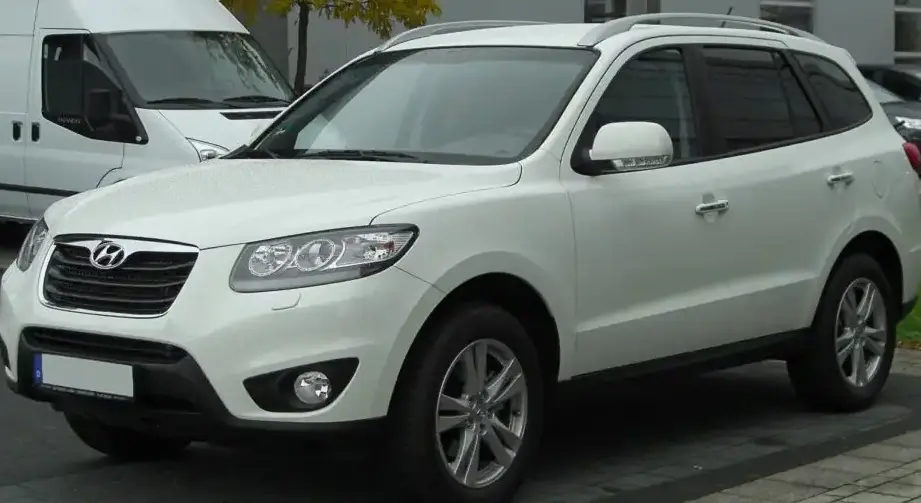
The Hyundai Santa Fe II (CM), particularly the facelifted version introduced in 2009, represented a significant step forward for the South Korean automaker in the competitive mid-size SUV segment. Produced from 2009 to 2012, this generation Santa Fe aimed to offer a compelling blend of practicality, comfort, and value. The 2.2 CRDi 4WD variant, equipped with a 2.2-liter turbocharged diesel engine producing 197 horsepower, was positioned as a strong all-around performer, appealing to buyers seeking capability and efficiency. It served as a key model in Hyundai’s lineup, bridging the gap between more basic trims and the range-topping options.
Technical Specifications
| Brand | Hyundai |
| Model | Santa Fe |
| Generation | Santa Fe II (CM, facelift 2009) |
| Type (Engine) | 2.2 CRDi (197 Hp) 4WD |
| Start of production | 2009 |
| End of production | 2012 |
| Powertrain Architecture | Internal Combustion engine |
| Body type | SUV |
| Seats | 5 |
| Doors | 5 |
| Fuel consumption (economy) – urban (NEDC) | 8.8 l/100 km (26.7 US mpg, 32.1 UK mpg, 11.4 km/l) |
| Fuel consumption (economy) – extra urban (NEDC) | 5.6 l/100 km (42 US mpg, 50.4 UK mpg, 17.9 km/l) |
| Fuel consumption (economy) – combined (NEDC) | 6.8 l/100 km (34.6 US mpg, 41.5 UK mpg, 14.7 km/l) |
| CO2 emissions (NEDC) | 176 g/km |
| Fuel Type | Diesel |
| Acceleration 0 – 100 km/h | 9.8 sec |
| Acceleration 0 – 62 mph | 9.8 sec |
| Acceleration 0 – 60 mph | 9.3 sec |
| Maximum speed | 190 km/h (118.06 mph) |
| Emission standard | Euro 5 |
| Weight-to-power ratio | 9.3 kg/Hp, 107.1 Hp/tonne |
| Weight-to-torque ratio | 4.4 kg/Nm, 228.8 Nm/tonne |
| Power | 197 Hp @ 3800 rpm |
| Torque | 421 Nm @ 1800-2500 rpm (310.51 lb.-ft. @ 1800-2500 rpm) |
| Engine layout | Front, Transverse |
| Engine Model/Code | D4HB |
| Engine displacement | 2199 cm3 (134.19 cu. in.) |
| Number of cylinders | 4 |
| Engine configuration | Inline |
| Cylinder Bore | 85.4 mm (3.36 in.) |
| Piston Stroke | 96 mm (3.78 in.) |
| Compression ratio | 16:1 |
| Number of valves per cylinder | 4 |
| Fuel injection system | Diesel Commonrail |
| Engine aspiration | Turbocharger, Intercooler |
| Valvetrain | DOHC |
| Engine oil capacity | 6.7 l (7.08 US qt | 5.9 UK qt) |
| Coolant | 8.6 l (9.09 US qt | 7.57 UK qt) |
| Kerb Weight | 1840-1920 kg (4056.51 – 4232.88 lbs.) |
| Max. weight | 2570 kg (5665.88 lbs.) |
| Max load | 650-730 kg (1433 – 1609.37 lbs.) |
| Trunk (boot) space – minimum | 528 l (18.65 cu. ft.) |
| Fuel tank capacity | 75 l (19.81 US gal | 16.5 UK gal) |
| Max. roof load | 100 kg (220.46 lbs.) |
| Permitted trailer load with brakes (8%) | 3000 kg (6613.87 lbs.) |
| Permitted trailer load with brakes (12%) | 2500 kg (5511.56 lbs.) |
| Permitted trailer load without brakes | 750 kg (1653.47 lbs.) |
| Permitted towbar download | 100 kg (220.46 lbs.) |
| Length | 4660 mm (183.46 in.) |
| Width | 1890 mm (74.41 in.) |
| Height | 1760 mm (69.29 in.) |
| Wheelbase | 2700 mm (106.3 in.) |
| Front track | 1615 mm (63.58 in.) |
| Rear (Back) track | 1620 mm (63.78 in.) |
| Front overhang | 930 mm (36.61 in.) |
| Rear overhang | 1030 mm (40.55 in.) |
| Ride height (ground clearance) | 200 mm (7.87 in.) |
| Drag coefficient (Cd) | 0.38 |
| Minimum turning circle (turning diameter) | 10.9 m (35.76 ft.) |
| Approach angle | 24.6° |
| Departure angle | 21.6° |
| Ramp-over (brakeover) angle | 17.9° |
| Wading depth | 500 mm (19.69 in.) |
| Drivetrain Architecture | The Internal combustion engine (ICE) drives the front wheels permanently, and the rear wheels are driven through an electrically or mechanically operated clutch if necessary. |
| Drive wheel | All wheel drive (4×4) |
| Number of gears and type of gearbox | 6 gears, manual transmission |
| Front suspension | Independent, type McPherson with coil spring and anti-roll bar |
| Rear suspension | Independent multi-link spring suspension with stabilizer |
| Front brakes | Ventilated discs |
| Rear brakes | Disc |
| Assisting systems | ABS (Anti-lock braking system) |
| Steering type | Steering rack and pinion |
| Power steering | Hydraulic Steering |
| Tires size | 235/65 R17; 235/60 R18 |
| Wheel rims size | 7J x 17; 7J x 18 |
Powertrain & Engine Architecture
The heart of the Santa Fe 2.2 CRDi 4WD is the Hyundai D4HB engine, a 2.2-liter inline-four cylinder diesel. This engine utilizes a common-rail direct injection system, delivering fuel at extremely high pressure for optimized combustion. A variable geometry turbocharger (VGT) and intercooler work in tandem to boost power and torque across a broad RPM range. The D4HB engine features a double overhead camshaft (DOHC) valvetrain with four valves per cylinder, enhancing breathing and overall efficiency. The engine produces 197 horsepower at 3800 rpm and a substantial 421 Nm (310.51 lb.-ft.) of torque between 1800 and 2500 rpm. This torque output is particularly beneficial for towing and navigating challenging terrain. The engine’s 16:1 compression ratio is typical for diesel engines, contributing to its thermal efficiency.
Driving Characteristics
The 2.2 CRDi 4WD Santa Fe offered a composed and capable driving experience. While not a sports SUV, the engine’s torque delivery provided ample power for everyday driving and overtaking maneuvers. The six-speed manual transmission allowed for precise control, although the gear ratios were tuned more for fuel economy and relaxed cruising than outright performance. Compared to the base 2.0-liter gasoline engine, the 2.2 CRDi offered significantly more power and torque, resulting in quicker acceleration and improved towing capacity. The all-wheel-drive system provided enhanced traction in slippery conditions, making it a suitable choice for drivers in regions with inclement weather.
Equipment & Trim Levels
The 2.2 CRDi 4WD trim typically included features such as air conditioning, power windows and locks, a CD player with MP3 compatibility, and alloy wheels. Higher trim levels added amenities like leather upholstery, a sunroof, automatic climate control, and a premium sound system. Safety features included ABS, front and side airbags, and electronic stability control. Optional extras often included a navigation system, rear parking sensors, and heated front seats.
Chassis & Braking
The Santa Fe II employed an independent McPherson strut suspension at the front and an independent multi-link suspension at the rear, providing a comfortable ride and good handling characteristics. The 4WD system utilized a part-time system, engaging the rear wheels when needed for added traction. Braking duties were handled by ventilated discs at the front and solid discs at the rear, providing adequate stopping power for the vehicle’s weight. Anti-lock braking system (ABS) was standard, enhancing safety during emergency braking situations.
Market Reception & Comparison
The Hyundai Santa Fe II 2.2 CRDi 4WD was generally well-received by automotive critics. It was praised for its spacious interior, comfortable ride, and strong diesel engine. Fuel economy was a key selling point, with the 2.2 CRDi offering significantly better mileage than the gasoline-powered models. Compared to rivals like the Toyota RAV4 and Honda CR-V, the Santa Fe offered a more affordable price point and a longer warranty. However, some critics noted that the interior materials weren’t as premium as those found in some competitors.
Legacy
The Hyundai Santa Fe II 2.2 CRDi 4WD has proven to be a relatively reliable vehicle, with the D4HB engine generally considered durable. Common maintenance items include regular oil changes, filter replacements, and timing belt service. The availability of parts is generally good, and repair costs are reasonable. On the used car market, these Santa Fes represent a good value proposition for buyers seeking a capable and fuel-efficient SUV. While older examples may show signs of wear and tear, well-maintained units can provide many years of reliable service.