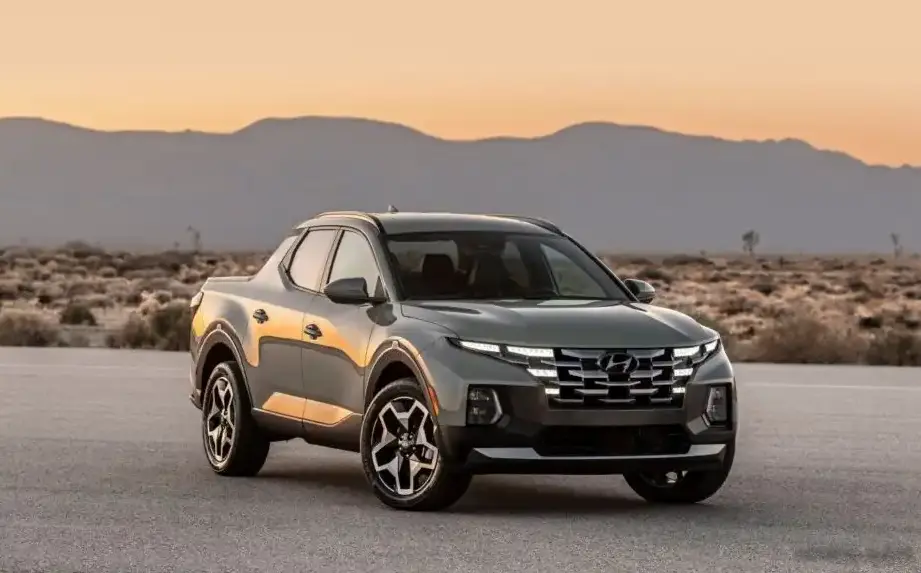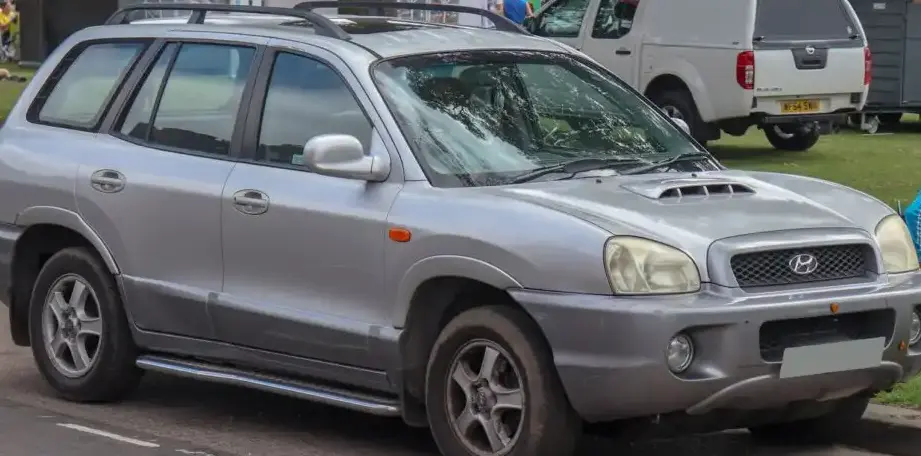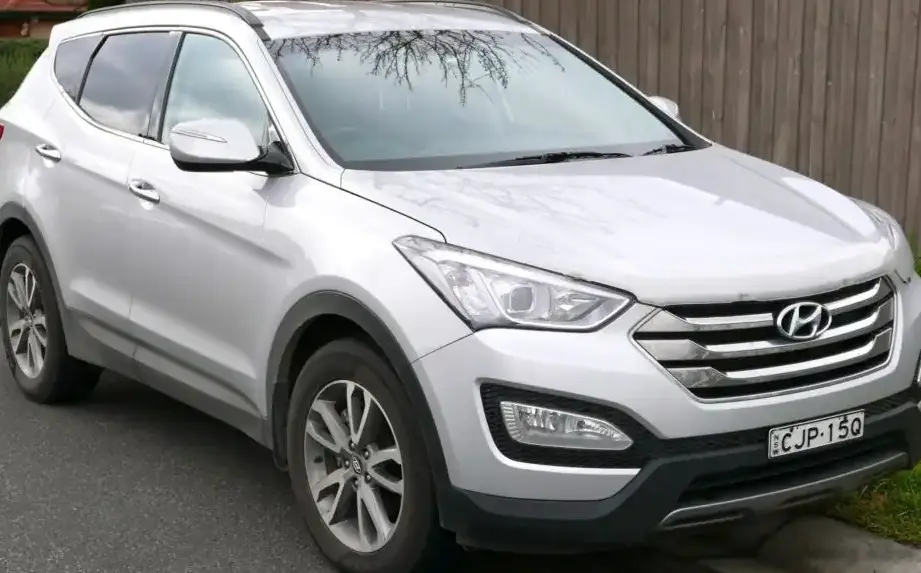
The Hyundai Santa Fe III (DM) 2.0T AWD Automatic, produced from 2012 to 2016, represented a significant step forward for Hyundai in the competitive mid-size SUV segment. Positioned as a near-premium offering within the DM generation Santa Fe lineup, this variant combined a turbocharged four-cylinder engine with a six-speed automatic transmission and all-wheel drive. It aimed to deliver a balance of performance, fuel efficiency, and all-weather capability, appealing to families and individuals seeking a versatile and modern SUV. The DM Santa Fe shared its platform with the Kia Sorento, and represented Hyundai’s increasing focus on design and technology.
Technical Specifications
| Brand | Hyundai |
| Model | Santa Fe |
| Generation | Santa Fe III (DM) |
| Type (Engine) | 2.0T (264 Hp) AWD Automatic |
| Start of production | 2012 year |
| End of production | 2016 year |
| Powertrain Architecture | Internal Combustion engine |
| Body type | SUV |
| Seats | 5 |
| Doors | 5 |
| Fuel consumption (economy) – urban (EPA) | 13.1 l/100 km (18 US mpg, 21.6 UK mpg, 7.6 km/l) |
| Fuel consumption (economy) – extra urban (EPA) | 9.8 l/100 km (24 US mpg, 28.8 UK mpg, 10.2 km/l) |
| Fuel consumption (economy) – combined (EPA) | 11.2 l/100 km (21 US mpg, 25.2 UK mpg, 8.9 km/l) |
| Fuel Type | Petrol (Gasoline) |
| Emission standard | LEV-II ULEV |
| Weight-to-power ratio | 6.4 kg/Hp, 157 Hp/tonne |
| Weight-to-torque ratio | 4.6 kg/Nm, 217.1 Nm/tonne |
| Power | 264 Hp @ 6000 rpm |
| Power per litre | 132.1 Hp/l |
| Torque | 365 Nm @ 1750 rpm (269.21 lb.-ft. @ 1750 rpm) |
| Engine layout | Front, Transverse |
| Engine Model/Code | Theta II / G4KH |
| Engine displacement | 1998 cm3 (121.93 cu. in.) |
| Number of cylinders | 4 |
| Engine configuration | Inline |
| Cylinder Bore | 86 mm (3.39 in.) |
| Piston Stroke | 86 mm (3.39 in.) |
| Compression ratio | 9.5:1 |
| Number of valves per cylinder | 4 |
| Fuel injection system | Direct injection |
| Engine aspiration | Twin-scroll turbo, Intercooler |
| Valvetrain | DOHC, Dual-CVVT |
| Engine oil capacity | 4.8 l (5.07 US qt | 4.22 UK qt) |
| Coolant | 9.7 l (10.25 US qt | 8.53 UK qt) |
| Kerb Weight | 1681-1823 kg (3705.97 – 4019.03 lbs.) |
| Max. weight | 2350 kg (5180.86 lbs.) |
| Max load | 527-669 kg (1161.84 – 1474.89 lbs.) |
| Trunk (boot) space – minimum | 1003 l (35.42 cu. ft.) |
| Trunk (boot) space – maximum | 2025 l (71.51 cu. ft.) |
| Fuel tank capacity | 66 l (17.44 US gal | 14.52 UK gal) |
| Permitted trailer load with brakes (12%) | 1590 kg (3505.35 lbs.) |
| Length | 4690 mm (184.65 in.) |
| Width | 1880 mm (74.02 in.) |
| Height | 1680 mm (66.14 in.) |
| Wheelbase | 2700 mm (106.3 in.) |
| Front track | 1628 mm (64.09 in.) |
| Rear (Back) track | 1639 mm (64.53 in.) |
| Ride height (ground clearance) | 185 mm (7.28 in.) |
| Drag coefficient (Cd) | 0.34 |
| Minimum turning circle (turning diameter) | 10.9 m (35.76 ft.) |
| Drivetrain Architecture | The Internal combustion engine (ICE) drives the front wheels permanently, and the rear wheels are driven through an electrically or mechanically operated clutch if necessary. |
| Drive wheel | All wheel drive (4×4) |
| Number of gears and type of gearbox | 6 gears, automatic transmission |
| Front suspension | Independent, type McPherson with coil spring and anti-roll bar |
| Rear suspension | Independent multi-link spring suspension with stabilizer |
| Front brakes | Ventilated discs |
| Rear brakes | Disc |
| Assisting systems | ABS (Anti-lock braking system) |
| Steering type | Steering rack and pinion |
| Power steering | Electric Steering |
| Tires size | 235/60 R18; 235/55 R19 |
| Wheel rims size | 7J x 18; 7.5J x 19 |
INTRODUCTION
The Hyundai Santa Fe III (DM) 2.0T AWD Automatic, launched in 2012, was a key model in Hyundai’s strategy to establish itself as a mainstream automotive brand. The DM generation represented a significant redesign of the Santa Fe, moving away from the more utilitarian styling of its predecessors towards a more sophisticated and car-like appearance. The 2.0T AWD Automatic trim sat towards the upper end of the DM Santa Fe range, offering a compelling combination of performance and features. It was positioned above the base 2.4L engine option and below the more expensive Limited trims. This variant was primarily sold in North America and select international markets.
Powertrain & Engine Architecture
At the heart of the Santa Fe 2.0T was Hyundai’s Theta II 2.0-liter turbocharged inline-four cylinder engine, designated G4KH. This engine featured direct injection, a twin-scroll turbocharger, and an intercooler, producing 264 horsepower at 6000 rpm and 365 Nm (269.21 lb-ft) of torque at 1750 rpm. The engine utilized a DOHC (Dual Overhead Camshaft) valvetrain with Dual-CVVT (Continuously Variable Valve Timing) on both intake and exhaust camshafts, optimizing performance and efficiency. The engine’s robust construction and advanced technologies allowed for a relatively high specific output of 132.1 hp per liter. Power was delivered to all four wheels through a six-speed automatic transmission, providing smooth and responsive shifts. The transmission was tuned for comfort and fuel economy, rather than outright performance.
Driving Characteristics
The 2.0T AWD Automatic Santa Fe offered a noticeable step up in performance compared to the base 2.4L model. While not a sports SUV, the turbocharged engine provided ample power for everyday driving and highway passing maneuvers. The all-wheel-drive system enhanced traction in inclement weather, providing added confidence and stability. The six-speed automatic transmission, while generally smooth, could sometimes feel hesitant during quick acceleration. The gear ratios were optimized for fuel efficiency, meaning the engine occasionally felt strained when climbing hills or carrying a full load. Compared to a manual transmission equipped Santa Fe (not widely available with this engine), the automatic offered less driver engagement but greater convenience.
Equipment & Trim Levels
The 2.0T AWD Automatic trim typically included a generous array of standard features. These commonly included leather upholstery, heated front seats, a touchscreen infotainment system with Bluetooth connectivity, a rearview camera, and automatic climate control. Optional extras often included a panoramic sunroof, navigation system, premium audio system, and advanced safety features such as blind-spot monitoring and lane departure warning. Interior materials were generally of good quality, contributing to a more upscale feel compared to lower trim levels. The dashboard layout was functional and user-friendly, with logically placed controls.
Chassis & Braking
The Santa Fe DM utilized a McPherson strut front suspension and an independent multi-link rear suspension, providing a comfortable and controlled ride. Stabilizer bars were fitted to both axles to reduce body roll during cornering. Braking duties were handled by ventilated discs at the front and solid discs at the rear, equipped with ABS (Anti-lock Braking System). The steering was electrically assisted, offering light and precise control. The all-wheel-drive system employed an electronically controlled multi-plate clutch to distribute torque between the front and rear axles as needed, optimizing traction and stability.
Market Reception & Comparison
The Hyundai Santa Fe 2.0T AWD Automatic was generally well-received by automotive critics. It was praised for its spacious interior, comfortable ride, and strong engine performance. However, some reviewers noted that the fuel economy was not as competitive as some rivals, and the automatic transmission could occasionally feel sluggish. Compared to other trims in the Santa Fe lineup, the 2.0T offered a more engaging driving experience and a higher level of refinement. Against competitors like the Honda CR-V, Toyota RAV4, and Ford Escape, the Santa Fe 2.0T offered a compelling value proposition, often undercutting its rivals in price while offering comparable features and performance.
Legacy
The Theta II 2.0T engine, while generally reliable, has been subject to some recalls related to potential engine failure due to manufacturing defects. Proper maintenance, including regular oil changes and adherence to Hyundai’s recommended service intervals, is crucial for ensuring the longevity of this powertrain. On the used car market, the Santa Fe 2.0T AWD Automatic remains a popular choice, offering a good balance of features, performance, and value. Its all-wheel-drive capability and spacious interior make it a practical and versatile option for families and individuals alike. Despite its age, the DM generation Santa Fe continues to be a relevant contender in the mid-size SUV segment.