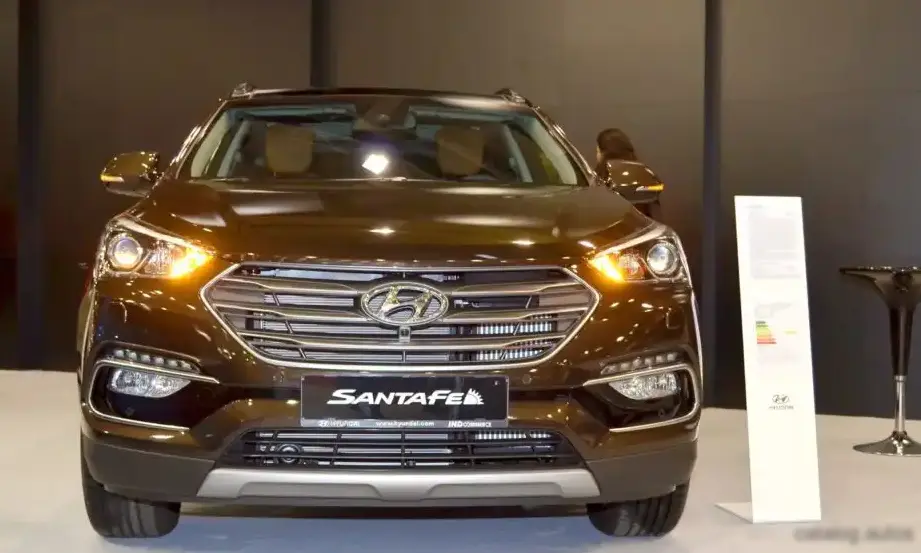
The Hyundai Santa Fe III (DM, facelift 2015) 2.2 CRDi 7-seat variant represents a significant iteration of Hyundai’s popular mid-size SUV. Introduced as part of the DM facelift in 2015 and continuing through the 2018 model year, this version aimed to balance family practicality with respectable performance and fuel efficiency. Positioned as a mid-to-upper trim level within the Santa Fe lineup, it offered a compelling alternative to established competitors like the Toyota Highlander and Honda Pilot, particularly for buyers seeking a diesel-powered option. This model was primarily targeted towards the European and Asian markets, where diesel engines held a stronger presence, though limited numbers were also available in other regions.
Technical Specifications
| Brand | Hyundai |
| Model | Santa Fe |
| Generation | Santa Fe III (DM, facelift 2015) |
| Type (Engine) | 2.2 CRDi (200 Hp) 7 Seat |
| Start of production | 2015 |
| End of production | 2018 |
| Powertrain Architecture | Internal Combustion engine |
| Body type | SUV |
| Seats | 7 |
| Doors | 5 |
| Fuel consumption (urban) | 7 l/100 km (33.6 US mpg, 40.4 UK mpg, 14.3 km/l) |
| Fuel consumption (extra urban) | 4.9 l/100 km (48 US mpg, 57.6 UK mpg, 20.4 km/l) |
| Fuel consumption (combined) | 5.7 l/100 km (41.3 US mpg, 49.6 UK mpg, 17.5 km/l) |
| CO2 emissions | 149 g/km |
| Fuel Type | Diesel |
| Acceleration 0 – 100 km/h | 8.7 sec |
| Acceleration 0 – 62 mph | 8.7 sec |
| Acceleration 0 – 60 mph | 8.3 sec |
| Maximum speed | 203 km/h (126.14 mph) |
| Emission standard | Euro 6 |
| Power | 200 Hp @ 3800 rpm |
| Power per litre | 91 Hp/l |
| Torque | 440 Nm @ 1750-2750 rpm (324.53 lb.-ft. @ 1750-2750 rpm) |
| Engine layout | Front, Transverse |
| Engine Model/Code | R II / D4HB |
| Engine displacement | 2199 cm3 (134.19 cu. in.) |
| Number of cylinders | 4 |
| Engine configuration | Inline |
| Cylinder Bore | 85.4 mm (3.36 in.) |
| Piston Stroke | 96 mm (3.78 in.) |
| Compression ratio | 16:1 |
| Number of valves per cylinder | 4 |
| Fuel injection system | Diesel Commonrail |
| Engine aspiration | Turbocharger, Intercooler |
| Engine oil capacity | 6.3 l (6.66 US qt | 5.54 UK qt) |
| Coolant | 9.1 l (9.62 US qt | 8.01 UK qt) |
| Trunk (boot) space – minimum | 516 l (18.22 cu. ft.) |
| Trunk (boot) space – maximum | 1615 l (57.03 cu. ft.) |
| Fuel tank capacity | 64 l (16.91 US gal | 14.08 UK gal) |
| Length | 4690 mm (184.65 in.) |
| Width | 1880 mm (74.02 in.) |
| Height | 1680 mm (66.14 in.) |
| Wheelbase | 2700 mm (106.3 in.) |
| Front track | 1628-1633 mm (64.09 – 64.29 in.) |
| Rear (Back) track | 1639-1644 mm (64.53 – 64.72 in.) |
| Front overhang | 935 mm (36.81 in.) |
| Rear overhang | 1055 mm (41.54 in.) |
| Ride height (ground clearance) | 185 mm (7.28 in.) |
| Minimum turning circle | 10.9 m (35.76 ft.) |
| Approach angle | 16.5° |
| Departure angle | 21.2° |
| Ramp-over angle | 16.6° |
| Drivetrain Architecture | Front wheel drive |
| Number of gears | 6 |
| Gearbox type | Manual transmission |
| Front suspension | Independent type McPherson |
| Rear suspension | Independent multi-link suspension |
| Front brakes | Ventilated discs |
| Rear brakes | Disc |
| Assisting systems | ABS (Anti-lock braking system) |
| Steering type | Steering rack and pinion |
| Power steering | Electric Steering |
| Tires size | 235/65 R17; 235/60 R18; 235/55 R19 |
| Wheel rims size | 7.0J x 17; 7.5J x 18; 7.5J x 19 |
INTRODUCTION
The Hyundai Santa Fe III, launched in 2012, represented a significant step forward for the Korean automaker in the competitive mid-size SUV segment. The 2015 facelift (DM) brought revised styling, improved interior materials, and updated technology. The 2.2 CRDi 7-seat variant, powered by the R II diesel engine, was a key offering, particularly in markets where diesel fuel was prevalent. This configuration provided a balance between fuel economy, torque for towing and hauling, and the practicality of three-row seating. It slotted above the base 2.0L petrol models and below any potential range-topping trims with more luxurious appointments.
Powertrain & Engine Architecture
At the heart of the Santa Fe 2.2 CRDi lies the Hyundai-Kia R II diesel engine, specifically the D4HB code. This is a 2.2-liter, inline-four cylinder engine featuring a cast iron block and aluminum cylinder head. The engine utilizes a common-rail direct injection system, delivering fuel at extremely high pressures for optimized combustion. A variable geometry turbocharger (VGT) with an intercooler further enhances performance and efficiency. The engine produces 200 horsepower at 3800 rpm and a substantial 440 Nm (324.53 lb.-ft.) of torque between 1750 and 2750 rpm. This broad torque curve is a hallmark of diesel engines, providing strong pulling power at lower engine speeds. The 6-speed manual transmission was standard, offering precise gear changes and contributing to the overall driving experience.
Driving Characteristics
The 2.2 CRDi engine, paired with the 6-speed manual transmission, delivers a composed and capable driving experience. While not overtly sporty, the Santa Fe offers ample power for everyday driving, highway cruising, and even towing. The generous torque output means that overtaking maneuvers are executed with confidence, and the engine feels relaxed even when fully loaded. The manual transmission allows for greater driver control, although it may not appeal to all buyers accustomed to the convenience of an automatic. Compared to the lower-powered 2.0L petrol variants, the 2.2 CRDi provides noticeably stronger acceleration and a more effortless feel. The gear ratios are well-chosen, providing a good balance between fuel economy and performance.
Equipment & Trim Levels
The 2.2 CRDi 7-seat trim typically included a comprehensive list of standard features. These generally included air conditioning, power windows and locks, a touchscreen infotainment system with Bluetooth connectivity, and alloy wheels. Safety features such as ABS, electronic stability control, and multiple airbags were also standard. Higher trim levels offered upgrades such as leather upholstery, a panoramic sunroof, heated front seats, and a more advanced infotainment system with navigation. Optional extras could include parking sensors, a rearview camera, and a premium sound system.
Chassis & Braking
The Santa Fe III utilizes a front-wheel-drive platform with independent suspension at all four corners. The front suspension employs a McPherson strut design, while the rear features a multi-link setup. This configuration provides a comfortable ride quality and good handling characteristics. Ventilated disc brakes are fitted to the front wheels, while solid discs are used at the rear. The braking system is assisted by ABS (Anti-lock Braking System) and Electronic Stability Control (ESC), enhancing safety and control. Stabilizer bars are present at both the front and rear to reduce body roll during cornering.
Market Reception & Comparison
The Hyundai Santa Fe 2.2 CRDi 7-seat variant was generally well-received by automotive critics. It was praised for its spacious interior, comfortable ride, and strong diesel engine. Fuel economy was also a key selling point, particularly in Europe where diesel fuel is often cheaper than gasoline. Compared to its competitors, the Santa Fe offered a compelling value proposition, often undercutting rivals in terms of price while offering a similar level of equipment. However, some critics noted that the interior design, while improved, still lacked the premium feel of some competitors. The manual transmission, while appreciated by enthusiasts, may have been a drawback for some buyers.
Legacy
The Hyundai Santa Fe III 2.2 CRDi has proven to be a relatively reliable vehicle, with the R II diesel engine generally regarded as durable. However, like all diesel engines, it’s important to ensure regular maintenance, including oil changes and filter replacements. The diesel particulate filter (DPF) requires periodic regeneration, and failure to do so can lead to costly repairs. In the used car market, these Santa Fes represent a good value for buyers seeking a spacious, fuel-efficient, and capable SUV. They continue to be popular choices for families and those who require a vehicle with towing capacity. The combination of practicality, reliability, and affordability has cemented the Santa Fe’s position as a strong contender in the mid-size SUV segment.