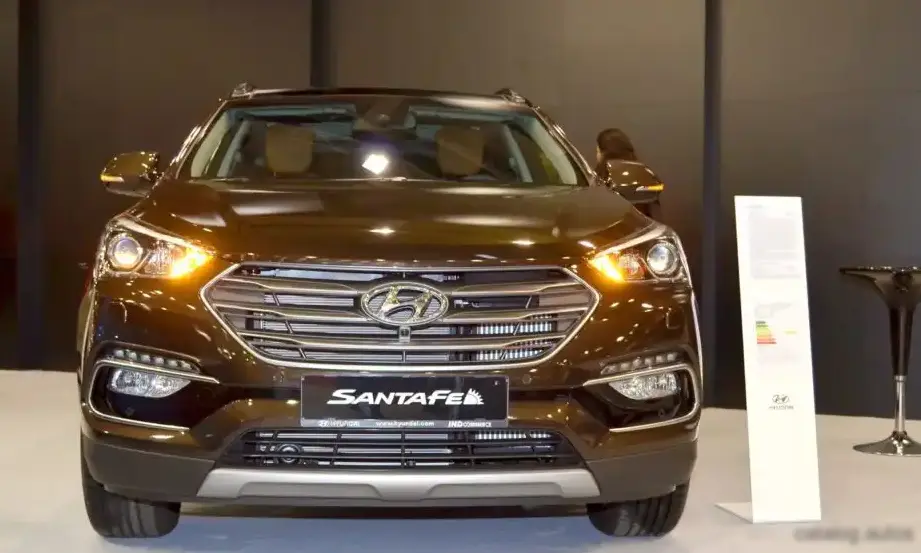
The Hyundai Santa Fe III, specifically the facelifted version introduced in 2015 (designated DM), represented a significant step forward for Hyundai in the competitive mid-size SUV segment. The 2.4 GDI (Gasoline Direct Injection) variant with the automatic transmission, produced from 2015 to 2018, occupied a key position in the lineup, offering a balance of fuel efficiency, performance, and features aimed at families and everyday drivers. This model aimed to provide a more refined and technologically advanced experience compared to its predecessors, while remaining competitively priced.
Technical Specifications
| Brand | Hyundai |
| Model | Santa Fe |
| Generation | Santa Fe III (DM, facelift 2015) |
| Type (Engine) | 2.4 GDI (188 Hp) Automatic |
| Start of production | 2015 |
| End of production | 2018 |
| Powertrain Architecture | Internal Combustion engine |
| Body type | SUV |
| Seats | 5 |
| Doors | 5 |
| Fuel consumption (urban) | 12.9 l/100 km (18.2 US mpg, 21.9 UK mpg, 7.8 km/l) |
| Fuel consumption (extra urban) | 7.3 l/100 km (32.2 US mpg, 38.7 UK mpg, 13.7 km/l) |
| Fuel consumption (combined) | 9.4 l/100 km (25 US mpg, 30.1 UK mpg, 10.6 km/l) |
| CO2 emissions | 218 g/km |
| Fuel Type | Petrol (Gasoline) |
| Acceleration 0 – 100 km/h | 9.9 sec |
| Acceleration 0 – 62 mph | 9.9 sec |
| Acceleration 0 – 60 mph | 9.4 sec |
| Maximum speed | 202 km/h (125.52 mph) |
| Emission standard | Euro 6 |
| Power | 188 Hp @ 6000 rpm |
| Torque | 241 Nm @ 4000 rpm (177.75 lb.-ft. @ 4000 rpm) |
| Engine layout | Front, Transverse |
| Engine Model/Code | Theta II / G4KJ |
| Engine displacement | 2359 cm3 (143.96 cu. in.) |
| Number of cylinders | 4 |
| Engine configuration | Inline |
| Cylinder Bore | 88 mm (3.46 in.) |
| Piston Stroke | 97 mm (3.82 in.) |
| Compression ratio | 11.3:1 |
| Number of valves per cylinder | 4 |
| Fuel injection system | Direct injection |
| Engine aspiration | Naturally aspirated engine |
| Valvetrain | DOHC |
| Engine oil capacity | 4.8 l (5.07 US qt | 4.22 UK qt) |
| Coolant capacity | 7.1 l (7.5 US qt | 6.25 UK qt) |
| Trunk (boot) space – minimum | 585 l (20.66 cu. ft.) |
| Trunk (boot) space – maximum | 1680 l (59.33 cu. ft.) |
| Fuel tank capacity | 64 l (16.91 US gal | 14.08 UK gal) |
| Length | 4690 mm (184.65 in.) |
| Width | 1880 mm (74.02 in.) |
| Height | 1680 mm (66.14 in.) |
| Wheelbase | 2700 mm (106.3 in.) |
| Front track | 1628-1633 mm (64.09 – 64.29 in.) |
| Rear track | 1639-1644 mm (64.53 – 64.72 in.) |
| Front overhang | 935 mm (36.81 in.) |
| Rear overhang | 1055 mm (41.54 in.) |
| Ride height (ground clearance) | 185 mm (7.28 in.) |
| Minimum turning circle | 10.9 m (35.76 ft.) |
| Approach angle | 16.5° |
| Departure angle | 21.2° |
| Ramp-over angle | 16.6° |
| Drivetrain Architecture | Front wheel drive |
| Number of gears | 6 |
| Gearbox type | Automatic transmission |
| Front suspension | Independent type McPherson |
| Rear suspension | Independent multi-link suspension |
| Front brakes | Ventilated discs |
| Rear brakes | Disc |
| Assisting systems | ABS (Anti-lock braking system) |
| Steering type | Steering rack and pinion |
| Power steering | Electric Steering |
| Tires size | 235/65 R17; 235/60 R18; 235/55 R19 |
| Wheel rims size | 7.0J x 17; 7.5J x 18; 7.5J x 19 |
Powertrain & Engine Architecture
The heart of this Santa Fe variant is the Hyundai Theta II 2.4-liter inline-four cylinder engine, internally designated G4KJ. This engine utilizes Gasoline Direct Injection (GDI) technology, where fuel is injected directly into the combustion chamber, improving efficiency and power output. The Theta II engine family was a significant development for Hyundai, offering improved refinement and performance over previous generations. The engine features a double overhead camshaft (DOHC) valvetrain with four valves per cylinder, optimizing airflow for increased power. The 6-speed automatic transmission, a common choice for this class of vehicle, was tuned for smooth shifts and reasonable fuel economy. While not a sport-oriented transmission, it provided adequate performance for everyday driving. The transmission’s gear ratios were optimized for both city and highway driving, prioritizing comfort and fuel efficiency over outright acceleration.
Driving Characteristics
The 188 horsepower and 177.75 lb-ft of torque delivered by the 2.4 GDI engine, coupled with the 6-speed automatic, resulted in a comfortable and predictable driving experience. Acceleration from 0-60 mph took approximately 9.4 seconds, which was adequate for merging onto highways and passing slower traffic, but noticeably slower than the more powerful V6 options available in the Santa Fe lineup. The automatic transmission generally shifted smoothly, but could sometimes feel hesitant during quick acceleration maneuvers. The front-wheel-drive configuration provided good traction in most conditions, but lacked the all-weather capability of the available all-wheel-drive system. Overall, the driving experience was geared towards comfort and ease of use, rather than sporty handling.
Equipment & Trim Levels
The 2.4 GDI automatic trim typically came standard with features such as air conditioning, power windows and locks, a touchscreen infotainment system with Bluetooth connectivity, and a rearview camera. Higher trim levels added features like leather upholstery, a panoramic sunroof, heated front seats, and advanced safety technologies such as blind-spot monitoring and lane departure warning. The interior design was generally well-appointed for its price point, with a focus on practicality and durability. Optional extras included a navigation system, premium audio system, and various appearance packages.
Chassis & Braking
The Santa Fe III utilized a McPherson strut front suspension and a multi-link rear suspension, providing a comfortable ride quality. The suspension was tuned to prioritize comfort over sporty handling, absorbing bumps and imperfections in the road effectively. Braking duties were handled by ventilated discs up front and solid discs in the rear. Anti-lock braking system (ABS) was standard, providing enhanced stopping power and control. The steering was electrically assisted, offering light and easy steering feel.
Market Reception & Comparison
The 2.4 GDI automatic Santa Fe was generally well-received by critics as a practical and value-oriented SUV. It offered a good balance of features, fuel economy, and space for the price. However, some reviewers noted that the engine lacked the power of the available V6 option, and the automatic transmission could sometimes feel sluggish. Compared to competitors like the Honda CR-V and Toyota RAV4, the Santa Fe offered a more spacious interior and a longer warranty, but lacked the brand recognition and resale value of its Japanese rivals. Fuel economy was competitive for its class, averaging around 25 mpg in combined driving.
Legacy
The Hyundai Santa Fe III 2.4 GDI automatic has proven to be a relatively reliable vehicle in the used car market. The Theta II engine, while not without its issues (some early versions experienced oil consumption problems, though these were largely addressed in later model years), has generally proven to be durable. The 6-speed automatic transmission is also known for its reliability. Today, these Santa Fes represent a good value for buyers seeking a spacious and comfortable SUV at an affordable price. Regular maintenance, including oil changes and fluid checks, is crucial for ensuring long-term reliability.