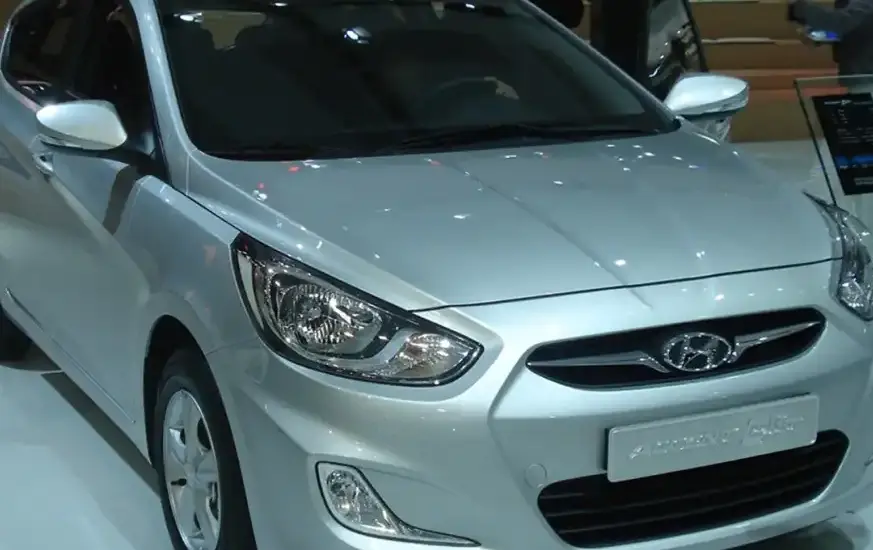
The Hyundai Solaris I 1.6 MPI (123 hp) Automatic, produced between 2011 and 2014, represents a significant entry for Hyundai into the competitive subcompact sedan market, particularly aimed at buyers in Russia and other Eastern European countries. Positioned as a mainstream offering within the first generation Solaris (also known as the Accent in some markets) lineup, this variant provided a balance of affordability, practicality, and ease of use with its automatic transmission. It was designed to appeal to drivers seeking a comfortable and reliable daily commuter, prioritizing convenience over outright performance. The Solaris I was built on the Hyundai’s PB platform, shared with the Kia Rio, and marked Hyundai’s commitment to offering a locally-adapted vehicle for these key markets.
Technical Specifications
| Brand | Hyundai |
| Model | Solaris |
| Generation | Solaris I |
| Type (Engine) | 1.6 MPI (123 Hp) Automatic |
| Start of production | 2011 |
| End of production | 2014 |
| Powertrain Architecture | Internal Combustion engine |
| Body type | Hatchback |
| Seats | 5 |
| Doors | 5 |
| Fuel consumption (urban) | 8.6 l/100 km (27.4 US mpg) |
| Fuel consumption (extra urban) | 5.2 l/100 km (45.2 US mpg) |
| Fuel consumption (combined) | 6.5 l/100 km (36.2 US mpg) |
| Fuel Type | Petrol (Gasoline) |
| Acceleration 0 – 100 km/h | 11.2 sec |
| Acceleration 0 – 62 mph | 11.2 sec |
| Acceleration 0 – 60 mph | 10.6 sec |
| Maximum speed | 180 km/h (111.85 mph) |
| Emission standard | Euro 4 |
| Weight-to-power ratio | 9.2 kg/Hp |
| Weight-to-torque ratio | 7.3 kg/Nm |
| Power | 123 Hp @ 6300 rpm |
| Torque | 155 Nm @ 4200 rpm (114.32 lb.-ft. @ 4200 rpm) |
| Engine layout | Front, Transverse |
| Engine displacement | 1591 cm3 (97.09 cu. in.) |
| Number of cylinders | 4 |
| Engine configuration | Inline |
| Number of valves per cylinder | 4 |
| Fuel injection system | Multi-port manifold injection |
| Engine aspiration | Naturally aspirated engine |
| Engine oil capacity | 3.3 l (3.49 US qt | 2.9 UK qt) |
| Coolant capacity | 5.3 l (5.6 US qt | 4.66 UK qt) |
| Kerb Weight | 1135 kg (2502.25 lbs) |
| Max. weight | 1565 kg (3450.23 lbs) |
| Max load | 430 kg (947.99 lbs) |
| Trunk (boot) space – minimum | 370 l (13.07 cu. ft.) |
| Fuel tank capacity | 43 l (11.36 US gal | 9.46 UK gal) |
| Permitted trailer load with brakes (12%) | 800 kg (1763.7 lbs) |
| Permitted trailer load without brakes | 450 kg (992.08 lbs) |
| Length | 4115 mm (162.01 in) |
| Width | 1700 mm (66.93 in) |
| Height | 1470 mm (57.87 in) |
| Wheelbase | 2570 mm (101.18 in) |
| Front track | 1490 mm (58.66 in) |
| Rear track | 1502 mm (59.13 in) |
| Front overhang | 820 mm (32.28 in) |
| Rear overhang | 725 mm (28.54 in) |
| Ride height (ground clearance) | 160 mm (6.3 in) |
| Minimum turning circle | 10.4 m (34.12 ft) |
| Drivetrain Architecture | Front wheel drive |
| Number of gears and type of gearbox | 4 gears, automatic transmission |
| Front suspension | Independent, type McPherson with coil spring and anti-roll bar |
| Rear suspension | Semi-independent, coil spring |
| Front brakes | Ventilated discs |
| Rear brakes | Disc |
| Assisting systems | ABS (Anti-lock braking system) |
| Steering type | Steering rack and pinion |
| Tires size | 185/65 R15; 195/55 R16 |
| Wheel rims size | 15; 16 |
Powertrain & Engine Architecture
The heart of the Solaris I 1.6 MPI Automatic is the Hyundai G4FA engine, a 1.6-liter inline-four cylinder gasoline engine. This engine utilizes a multi-point fuel injection system, delivering fuel directly into the intake ports. The G4FA features a dual overhead camshaft (DOHC) design with four valves per cylinder, contributing to its relatively efficient operation. The engine’s output of 123 horsepower at 6300 rpm and 155 Nm (114 lb-ft) of torque at 4200 rpm is respectable for its displacement and intended application. Paired with this engine is a four-speed automatic transmission. While not the most modern transmission available at the time, it provided smooth and convenient shifting, a key selling point for this trim level. The transmission was chosen for its reliability and cost-effectiveness, aligning with the Solaris’s overall value proposition.
Driving Characteristics
The 1.6L engine and four-speed automatic combination in the Solaris I delivers adequate, but not exhilarating, performance. Acceleration from 0-60 mph takes around 10.6 seconds, and top speed is limited to 180 km/h (112 mph). The automatic transmission is tuned for comfort and fuel efficiency, resulting in relatively relaxed gear changes. Compared to the manual transmission versions of the same engine, the automatic sacrifices some responsiveness. The gear ratios are spaced to prioritize fuel economy and smooth cruising, rather than aggressive acceleration. In real-world driving, the Solaris I 1.6 Automatic feels best suited for city commuting and highway cruising, where its comfortable ride and ease of use are most appreciated.
Equipment & Trim Levels
The Solaris I 1.6 MPI Automatic typically came equipped with a reasonable level of standard features. These included air conditioning, power windows, power door locks, and a basic audio system with CD player and auxiliary input. Higher trim levels, often denoted by suffixes like “Comfort” or “Luxury,” added features such as alloy wheels, fog lights, a more advanced audio system, and sometimes even a sunroof. Interior upholstery was typically cloth, with options for upgraded materials on higher trims. Safety features included dual front airbags and ABS brakes as standard equipment.
Chassis & Braking
The Solaris I utilizes a McPherson strut front suspension and a semi-independent coil spring rear suspension. This setup provides a comfortable ride quality, absorbing bumps and irregularities in the road surface effectively. The front brakes are ventilated discs, offering good stopping power, while the rear brakes are solid discs. The steering is a rack-and-pinion system, providing reasonably precise and responsive handling. Stabilizer bars are included on both axles to reduce body roll during cornering.
Market Reception & Comparison
The Hyundai Solaris I was generally well-received in its target markets. Critics praised its affordability, reliability, and comfortable ride. The 1.6 MPI Automatic variant was particularly popular among buyers who prioritized convenience over performance. Compared to other subcompact sedans available at the time, such as the Renault Logan and Skoda Rapid, the Solaris offered a more modern design, a more refined interior, and a more comprehensive feature set. Fuel economy was competitive, averaging around 6.5 l/100 km (36.2 US mpg) in combined driving conditions. However, some reviewers noted that the four-speed automatic transmission felt dated compared to the continuously variable transmissions (CVTs) and six-speed automatics offered by some competitors.
Legacy
The Hyundai Solaris I, particularly the 1.6 MPI Automatic variant, has proven to be a reliable and durable vehicle. The G4FA engine is known for its longevity, and the four-speed automatic transmission, while not technologically advanced, is generally robust. On the used car market, these vehicles are often sought after for their affordability and practicality. Maintenance costs are relatively low, and spare parts are readily available. While not a performance icon, the Solaris I 1.6 Automatic remains a sensible and dependable choice for budget-conscious buyers seeking a comfortable and reliable daily commuter.