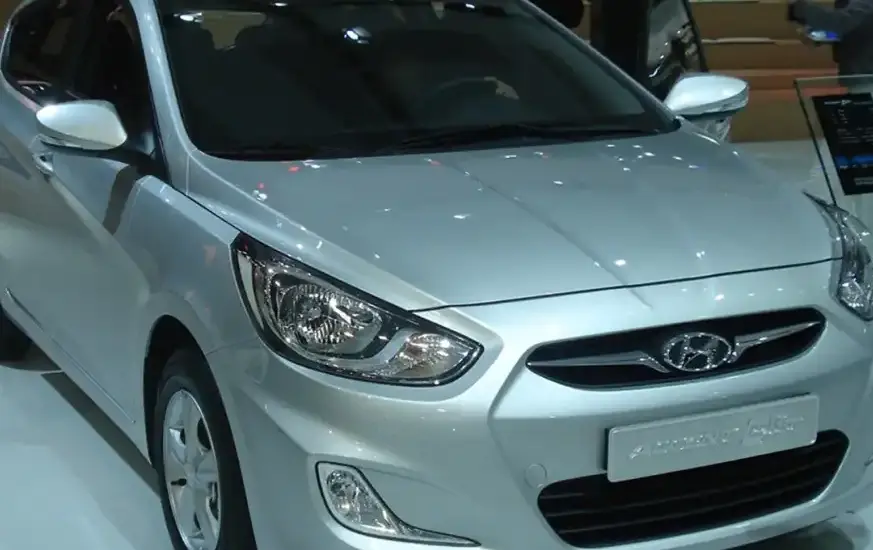
The Hyundai Solaris I (facelift 2014) 1.4 MPI with an automatic transmission represents a significant entry point into the compact sedan market for Hyundai, particularly in regions like Russia and the Commonwealth of Independent States (CIS). Produced from 2014 to 2016, this variant was a key component of the first-generation Solaris (HB) model, which was based on the Hyundai-Kia’s PB platform. The facelift brought updated styling and minor mechanical refinements to the original Solaris, aiming to enhance its appeal to budget-conscious buyers seeking a reliable and practical vehicle. This specific 1.4L automatic configuration was positioned as the more accessible trim level, offering a balance between affordability and convenience.
Technical Specifications
| Brand | Hyundai |
| Model | Solaris |
| Generation | Solaris I (facelift 2014) |
| Type (Engine) | 1.4 MPI (107 Hp) Automatic |
| Start of production | 2014 |
| End of production | 2016 |
| Powertrain Architecture | Internal Combustion engine |
| Body type | Hatchback |
| Seats | 5 |
| Doors | 5 |
| Fuel consumption (urban) | 8.5 l/100 km (27.7 US mpg) |
| Fuel consumption (extra urban) | 5.2 l/100 km (45.2 US mpg) |
| Fuel consumption (combined) | 6.4 l/100 km (36.8 US mpg) |
| Fuel Type | Petrol (Gasoline) |
| Acceleration 0 – 100 km/h | 13.2 sec |
| Acceleration 0 – 62 mph | 13.2 sec |
| Acceleration 0 – 60 mph | 12.5 sec |
| Maximum speed | 170 km/h (105.63 mph) |
| Emission standard | Euro 4 |
| Weight-to-power ratio | 11.4 kg/Hp |
| Weight-to-torque ratio | 9 kg/Nm |
| Power | 107 Hp @ 6300 rpm |
| Torque | 135 Nm @ 5000 rpm (99.57 lb.-ft. @ 5000 rpm) |
| Engine layout | Front, Transverse |
| Engine displacement | 1396 cm3 (85.19 cu. in.) |
| Number of cylinders | 4 |
| Engine configuration | Inline |
| Number of valves per cylinder | 4 |
| Fuel injection system | Multi-port manifold injection |
| Engine aspiration | Naturally aspirated engine |
| Engine oil capacity | 3.6 l (3.8 US qt | 3.17 UK qt) |
| Coolant capacity | 6.8 l (7.19 US qt | 5.98 UK qt) |
| Kerb Weight | 1220 kg (2689.64 lbs.) |
| Max. weight | 1565 kg (3450.23 lbs.) |
| Max load | 345 kg (760.59 lbs.) |
| Trunk (boot) space – minimum | 370 l (13.07 cu. ft.) |
| Trunk (boot) space – maximum | 1043 l (36.83 cu. ft.) |
| Fuel tank capacity | 43 l (11.36 US gal | 9.46 UK gal) |
| Permitted trailer load with brakes (12%) | 800 kg (1763.7 lbs.) |
| Permitted trailer load without brakes | 450 kg (992.08 lbs.) |
| Length | 4120 mm (162.2 in.) |
| Width | 1700 mm (66.93 in.) |
| Height | 1470 mm (57.87 in.) |
| Wheelbase | 2570 mm (101.18 in.) |
| Front track | 1495 mm (58.86 in.) |
| Rear (Back) track | 1502 mm (59.13 in.) |
| Ride height (ground clearance) | 160 mm (6.3 in.) |
| Minimum turning circle (turning diameter) | 10.4 m (34.12 ft.) |
| Drivetrain Architecture | Front wheel drive |
| Number of gears and type of gearbox | 4 gears, automatic transmission |
| Front suspension | Independent, type McPherson with coil spring and anti-roll bar |
| Rear suspension | Semi-independent, coil spring |
| Front brakes | Ventilated discs |
| Rear brakes | Disc |
| Assisting systems | ABS (Anti-lock braking system) |
| Steering type | Steering rack and pinion |
| Tires size | 185/65 R15; 195/55 R16 |
| Wheel rims size | 6.0J x 15; 6.0J x 16 |
Powertrain & Engine Architecture
The heart of this Solaris variant is the Hyundai G4FA 1.4-liter inline-four cylinder engine. This engine utilizes a multi-point fuel injection (MPI) system, a relatively simple and cost-effective technology. The G4FA engine features a dual overhead camshaft (DOHC) design with four valves per cylinder, contributing to reasonable efficiency and power output for its displacement. The engine’s 107 horsepower and 135 Nm (99.57 lb-ft) of torque are delivered at 6300 rpm and 5000 rpm respectively. The engine is transversely mounted, driving the front wheels. Paired with this engine is a four-speed automatic transmission. While not the most modern transmission available, it provided a convenient and accessible option for drivers prioritizing ease of use over outright performance. This transmission was chosen for its affordability and reliability, aligning with the Solaris’s overall value proposition.
Driving Characteristics
The 1.4L automatic Solaris offers a comfortable, if not particularly exhilarating, driving experience. Acceleration from 0-100 km/h takes around 13.2 seconds, making it adequate for city driving and routine commutes. The four-speed automatic transmission, while smooth, lacks the responsiveness and efficiency of more modern transmissions with a greater number of gears. Gear ratios are tuned for fuel economy and drivability rather than sporty performance. Compared to the manual transmission version of the same engine, the automatic suffers a slight performance penalty due to the transmission’s inherent losses. Higher trim levels equipped with a 1.6-liter engine offered significantly more power and a more engaging driving experience, but at a higher price point.
Equipment & Trim Levels
The 1.4 MPI Automatic Solaris typically came equipped with basic but essential features. Standard equipment generally included air conditioning, power windows, central locking, and an audio system with USB connectivity. Safety features such as ABS and dual airbags were also standard. Interior upholstery was typically cloth, and the dashboard featured a functional, if somewhat basic, design. Optional extras included alloy wheels, a rear parking sensor, and an upgraded audio system. The trim level of this variant was generally considered entry-level or mid-range, depending on the specific options selected.
Chassis & Braking
The Solaris I utilized a McPherson strut front suspension and a semi-independent coil spring rear suspension. This setup provided a comfortable ride quality, suitable for the often-rough road conditions prevalent in its target markets. The front brakes were ventilated discs, while the rear brakes were solid discs. The braking system, combined with ABS, offered adequate stopping power for everyday driving. The steering was a rack and pinion system, providing reasonable precision and feedback.
Market Reception & Comparison
The Hyundai Solaris, and specifically the 1.4L automatic variant, was well-received in its primary markets. Critics praised its affordability, reliability, and practicality. Fuel economy was a strong point, with combined fuel consumption figures around 6.4 l/100 km (36.8 US mpg). Compared to competitors like the Skoda Rapid or Volkswagen Polo, the Solaris offered a more competitive price point, although some reviewers noted that the interior materials and overall refinement were not quite on par with those of its European rivals. The 1.6L engine variants were often preferred by drivers seeking more performance, but the 1.4L automatic remained a popular choice for those prioritizing value and ease of use.
Legacy
The Hyundai Solaris I (facelift 2014) 1.4 MPI Automatic has proven to be a relatively reliable vehicle in the used car market. The G4FA engine is known for its durability, and the four-speed automatic transmission, while not cutting-edge, is generally dependable. Maintenance costs are relatively low, thanks to the readily available parts and the simplicity of the powertrain. Today, these vehicles can be found at very affordable prices, making them a practical option for budget-conscious buyers seeking a dependable and fuel-efficient compact car. However, potential buyers should be aware of the age of the vehicle and the potential for wear and tear on components like the suspension and brakes.