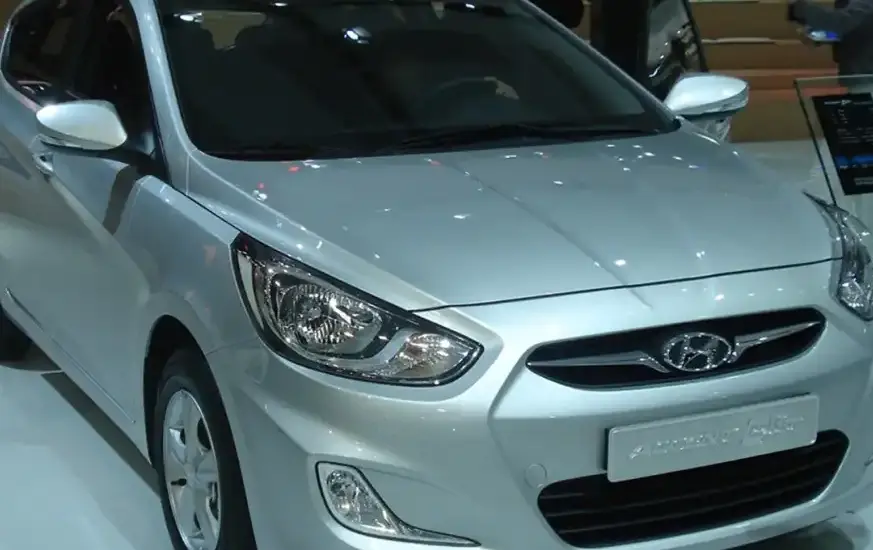
The Hyundai Solaris I Sedan 1.4 MPI (107 Hp) Automatic, produced between 2011 and 2014, represents a significant entry for Hyundai into the compact sedan market, particularly aimed at buyers in Russia and other Eastern European countries. Positioned as an affordable and practical vehicle, the Solaris was designed to compete with established players like the Skoda Rapid, Volkswagen Polo, and Renault Logan. This specific 1.4-liter engine paired with a four-speed automatic transmission served as a mid-range offering within the Solaris lineup, providing a balance between fuel efficiency and ease of use. It was built on the Hyundai-Kia’s PB platform, shared with the Kia Rio, and marked Hyundai’s commitment to localized production and understanding of regional consumer preferences.
Technical Specifications
| Brand | Hyundai |
| Model | Solaris |
| Generation | Solaris I Sedan |
| Type (Engine) | 1.4 MPI (107 Hp) Automatic |
| Start of production | 2011 |
| End of production | 2014 |
| Powertrain Architecture | Internal Combustion engine |
| Body type | Sedan |
| Seats | 5 |
| Doors | 4 |
| Fuel consumption (urban) | 8.5 l/100 km (27.7 US mpg) |
| Fuel consumption (extra urban) | 5.2 l/100 km (45.2 US mpg) |
| Fuel consumption (combined) | 6.4 l/100 km (36.8 US mpg) |
| Fuel Type | Petrol (Gasoline) |
| Acceleration 0 – 100 km/h | 13.2 sec |
| Acceleration 0 – 62 mph | 13.2 sec |
| Acceleration 0 – 60 mph | 12.5 sec |
| Maximum speed | 170 km/h (105.63 mph) |
| Emission standard | Euro 4 |
| Weight-to-power ratio | 10.6 kg/Hp |
| Weight-to-torque ratio | 8.4 kg/Nm |
| Power | 107 Hp @ 6300 rpm |
| Torque | 135 Nm @ 5000 rpm (99.57 lb.-ft. @ 5000 rpm) |
| Engine layout | Front, Transverse |
| Engine displacement | 1396 cm3 (85.19 cu. in.) |
| Number of cylinders | 4 |
| Engine configuration | Inline |
| Number of valves per cylinder | 4 |
| Fuel injection system | Multi-port manifold injection |
| Engine aspiration | Naturally aspirated engine |
| Engine oil capacity | 3.3 l (3.49 US qt | 2.9 UK qt) |
| Coolant capacity | 5.3 l (5.6 US qt | 4.66 UK qt) |
| Kerb Weight | 1135 kg (2502.25 lbs.) |
| Max. weight | 1565 kg (3450.23 lbs.) |
| Max load | 430 kg (947.99 lbs.) |
| Trunk (boot) space – minimum | 454 l (16.03 cu. ft.) |
| Fuel tank capacity | 43 l (11.36 US gal | 9.46 UK gal) |
| Permitted trailer load with brakes (12%) | 800 kg (1763.7 lbs.) |
| Permitted trailer load without brakes | 450 kg (992.08 lbs.) |
| Length | 4370 mm (172.05 in.) |
| Width | 1700 mm (66.93 in.) |
| Height | 1470 mm (57.87 in.) |
| Wheelbase | 2570 mm (101.18 in.) |
| Front track | 1495 mm (58.86 in.) |
| Rear track | 1502 mm (59.13 in.) |
| Front overhang | 820 mm (32.28 in.) |
| Rear overhang | 980 mm (38.58 in.) |
| Ride height (ground clearance) | 160 mm (6.3 in.) |
| Minimum turning circle | 10.4 m (34.12 ft.) |
| Drivetrain Architecture | Front wheel drive |
| Number of gears and type of gearbox | 4 gears, automatic transmission |
| Front suspension | Independent, type McPherson with coil spring and anti-roll bar |
| Rear suspension | Semi-independent, coil spring |
| Front brakes | Ventilated discs |
| Rear brakes | Disc |
| Assisting systems | ABS (Anti-lock braking system) |
| Steering type | Steering rack and pinion |
| Tires size | 185/65 R15; 195/55 R16 |
| Wheel rims size | 15; 16 |
Powertrain & Engine Architecture
The Solaris 1.4 MPI utilizes the Hyundai G4FA engine, a four-cylinder, naturally aspirated powerplant. This engine is characterized by its multi-point fuel injection system, which delivers fuel directly to the intake ports. The engine features a double overhead camshaft (DOHC) valvetrain with four valves per cylinder, contributing to improved breathing and efficiency. The 1.4-liter engine produces 107 horsepower at 6300 rpm and 135 Nm (99.57 lb-ft) of torque at 5000 rpm. The four-speed automatic transmission, while providing convenience, is a relatively older design. It features traditional hydraulic control and lacks the efficiency of more modern transmissions with more gears. The gear ratios are tuned for fuel economy and smooth operation rather than outright performance.
Driving Characteristics
The 1.4L Automatic Solaris delivers adequate, but not exhilarating, performance. Acceleration from 0-100 km/h takes approximately 13.2 seconds. The automatic transmission contributes to a smooth driving experience, particularly in urban environments. However, the limited number of gears and the engine’s modest output mean that overtaking maneuvers require careful planning. Compared to the manual transmission version, the automatic suffers a slight performance penalty. Higher trims with larger engines, such as the 1.6L, offered significantly more power and a more engaging driving experience, but at a higher price point. The Solaris 1.4 Automatic prioritizes comfort and ease of use over sporty handling.
Equipment & Trim Levels
The Solaris 1.4 MPI Automatic typically came equipped with standard features such as air conditioning, power windows, central locking, and a basic audio system. Higher trim levels added features like alloy wheels, fog lights, a more advanced audio system with Bluetooth connectivity, and a trip computer. Interior upholstery was generally cloth, with options for upgraded materials on higher trims. Safety features included dual front airbags and ABS brakes. The specific equipment level varied depending on the market and optional packages selected by the buyer.
Chassis & Braking
The Solaris utilizes a McPherson strut front suspension and a semi-independent coil spring rear suspension. This setup provides a comfortable ride quality, well-suited for the often-poor road conditions found in its target markets. The front brakes are ventilated discs, while the rear brakes are solid discs. ABS (Anti-lock Braking System) is standard, enhancing braking performance and stability. The steering is a rack and pinion system, providing reasonable precision and feedback. The suspension tuning prioritizes ride comfort over sporty handling.
Market Reception & Comparison
The Hyundai Solaris was generally well-received by critics and consumers alike. It was praised for its affordability, practicality, and relatively spacious interior. The 1.4-liter automatic variant was seen as a good option for drivers who prioritized ease of use and fuel economy. However, some reviewers criticized the engine’s lack of power and the transmission’s dated design. Compared to competitors like the Skoda Rapid and Volkswagen Polo, the Solaris offered a more competitive price point, but lacked the same level of refinement and driving dynamics. Fuel economy was a strong point, with combined fuel consumption averaging around 6.4 l/100 km (36.8 US mpg).
Legacy
The Hyundai Solaris I Sedan established Hyundai as a major player in the compact sedan segment in Russia and Eastern Europe. The 1.4 MPI Automatic powertrain proved to be relatively reliable, with few major mechanical issues reported. In the used car market, these models remain popular due to their affordability and low running costs. While the four-speed automatic transmission is not as efficient as more modern units, it is generally durable and requires minimal maintenance. The Solaris’s success paved the way for the second-generation model, which further refined the formula and solidified Hyundai’s position in the region.