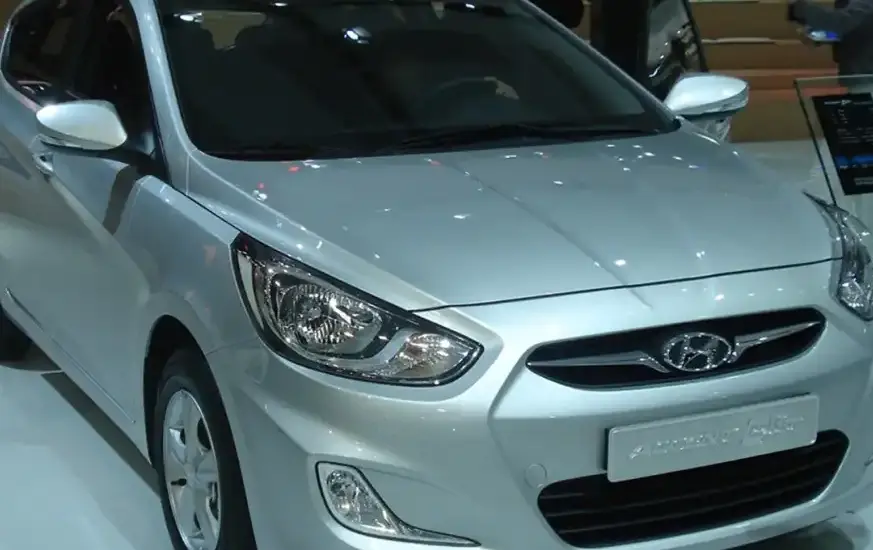
The Hyundai Solaris I Sedan (facelifted in 2014) with the 1.6-liter MPI engine producing 123 horsepower represents a significant model within Hyundai’s entry-level sedan offerings. Introduced as a direct competitor to established players in the compact car segment, particularly in markets like Russia and Eastern Europe, the Solaris aimed to deliver affordability, reliability, and a relatively modern feature set. Production of this specific facelifted version ran from 2014 to 2016, building upon the initial Solaris launch and addressing some early customer feedback. This variant occupied a mid-range position within the Solaris lineup, offering a balance between price and performance, slotting below the more basic trims and above any potential future higher-performance options.
Technical Specifications
| Brand | Hyundai |
| Model | Solaris |
| Generation | Solaris I Sedan (facelift 2014) |
| Type (Engine) | 1.6 MPI (123 Hp) |
| Start of production | 2014 |
| End of production | 2016 |
| Powertrain Architecture | Internal Combustion engine |
| Body type | Sedan |
| Seats | 5 |
| Doors | 4 |
| Fuel consumption (urban) | 8.1 l/100 km (29 US mpg, 34.9 UK mpg, 12.3 km/l) |
| Fuel consumption (extra urban) | 4.9 l/100 km (48 US mpg, 57.6 UK mpg, 20.4 km/l) |
| Fuel consumption (combined) | 6.1 l/100 km (38.6 US mpg, 46.3 UK mpg, 16.4 km/l) |
| Fuel Type | Petrol (Gasoline) |
| Acceleration 0 – 100 km/h | 10.3 sec |
| Acceleration 0 – 62 mph | 10.3 sec |
| Acceleration 0 – 60 mph | 9.8 sec |
| Maximum speed | 190 km/h (118.06 mph) |
| Emission standard | Euro 4 |
| Weight-to-power ratio | 10 kg/Hp, 100.3 Hp/tonne |
| Weight-to-torque ratio | 7.9 kg/Nm, 126.4 Nm/tonne |
| Power | 123 Hp @ 6300 rpm |
| Power per litre | 77.3 Hp/l |
| Torque | 155 Nm @ 4200 rpm (114.32 lb.-ft. @ 4200 rpm) |
| Engine layout | Front, Transverse |
| Engine displacement | 1591 cm3 (97.09 cu. in.) |
| Number of cylinders | 4 |
| Engine configuration | Inline |
| Number of valves per cylinder | 4 |
| Fuel injection system | Multi-port manifold injection |
| Engine aspiration | Naturally aspirated engine |
| Engine oil capacity | 3.6 l (3.8 US qt | 3.17 UK qt) |
| Coolant capacity | 5.3 l (5.6 US qt | 4.66 UK qt) |
| Kerb Weight | 1226 kg (2702.87 lbs.) |
| Max. weight | 1565 kg (3450.23 lbs.) |
| Max load | 339 kg (747.37 lbs.) |
| Trunk (boot) space – minimum | 470 l (16.6 cu. ft.) |
| Fuel tank capacity | 43 l (11.36 US gal | 9.46 UK gal) |
| Permitted trailer load with brakes (12%) | 1000 kg (2204.62 lbs.) |
| Permitted trailer load without brakes | 450 kg (992.08 lbs.) |
| Length | 4375 mm (172.24 in.) |
| Width | 1700 mm (66.93 in.) |
| Height | 1470 mm (57.87 in.) |
| Wheelbase | 2570 mm (101.18 in.) |
| Front track | 1495 mm (58.86 in.) |
| Rear (Back) track | 1502 mm (59.13 in.) |
| Ride height (ground clearance) | 160 mm (6.3 in.) |
| Minimum turning circle (turning diameter) | 10.4 m (34.12 ft.) |
| Drivetrain Architecture | Front wheel drive |
| Drive wheel | Front wheel drive |
| Number of gears and type of gearbox | 6 gears, manual transmission |
| Front suspension | Independent, type McPherson with coil spring and anti-roll bar |
| Rear suspension | Semi-independent, coil spring |
| Front brakes | Ventilated discs |
| Rear brakes | Disc |
| Assisting systems | ABS (Anti-lock braking system) |
| Steering type | Steering rack and pinion |
| Tires size | 185/65 R15; 195/55 R16 |
| Wheel rims size | 6.0J x 15; 6.0J x 16 |
INTRODUCTION
The Hyundai Solaris I Sedan, particularly the 2014 facelifted version equipped with the 1.6-liter MPI engine and producing 123 horsepower, was designed to appeal to a broad customer base seeking a practical and affordable compact sedan. Built on the PB platform (shared with the Kia Rio), the Solaris aimed to provide a step up in quality and features compared to older Hyundai offerings while remaining competitive on price. The facelift brought subtle styling updates, improved interior materials, and refinements to the suspension. This 1.6L variant was positioned as a sweet spot in the lineup, offering sufficient power for everyday driving without the higher cost of potentially available, more powerful engine options. It was primarily marketed in Russia, Ukraine, Kazakhstan, and other Eastern European and CIS countries.
Powertrain & Engine Architecture
The heart of this Solaris variant is the Hyundai Gamma II family 1.6-liter inline-four cylinder engine. Specifically, it utilizes a multi-point fuel injection (MPI) system, a relatively simple and reliable technology. The engine code is typically designated as G4FA. The engine features a dual overhead camshaft (DOHC) valvetrain with four valves per cylinder, contributing to its respectable power output for its displacement. The 123 horsepower peak is achieved at 6300 rpm, while the 155 Nm (114 lb-ft) of torque is available at 4200 rpm. The engine is transversely mounted in the front of the vehicle. Paired with this engine is a 6-speed manual transmission, offering a balance between fuel efficiency and driver engagement. While an automatic transmission was available on other Solaris trims, this specific 123 hp version was primarily offered with the manual gearbox in many markets.
Driving Characteristics
The Solaris 1.6L with the manual transmission delivers adequate performance for typical urban and highway driving. Acceleration from 0-60 mph takes around 9.8 seconds, and the top speed is approximately 118 mph. The engine feels responsive enough for merging onto highways and overtaking slower traffic, but it’s not a particularly sporty performer. The 6-speed manual transmission is well-matched to the engine’s powerband, providing relatively short gear ratios that keep the engine in its optimal operating range. Compared to potential higher-output versions (if offered in some markets), this variant feels less eager to rev and offers a more relaxed driving experience. The manual transmission also provides better fuel economy than an automatic would.
Equipment & Trim Levels
The 1.6L manual Solaris typically came with a reasonable level of standard equipment. This included power windows, power door locks, air conditioning, and a basic audio system with USB connectivity. Safety features such as ABS (Anti-lock Braking System) and dual front airbags were also standard. Higher trim levels offered options like alloy wheels, a more advanced audio system, a rear parking sensor, and a trip computer. Interior upholstery was typically cloth, with a relatively simple dashboard layout. The overall interior design prioritized functionality and durability over luxury.
Chassis & Braking
The Solaris utilizes a McPherson strut front suspension and a semi-independent coil spring rear suspension. This setup provides a comfortable ride quality, absorbing bumps and imperfections in the road reasonably well. The front brakes are ventilated discs, offering good stopping power, while the rear brakes are solid discs. The steering is a rack-and-pinion system, providing decent feedback and precision. The chassis is tuned for comfort rather than outright handling prowess, making it a predictable and easy-to-drive vehicle.
Market Reception & Comparison
The Hyundai Solaris was generally well-received in its target markets. Critics praised its affordability, reliability, and relatively modern features. The 1.6L manual variant was considered a good value for money, offering a practical and efficient transportation solution. Compared to competitors like the Skoda Rapid, Volkswagen Polo, and Renault Logan, the Solaris often stood out for its more stylish design and better-equipped interior. Fuel economy was also a strong point, with combined fuel consumption figures around 38.6 US mpg. However, some critics noted that the interior materials were not as premium as those found in some European competitors.
Legacy
The Hyundai Solaris I Sedan, including the 1.6L MPI variant, established Hyundai as a major player in the compact car segment in Eastern Europe and Russia. The Gamma II engine proved to be a reliable and durable unit, and many examples are still on the road today. While not known for any groundbreaking technology, the Solaris offered a compelling combination of affordability, practicality, and reliability. In the used car market, these models are often sought after for their low running costs and relatively simple mechanical design, making them a popular choice for first-time car buyers or those seeking a dependable and economical vehicle.