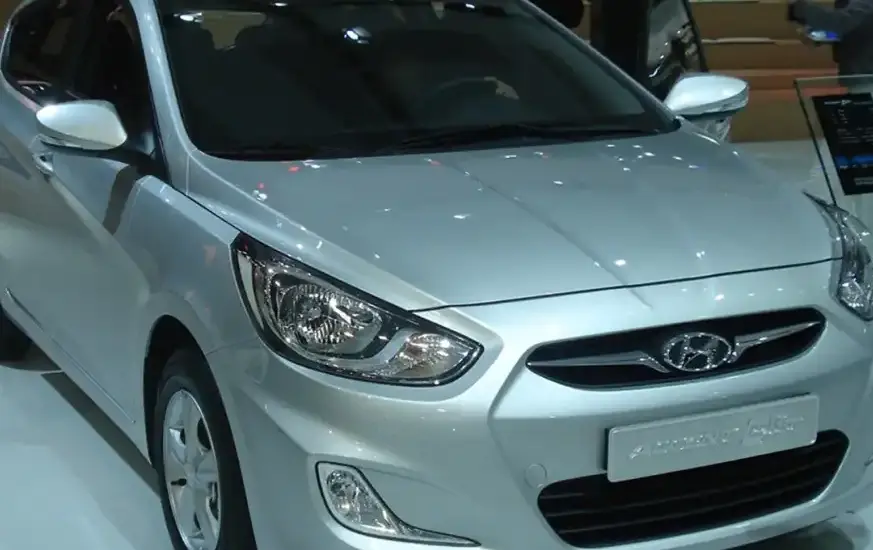
The Hyundai Solaris II Sedan 1.4 MPI (100 hp) is a compact sedan produced by the South Korean automaker Hyundai, primarily targeted at the Russian and Eastern European markets. Introduced in 2017 as part of the second-generation Solaris (HBJS) model, this variant occupied the entry-level position in the lineup, offering a balance of affordability and practicality. It’s built on the Hyundai-Kia’s PB platform, shared with the Kia Rio. The 1.4 MPI engine and manual transmission combination aimed to provide a fuel-efficient and accessible option for first-time buyers and those seeking a reliable, economical vehicle.
Technical Specifications
| Brand | Hyundai |
| Model | Solaris |
| Generation | Solaris II Sedan |
| Type (Engine) | 1.4 MPI (100 Hp) |
| Start of production | 2017 |
| Powertrain Architecture | Internal Combustion engine |
| Body type | Sedan |
| Seats | 5 |
| Doors | 4 |
| Fuel consumption (urban) | 7.2 l/100 km (32.7 US mpg) |
| Fuel consumption (extra urban) | 4.8 l/100 km (49 US mpg) |
| Fuel consumption (combined) | 5.7 l/100 km (41.3 US mpg) |
| CO2 emissions | 133 g/km |
| Fuel Type | Petrol (Gasoline) |
| Acceleration 0 – 100 km/h | 12.2 sec |
| Acceleration 0 – 62 mph | 12.2 sec |
| Acceleration 0 – 60 mph | 11.6 sec |
| Maximum speed | 185 km/h (114.95 mph) |
| Emission standard | Euro 5 |
| Weight-to-power ratio | 11.5 kg/Hp |
| Weight-to-torque ratio | 8.7 kg/Nm |
| Power | 100 Hp @ 6000 rpm |
| Torque | 132 Nm @ 4000 rpm (97.36 lb.-ft. @ 4000 rpm) |
| Engine layout | Front, Transverse |
| Engine displacement | 1368 cm3 (83.48 cu. in.) |
| Number of cylinders | 4 |
| Engine configuration | Inline |
| Number of valves per cylinder | 4 |
| Fuel injection system | Multi-port manifold injection |
| Engine aspiration | Naturally aspirated |
| Engine oil capacity | 3.5 l (3.7 US qt | 3.08 UK qt) |
| Coolant capacity | 5.5 l (5.81 US qt | 4.84 UK qt) |
| Kerb Weight | 1150 kg (2535.32 lbs) |
| Max. weight | 1560 kg (3439.21 lbs) |
| Max load | 410 kg (903.9 lbs) |
| Trunk (boot) space | 480 l (16.95 cu. ft.) |
| Fuel tank capacity | 50 l (13.21 US gal | 11 UK gal) |
| Permitted trailer load (braked) | 1000 kg (2204.62 lbs) |
| Permitted trailer load (unbraked) | 450 kg (992.08 lbs) |
| Length | 4405 mm (173.43 in) |
| Width | 1729 mm (68.07 in) |
| Height | 1469 mm (57.83 in) |
| Wheelbase | 2600 mm (102.36 in) |
| Front track | 1516-1510 mm (59.69 – 59.45 in) |
| Rear track | 1524-1518 mm (60 – 59.76 in) |
| Front overhang | 830 mm (32.68 in) |
| Rear overhang | 975 mm (38.39 in) |
| Ride height | 160 mm (6.3 in) |
| Drivetrain | Front wheel drive |
| Number of gears | 6 |
| Gearbox type | Manual transmission |
| Front suspension | Independent, McPherson with coil spring and anti-roll bar |
| Rear suspension | Semi-independent, coil spring |
| Front brakes | Ventilated discs |
| Rear brakes | Disc |
| Assisting systems | ABS (Anti-lock braking system) |
| Steering type | Steering rack and pinion |
| Tire size | 185/65 R15; 195/55 R16 |
| Wheel rim size | 15; 16 |
Powertrain & Engine Architecture
The Solaris 1.4 MPI utilizes the Hyundai G4FA engine, a 1.4-liter inline-four cylinder gasoline engine. This engine is a member of Hyundai’s Gamma family, known for its relatively simple design and focus on fuel efficiency. It employs a multi-point fuel injection system, delivering fuel directly into the intake ports. The engine features a dual overhead camshaft (DOHC) valvetrain with four valves per cylinder, contributing to improved breathing and power output. The 100 hp output is achieved at 6000 rpm, while peak torque of 132 Nm (97 lb-ft) is delivered at 4000 rpm. The engine is transversely mounted in the front of the vehicle, driving the front wheels. The standard transmission for this variant was a six-speed manual gearbox, chosen for its efficiency and lower cost compared to an automatic option. The gearbox ratios were tuned for everyday driving, prioritizing fuel economy over outright performance.
Driving Characteristics
The 1.4 MPI engine paired with the six-speed manual transmission delivers adequate, though not exhilarating, performance. Acceleration from 0 to 60 mph takes approximately 11.6 seconds, and the top speed is around 115 mph. The engine feels somewhat strained at higher speeds, particularly when overtaking. The gear ratios are well-spaced, allowing for comfortable cruising on highways, but require frequent downshifts for quicker acceleration. Compared to the more powerful 1.6-liter engine option available in the Solaris range, the 1.4 MPI feels noticeably less responsive. However, the lighter engine weight contributes to better handling and a more nimble feel in city driving. The manual transmission provides drivers with greater control over the engine’s power band, allowing them to optimize fuel efficiency or extract more performance when needed.
Equipment & Trim Levels
The 1.4 MPI variant of the Solaris II Sedan typically came with a base level of equipment, focusing on essential features. Standard amenities included air conditioning, power windows, central locking, and a basic audio system with USB connectivity. Safety features such as ABS, front airbags, and seatbelt pretensioners were also standard. Higher trim levels, such as Elegance and Comfort, offered additional features like alloy wheels, a more advanced audio system, rear parking sensors, and a trip computer. Interior upholstery was typically cloth, with a simple and functional dashboard layout. Optional extras included a sunroof, heated seats, and a navigation system.
Chassis & Braking
The Solaris II Sedan utilizes a McPherson strut front suspension and a semi-independent torsion beam rear suspension. This setup provides a comfortable ride quality, absorbing bumps and imperfections in the road effectively. The front suspension incorporates a stabilizer bar to reduce body roll during cornering. The braking system consists of ventilated disc brakes at the front and solid disc brakes at the rear. ABS (Anti-lock Braking System) is standard, enhancing braking performance and stability in emergency situations. The steering is a rack-and-pinion system, providing precise and responsive steering feel.
Market Reception & Comparison
The Hyundai Solaris II Sedan 1.4 MPI was well-received in its target markets, particularly for its affordability and fuel efficiency. Critics praised its practicality and reliability, making it a popular choice for budget-conscious buyers. Compared to other compact sedans in its class, such as the Skoda Rapid and Volkswagen Polo, the Solaris offered a competitive price point and a generous warranty. However, some reviewers noted that the 1.4 MPI engine lacked the refinement and performance of its competitors’ offerings. Fuel economy was a strong point, with the Solaris achieving around 41 mpg in combined driving conditions. Reliability proved to be good, with relatively few reported issues with the engine or transmission.
Legacy
The Hyundai Solaris II Sedan 1.4 MPI has established a reputation as a reliable and economical compact sedan. In the used car market, these models are generally well-regarded for their affordability and low running costs. The G4FA engine has proven to be durable and relatively easy to maintain, making it a popular choice for first-time car owners and those seeking a dependable daily driver. While not known for its performance, the 1.4 MPI variant offers a practical and efficient transportation solution, and continues to be a common sight on the roads of Russia and Eastern Europe.