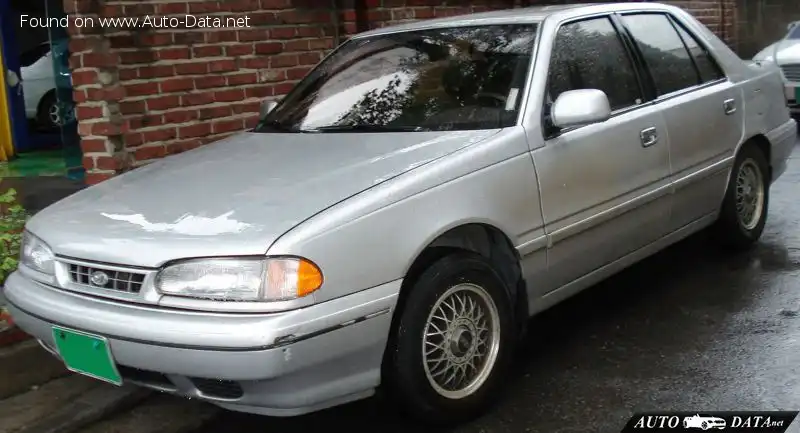
The Hyundai Sonata II (Y2), specifically the 2.0i GLS 16V variant produced from 1991 to 1993, represented a significant step forward for the South Korean automaker in establishing a presence in the mid-size sedan market. This facelifted version of the second-generation Sonata aimed to offer a more refined and feature-rich package compared to its predecessor, targeting buyers seeking a comfortable and reliable family car. Positioned as a mid-range trim, the 2.0i GLS 16V offered a balance between performance and affordability within the Sonata II lineup, slotting above the base models and below the potentially available higher-specification trims. It was primarily sold in the South Korean domestic market and select export markets, including parts of Europe and the Middle East.
Technical Specifications
| Brand | Hyundai |
| Model | Sonata |
| Generation | Sonata II (Y2, facelift 1991) |
| Type (Engine) | 2.0i GLS 16V (131 Hp) |
| Start of production | 1991 |
| End of production | 1993 |
| Powertrain Architecture | Internal Combustion engine |
| Body type | Sedan |
| Seats | 5 |
| Doors | 4 |
| Fuel consumption (urban) | 10 l/100 km (23.5 US mpg) |
| Fuel consumption (extra urban) | 6.6 l/100 km (35.6 US mpg) |
| Fuel consumption (combined) | 8.3 l/100 km (28.3 US mpg) |
| Fuel Type | Petrol (Gasoline) |
| Acceleration 0 – 100 km/h | 10.6 sec |
| Acceleration 0 – 62 mph | 10.6 sec |
| Acceleration 0 – 60 mph | 10.1 sec |
| Maximum speed | 192 km/h (119.3 mph) |
| Emission standard | Euro 1 |
| Weight-to-power ratio | 9.8 kg/Hp |
| Weight-to-torque ratio | 7.7 kg/Nm |
| Power | 131 Hp @ 6000 rpm |
| Torque | 166 Nm @ 4000 rpm (122.44 lb.-ft. @ 4000 rpm) |
| Engine layout | Front, Transverse |
| Engine displacement | 1997 cm3 (121.86 cu. in.) |
| Number of cylinders | 4 |
| Engine configuration | Inline |
| Cylinder Bore | 85 mm (3.35 in.) |
| Piston Stroke | 88 mm (3.46 in.) |
| Compression ratio | 9:1 |
| Number of valves per cylinder | 4 |
| Fuel injection system | Multi-port manifold injection |
| Engine aspiration | Naturally aspirated engine |
| Valvetrain | DOHC |
| Kerb Weight | 1284 kg (2830.74 lbs.) |
| Trunk (boot) space | 473 l (16.7 cu. ft.) |
| Fuel tank capacity | 65 l (17.17 US gal) |
| Max. roof load | 75 kg (165.35 lbs.) |
| Permitted trailer load (braked) | 1400 kg (3086.47 lbs.) |
| Permitted trailer load (unbraked) | 660 kg (1455.05 lbs.) |
| Length | 4680 mm (184.25 in.) |
| Width | 1751 mm (68.94 in.) |
| Height | 1408 mm (55.43 in.) |
| Wheelbase | 2650 mm (104.33 in.) |
| Front track | 1480 mm (58.27 in.) |
| Rear track | 1460 mm (57.48 in.) |
| Drivetrain | Front wheel drive |
| Number of gears | 5 gears, manual transmission |
| Front suspension | Independent, McPherson with coil spring and anti-roll bar |
| Rear suspension | Coil spring |
| Front brakes | Ventilated discs |
| Rear brakes | Ventilated discs |
| Assisting systems | ABS (Anti-lock braking system) |
| Steering type | Steering rack and pinion |
| Power steering | Hydraulic |
| Tires size | 195/70 R14 |
| Wheel rims size | 5.5J x 14 |
Powertrain & Engine Architecture
The heart of the Sonata II 2.0i GLS 16V is the Hyundai-developed 1.997-liter inline-four cylinder engine. This engine, often identified by its internal codes, featured a dual overhead camshaft (DOHC) valvetrain operating four valves per cylinder – a significant upgrade from earlier Hyundai engines. The multi-port fuel injection system delivered fuel directly to each intake port, improving combustion efficiency and contributing to the engine’s 131 horsepower output at 6000 rpm and 166 Nm (122.44 lb-ft) of torque at 4000 rpm. The 9:1 compression ratio was typical for the era, balancing performance and fuel economy. The engine’s transverse mounting within the front-wheel-drive configuration maximized interior space. The five-speed manual transmission was the standard offering, providing drivers with direct control over the engine’s power band.
Driving Characteristics
The 2.0i GLS 16V offered a reasonably engaging driving experience for its time. While not a sports sedan, the 131 hp engine provided adequate power for everyday driving and highway cruising. Acceleration from 0 to 60 mph took approximately 10.1 seconds, and the car could reach a top speed of around 119 mph. The five-speed manual transmission allowed drivers to keep the engine in its optimal power range, resulting in responsive acceleration. Compared to lower-powered Sonata variants, the 2.0i GLS 16V offered noticeably improved performance. However, it didn’t match the quicker acceleration of potential higher-spec trims if they were offered. The front-wheel-drive layout provided predictable handling, and the suspension offered a comfortable ride, although it wasn’t particularly sporty.
Equipment & Trim Levels
The GLS trim level indicated a step up in features compared to the base Sonata II models. Standard equipment typically included power steering, air conditioning, a basic audio system, and cloth upholstery. The interior design was functional and straightforward, prioritizing practicality over luxury. Optional extras could include power windows, central locking, and an upgraded audio system. The dashboard layout was typical of early 1990s sedans, with clearly labeled controls and a relatively simple instrument cluster. The GLS trim aimed to provide a comfortable and well-equipped vehicle for families and commuters.
Chassis & Braking
The Sonata II utilized a McPherson strut front suspension with coil springs and an anti-roll bar, providing a good balance of ride comfort and handling. The rear suspension employed a simpler coil spring setup. Braking duties were handled by ventilated disc brakes on all four wheels, a feature that was relatively advanced for a car in this class at the time. An Anti-lock Braking System (ABS) was included as a standard safety feature, enhancing braking performance and stability, especially in adverse conditions. The steering system was a rack-and-pinion setup with hydraulic power assistance, providing precise and responsive steering feel.
Market Reception & Comparison
The Hyundai Sonata II 2.0i GLS 16V was generally well-received by automotive critics as a solid and reliable mid-size sedan. It offered a good value proposition, providing a competitive level of features and performance for its price. Fuel economy was respectable for the era, with combined fuel consumption around 28.3 US mpg. Compared to other mid-size sedans available at the time, such as the Toyota Camry and Honda Accord, the Sonata II offered a more affordable alternative, although it didn’t quite match the refinement or brand reputation of its Japanese competitors. Reliability was a key selling point for the Sonata II, and the 2.0i GLS 16V powertrain proved to be relatively durable.
Legacy
The Hyundai Sonata II 2.0i GLS 16V played a crucial role in establishing Hyundai as a credible automaker in international markets. The engine and transmission combination proved to be reasonably reliable, and many examples are still on the road today. In the used car market, these Sonatas are often sought after by enthusiasts and collectors looking for affordable and classic Korean automobiles. While maintenance costs may be higher due to the age of the vehicles, the Sonata II 2.0i GLS 16V remains a testament to Hyundai’s early efforts to build quality and reliable cars.