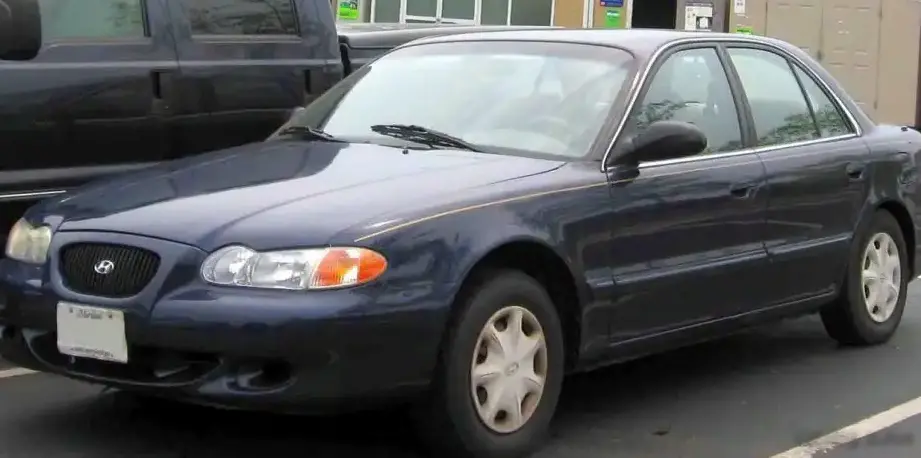
The Hyundai Sonata III (Y3), particularly the facelifted version introduced in 1996, marked a pivotal moment for Hyundai as the South Korean automaker sought to gain a foothold in international automotive markets. Produced between 1996 and 1998, the 2.0i 16V variant equipped with an automatic transmission was strategically positioned as a comfortable and reasonably well-equipped mid-range option within the broader Sonata lineup. This generation aimed to present a more refined and contemporary alternative to established Japanese and American sedans, emphasizing value and practicality. It was a key component of Hyundai’s ambition to shed its image as a solely budget-focused brand.
Technical Specifications
| Brand | Hyundai |
| Model | Sonata |
| Generation | Sonata III (Y3, facelift 1996) |
| Type (Engine) | 2.0i 16V (139 Hp) Automatic |
| Start of production | 1996 |
| End of production | 1998 |
| Powertrain Architecture | Internal Combustion engine |
| Body type | Sedan |
| Seats | 5 |
| Doors | 4 |
| Fuel Type | Petrol (Gasoline) |
| Weight-to-power ratio | 9.7 kg/Hp, 103 Hp/tonne |
| Weight-to-torque ratio | 7.5 kg/Nm, 133.3 Nm/tonne |
| Power | 139 Hp @ 6000 rpm |
| Power per litre | 69.6 Hp/l |
| Torque | 180 Nm @ 4000 rpm, 132.76 lb.-ft. @ 4000 rpm |
| Engine layout | Front, Transverse |
| Engine Model/Code | Sirius / G4CP |
| Engine displacement | 1997 cm3, 121.86 cu. in. |
| Number of cylinders | 4 |
| Engine configuration | Inline |
| Cylinder Bore | 85 mm, 3.35 in. |
| Piston Stroke | 88 mm, 3.46 in. |
| Compression ratio | 9.9:1 |
| Number of valves per cylinder | 4 |
| Fuel injection system | Multi-port manifold injection |
| Engine aspiration | Naturally aspirated engine |
| Valvetrain | DOHC |
| Engine oil capacity | 4.4 l, 4.65 US qt | 3.87 UK qt |
| Kerb Weight | 1350 kg, 2976.24 lbs |
| Trunk (boot) space – minimum | 373 l, 13.17 cu. ft |
| Fuel tank capacity | 65 l, 17.17 US gal | 14.3 UK gal |
| Length | 4700 mm, 185.04 in |
| Width | 1770 mm, 69.69 in |
| Height | 1405 mm, 55.31 in |
| Wheelbase | 2700 mm, 106.3 in |
| Front track | 1520 mm, 59.84 in |
| Rear (Back) track | 1510 mm, 59.45 in |
| Ride height (ground clearance) | 170 mm, 6.69 in |
| Drag coefficient (Cd) | 0.35 |
| Minimum turning circle (turning diameter) | 10.5 m, 34.45 ft |
| Drivetrain Architecture | The Internal combustion engine (ICE) drives the front wheels of the vehicle. |
| Drive wheel | Front wheel drive |
| Number of gears and type of gearbox | 4 gears, automatic transmission |
| Front suspension | Independent, type McPherson with coil spring and anti-roll bar |
| Rear suspension | Independent multi-link suspension |
| Front brakes | Ventilated discs |
| Rear brakes | Ventilated discs |
| Assisting systems | ABS (Anti-lock braking system) |
| Steering type | Steering rack and pinion |
| Power steering | Hydraulic Steering |
| Tires size | 195/70 R14 |
| Wheel rims size | 14 |
Powertrain & Engine Architecture
The 1996-1998 Hyundai Sonata 2.0i Automatic is powered by the Sirius / G4CP engine, a 1.997-liter (121.86 cubic inches) inline-four cylinder engine. This engine featured a double overhead camshaft (DOHC) valvetrain with four valves per cylinder, contributing to its respectable power output for its displacement. The engine utilized a multi-port fuel injection system, which improved fuel atomization and combustion efficiency compared to earlier throttle-body injection systems. The 9.9:1 compression ratio was a standard figure for naturally aspirated engines of the era. The engine was transversely mounted in the front of the vehicle, driving the front wheels.
Paired with the Sirius engine was a four-speed automatic transmission. While not offering the most advanced gear ratios, this transmission was chosen for its ease of use and suitability for the target market, which prioritized comfort and convenience over outright performance. The automatic transmission was designed to provide smooth shifts and acceptable acceleration for everyday driving conditions.
Driving Characteristics
The 2.0i Automatic Sonata offered a comfortable, if not particularly sporty, driving experience. With 139 horsepower and 180 Nm (132.76 lb-ft) of torque, acceleration was adequate for merging onto highways and passing slower traffic, but it wasn’t a particularly quick car. The four-speed automatic transmission, while smooth, did contribute to a feeling of the engine working hard during acceleration. Compared to the manual transmission versions of the 2.0i, the automatic resulted in a slight performance decrease. The automatic’s gear ratios were optimized for fuel economy and smooth cruising rather than aggressive acceleration. The power delivery was relatively linear, making it predictable and easy to control.
Equipment & Trim Levels
The 2.0i Automatic trim level typically included features such as power windows, power door locks, and air conditioning as standard equipment. Interior upholstery was generally cloth, with options for upgraded materials available. The dashboard layout was functional and straightforward, prioritizing ease of use. Optional extras could include a cassette player with upgraded speakers, alloy wheels, and a sunroof. The Sonata aimed to offer a good level of equipment for its price point, competing with other mid-size sedans like the Toyota Camry and Honda Accord.
Chassis & Braking
The Sonata III utilized an independent suspension system at all four wheels. The front suspension employed a McPherson strut design with coil springs and an anti-roll bar, while the rear suspension featured a multi-link setup. This suspension configuration aimed to provide a comfortable ride and reasonable handling characteristics. Braking duties were handled by ventilated disc brakes on all four wheels, a relatively advanced feature for a car in this class at the time. An Anti-lock Braking System (ABS) was also included as standard equipment, enhancing safety by preventing wheel lockup during hard braking.
Market Reception & Comparison
The 1996-1998 Hyundai Sonata 2.0i Automatic was generally well-received by critics as a solid and reliable family sedan. It was praised for its spacious interior, comfortable ride, and competitive price. However, it was often criticized for its somewhat bland styling and lack of sporty driving dynamics. Compared to the higher-output engines available in the Sonata lineup, the 2.0i Automatic offered a more fuel-efficient and affordable option, but at the expense of performance. Fuel economy was a strong point, making it an attractive option for budget-conscious buyers. Reliability was generally good, although some owners reported minor issues with the automatic transmission over the long term.
Legacy
The Hyundai Sonata III, and specifically the 2.0i Automatic variant, played a crucial role in establishing Hyundai as a credible automotive manufacturer in many international markets. The Sirius engine proved to be a durable and reliable powerplant, and many examples are still on the road today. While not a collector’s item, well-maintained Sonatas from this era are often sought after by those looking for an affordable and dependable used car. The automatic transmission, while not known for its sophistication, generally held up well over time with proper maintenance. The Sonata III laid the groundwork for Hyundai’s continued success in the mid-size sedan segment, paving the way for future generations of the popular model.